
ASTM D1667 Standard Specification for Flexible Cellular Materials—Poly (Vinyl Chloride) Foam (Closed-Cell)

    What is ASTM D1667?

    ASTM D1667 is a standard specification for flexible closed-cell poly(vinyl chloride) foam and related copolymer products. Manufacturers use the specification to classify closed-cell vinyl by grade and evaluate important physical properties. The standard specifies VE grades ranging from VE-40 to VE-45, where lower grades represent being softer and higher grades represent being firmer. The specification uses basic requirements for compression deflection and optional requirements identified by suffix letters. These suffixes may include compression set, weather resistance, load deflection, oil resistance, low-temperature performance, tear resistance, flex resistance, abrasion resistance, adhesion, water absorption, flame resistance, non-staining behavior, and rebound.

    Read more

    Get Certified ASTM D1667 Testing for Closed-Cell PVC Foam

    Closed-cell PVC foam requires consistent physical properties for applications that depend on flexibility, firmness, dimensional performance, and resistance to water. Manufacturers use ASTM D1667 (Standard Specification for Flexible Cellular Materials—Poly (Vinyl Chloride) Foam (Closed-Cell)) to compare material grades and ensure the specified physical properties. Laboratories can test compression deflection, compression set, and water absorption, depending on the requirements. ASTM D1667 allows engineers to specify additional suffix tests when they need properties beyond the basic requirements.

    What is the scope of ASTM D1667?

    ASTM D1667 establishes requirements for flexible closed-cell or non-interconnecting cellular materials that are primarily composed of poly(vinyl chloride) or its copolymers. The specification includes products supplied as sheets, strips, molded forms, and simple shapes and includes requirements for compression deflection, compression set under constant deflection, and water absorption.

    Read more

    This standard applies to flexible closed-cell or non-interconnecting cellular products that use poly(vinyl chloride) or its copolymers as the major elastomer. Manufacturers can produce these materials such as sheets, strips, molded products, or simple specific shapes. The ASTM D1667 standard-

    • Covers flexible closed-cell PVC cellular materials. 
    • Includes PVC and PVC copolymer products. 
    • Applies to sheet, strip, molded, and simple-shaped products. 
    • Establishes physical requirements for selected grades. 
    • Evaluates compression set under constant deflection. 
    • Provides an optional water-absorption requirement.

    What are the uses of ASTM D1667 testing?

    This test method helps manufacturers assess closed-cell PVC foam based on specified physical properties. Manufacturers use these results to assess material classification, product quality control, specification compliance, and comparisons of production lots. The ASTM D1667 standard specification-

    • Checks compression-deflection performance. 
    • Evaluates compression-set behavior. 
    • Measures water absorption when the specification requires it. 
    • Supports closed-cell PVC grade classification. 
    • Helps manufacturers compare material performance. 
    • Supports quality control during production. 
    • Helps purchasers verify specified material requirements.

    How Does ASTM D1667 Classify Closed-Cell PVC Foam?

    ASTM D1667 uses the VE designation for closed-cell vinyl. The letter V points to vinyl, and the E indicates the closed-cell structure. The next two digits refer to the grade and the degree of firmness, with lower numbers signifying softer grades and higher numbers signifying firmer grades.

    Grade           Compression Deflection at 25 % Deflection

    VE-40             3.5 to 15 kPa

    VE-41             15 to 35 kPa

    VE-42             35 to 65 kPa

    VE-43             65 to 90 kPa

    VE-44             90 to 120 kPa

    VE-45             120 to 170 kPa

    What Materials Can Be Tested Under ASTM D1667?

    ASTM D1667 covers flexible closed-cell or non-interconnecting cellular materials, which are primarily composed of poly(vinyl chloride) or copolymers of this chloride. Manufacturers can provide these materials in simple shapes, strips, or sheets.

    Why is ASTM D1667 important?

    ASTM D1667 offers a uniform system of classification and evaluation for flexible closed-cell PVC foam. The specification allows manufacturers to set firmness, compression behavior, compression set, and water absorption based on the necessary grade and suffix.

    ASTM D1667 Equipment and Sample Preparation Guide

    ASTM D1667 provides procedures for preparing and testing closed-cell PVC specimens. Technicians should select representative material from the finished product whenever possible and prepare specimens in accordance with the selected test requirements. The standard also recognizes that apparent density and physical properties can vary within complicated products or products with different thicknesses. 

    Read more

    Sample and Specimen DetailsTechnicians first select representative samples from a lot. They should use the completed manufactured product whenever possible.
    Specimen PreparationTechnicians cut test pieces from finished products, standard test slabs, or commercial flat sheets based on the test selected.
    Specimen DimensionsCompression-deflection specimens use cylindrical specimens measuring approximately 28.67 ± 0.50 mm in diameter. Water-absorption specimens use specimens approximately 101.6 × 101.6 mm and 12.7 mm thick.
    InstrumentationCompression-testing equipment, compression foot, clamping device, thickness-measuring equipment, balance, water-immersion equipment, and dimensional-measurement tools.

    ASTM D1667 Testing Procedures and Requirements

    ASTM D1667 specifies physical requirements for closed-cell PVC products and specifies test procedures for the selected physical properties. Laboratories should identify the required test or tests rather than refer to the entire group of methods as one test.

    Read more

    Other reference ASTM standards include D395, D573, D1056, and E691.

    Compression DeflectionTechnicians compress the specimen to the desired deflection and record the amount of force needed to compress the specimen.
    Compression Set Under Constant DeflectionLaboratories compress the specimens to 25 ± 1% of their original height, maintain compression for 22 h ± 15 min at room temperature, and evaluate the recovered thickness after the specified recovery period.
    Water AbsorptionAnalysts weigh the specimen before and after submersion in water and determine water absorption from mass increase and cut surface area.
    Result ReportingLaboratories report results for the applicable property in accordance with the required property and the applicable test procedure.
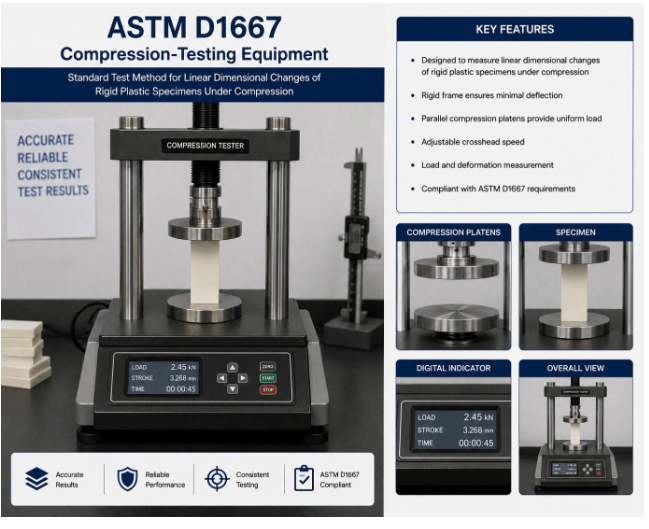
    This image shows a universal testing machine with a compression fixture used to measure linear dimensional changes in rigid plastic specimens under compression in accordance with ASTM D1667.
    ASTM D1667 Universal Testing Machine (UTM) with Compression Fixture 

    Common Challenges and Troubleshooting

    Representative sampling and proper specimen preparation, dimensional measurements, and test equipment are necessary for accurate closed-cell PVC testing. Physical test results may vary depending on location, thickness, skin surfaces, and product geometry. Technicians take representative specimens, record the sample source, verify equipment conditions, and ensure the specified test conditions. When a material fails a requirement, ASTM D1667 requires additional testing for the failed requirement before final rejection.

    ASTM D1667 Testing Process and Data Collection

    Technicians first take representative material from the production lot, prepare specimens based on the selected physical tests, and measure the required dimensions. The laboratory records the compression-deflection force for compression-deflection testing. 

    In compression set tests, technicians compress the specimens for the specified period and measure thickness after compression. Technicians measure the mass before and after immersion to determine the absorption from mass change and cut surface area. 

    ASTM D1667 Analysis Results and Interpretation

    • Laboratories report results using the units specified for each requirement. 
    • ASTM D1667 identifies SI units as the standard and gives inch-pound values for information.
    • Laboratories report results for compression deflection in kPa, compression in %, dimensions in mm, temperature in ºC, and water uptake in kg/m2.
    • Manufacturers compare the measured values to the applicable grade requirements and any grade suffix requirements. 
    • If a material fails a specified requirement, it should be tested again in accordance with the inspection and rejection provisions.

    Link to ASTM D1667

    Read more

    Updated on August 20, 2026

    Dr Ruchika Yogesh
    About Author
    Dr. Ruchika Yogesh is a serial entrepreneur, material science and AI/ML enthusiast, medicinal chemistry subject matter expert (SME), scientific/medical copyeditor, and a researcher.
    Know More
    Testimonials
    Real results
    Engineers trust us with what matters most
    Start Your Testing
    Project Today
    Define your requirements and get access to
    specialized laboratories ready to deliver results
    Partners with us
    Clients
    Vendors
    Process for testing
    • STEP 01

      You share your testing requirements

    • STEP 02

      You share your sample(s)

    • STEP 03

      We deliver your test reports

    Get your testing done

    Let us know your testing requirements and we will be right back with a solution.

      Let us root for each other. Collaborate to grow, expand, and accelerate our businesses.

      Partner with us

        Discover more from Matestlab

        Subscribe now to keep reading and get access to the full archive.

        Continue reading