
ASTM D1499 Standard Practice for Filtered Open-Flame Carbon-Arc Exposures of Plastics

    What is ASTM D1499? 

    ASTM D1499 is a standard practice for filtered open-flame carbon-arc exposure of plastics. The practice uses filtered open-flame carbon-arc exposure equipment, in accordance with ASTM G151 and ASTM G152, to evaluate changes due to light, heat, and water. Laboratories use these exposure results to compare material performance and assess product durability in sun and water conditions. This standard uses SI units and specifies the exposure conditions. The practice covers specimen preparation, suitable exposure conditions for plastics, and resulting changes in evaluation. ASTM D1499 (Standard Practice for Filtered Open-Flame Carbon-Arc Exposures of Plastics) covers deterioration caused by sunlight, moisture, and heat, rather than specific weather conditions such as biological attacks, saltwater, or atmospheric pollution. 

    Read more

    Get Certified ASTM D1499 Plastic Exposure Testing

    Plastic products may lose mechanical, electrical, or optical performance after long exposure to sunlight, heat, and moisture. ASTM D1499 provides controlled laboratory exposure conditions to help manufacturers compare materials’ durability and determine performance changes. Laboratories can expose test and control materials under the same conditions to facilitate meaningful performance comparisons. The practice recommends exposing at least three replicates of each material for statistical evaluation.
    What is the scope of ASTM D1499?

    ASTM D1499 covers specific procedures and test conditions for exposing plastics in filtered open-flame carbon-arc devices. It also covers specimen preparation, optimum exposure conditions for plastics, and evaluation of test results. This standard-

    Read more

    • Covers filtered open-flame carbon-arc exposure of plastics. 
    • Uses equipment operated according to ASTM G151 and ASTM G152. 
    • Covers preparation of plastic test specimens. 
    • Provides exposure conditions suitable for plastics. 
    • Supports evaluation of changes caused by light, heat, and water.

    What are the uses of ASTM D1499 testing?

    Engineers use ASTM D1499 to evaluate how plastics respond to laboratory exposure that represents significant outdoor service conditions. This practice can cause changes associated with sunlight, moisture, and heat and can facilitate comparisons between materials. This standard practice-

    • Evaluates plastic durability under controlled light exposure. 
    • Compares the performance of different plastic materials. 
    • Assesses changes in mechanical properties, electrical properties, and optical properties.  
    • Supports material development and quality control. 
    • Helps manufacturers compare test materials with control materials. 
    • Supports evaluation of plastics for outdoor applications.

    What ASTM standards are referenced by ASTM D1499? 

    ASTM D1499 is used with other related exposure standards and guidance documents.

    • ASTM G151: General requirements for laboratory light exposure to nonmetallic materials. 
    • ASTM G152: Covers operating light-exposure apparatus using carbon-arc sources. 

    What Materials Can Be Tested Under ASTM D1499?

    ASTM D1499 covers plastic materials that require laboratory exposure in a filtered open-flame carbon-arc device. Laboratories use specific specimen sizes and shapes depending on the property-evaluation method.

    Why is ASTM D1499 Important?

    ASTM D1499 provides a standard method for determining the degradation of plastics due to exposure to light, heat, and water. It also helps laboratories compare materials under the same exposure conditions, filters, and carbon-arc type.

    ASTM D1499 Equipment and Sample Preparation Guide 

    Reliable and accurate exposure testing requires suitable specimens, controlled exposure conditions, and properly operated carbon-arc equipment. ASTM D1499 specifies the requirement for filtered open-flame carbon-arc apparatus that meets the criteria of ASTM G151 and ASTM G152.

    Read more

    Sample and Specimen DetailsTechnicians first select representative plastic specimens and, if applicable, expose a similar material with known performance as a control. The practice suggests at least three replicates for each material.
    Specimen PreparationTechnicians prepare specimens based on specific property-evaluation methods and mount them so that the exposure area remains available for evaluation. 
    Specimen DimensionsASTM D1499 requires test and control specimen thickness to remain within ±10% of the nominal thickness.
    InstrumentationFiltered open-flame carbon-arc exposure apparatus, appropriate carbon-arc filters, specimen holders or racks, temperature and humidity controls, a water-spray system, and equipment for evaluating the selected material properties.

    Testing Procedures and Requirements for ASTM D1499

    ASTM D1499 relies on controlled light, heat, and water exposure to simulate the changes plastics may experience during outdoor service. The laboratory shall operate the exposure equipment in accordance with the applicable requirements of ASTM G151 and G152.

    Read more

    Other reference ASTM standards include D3980, D5870, D6360, E691, G113, G141, G147, G151, G152, G153, and G169.

    Specimen Selection and Equipment SetupTechnicians take representative plastic samples and samples with known performance as a control if applicable. They use a filtered open-flame carbon-arc apparatus in accordance with ASTM G151 and G152.
    Filter Selection and Specimen MountingAnalysts use the applicable carbon-arc filters and ensure specific spectral distribution during exposure. Then they mount specimens in the exposure apparatus based on the applicable test method. 
    Exposure Conditions and MonitoringLaboratories maintain the specified light, temperature, humidity, and water conditions during exposure and control operating factors such as line voltage, water condition, temperature, humidity, and electrode condition.
    Performance EvaluationAnalysts evaluate changes in the selected mechanical, electrical, optical, or other relevant properties after exposure.
    ReportingLaboratories report on the specific operating conditions used during the exposure with the test results.

    ASTM D1499 Testing Process and Data Collection

    Technicians first take representative specimens and, if applicable, a control material, prepare them based on the applicable property-evaluation method, and place them in the filtered open-flame carbon-arc apparatus. Then laboratories expose the specimens under controlled conditions, such as light, heat, humidity, and water. Analysts then monitor key variables during exposure and maintain equipment in accordance with ASTM G151 and G152 requirements. Then they measure the selected material properties and compare them with control specimens. Laboratories document specimen identification, exposure conditions, and duration, then evaluate results.

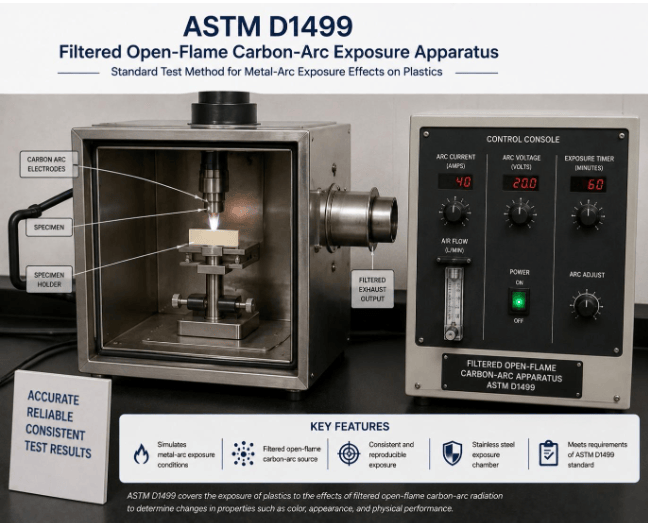
    This image shows a filtered open-flame carbon-arc exposure apparatus used to evaluate the effects of carbon-arc radiation on plastics in accordance with ASTM D1499.
    ASTM D1499 Filtered Open-Flame Carbon-Arc Exposure Apparatus

    Common Challenges and Troubleshooting

    Several factors can affect the reproducibility of carbon-arc exposure results. Variations in line voltage, water deposits, temperature, humidity, electrode condition, filters, and exposure conditions can influence material degradation. Technicians should keep the exposure equipment clean, use consistent operating conditions, and control specimen thickness. When comparing results between laboratories, they should use the same carbon-arc type, filters, and exposure conditions.

    ASTM D1499 Analysis Results and Interpretation

    • Laboratories report results based on specific property-evaluation methods after exposure.
    • Laboratories report results for gloss change in GU, color change in ΔE, mechanical properties in MPa, mass change in %, and exposure conditions in hours (h) or radiant exposure in MJ/m².   
    • Engineers compare exposed specimens with control materials to evaluate relative performance.
    • Different laboratories rank materials differently, depending on the carbon-arc source, filters, or exposure conditions.

    Link to ASTM D1499

    Read more

    FAQ

    Where can I get the astm d1499 tested?
    You can share your astm d1499 testing requirements with MaTestLab. MaTestLab has a vast network of material testing laboratories, spread across the USA and Canada. We support your all material testing needs ranging from specific astm d1499 test to various testing techniques.
    Please contact us for a detailed quote for your astm d1499 testing needs. Cost incurred to carry out different astm d1499 testing methodology depends on the type of raw material; number of samples, coupons, or specimens; test conditions, turn around time etc. Costs of some ASTM testing methods start from $100 and the final value depends upon the factors listed above. Please contact us for the best and latest prices.
    The required number of samples or specimens should comply with the procedure given in the astm d1499 standard. However, the MaTestLab operations team can assist you for your special requirements once you share your testing details with us.
    MaTestLab has a vast testing laboratory network, hence we bring you the best testing facilities in a cost-effective way. We offer considerable discounts (15-20%) to our returning customers based on test volume and frequency.
    The turnaround time for astm d1499 test methodology depends upon the test procedure mentioned in the standard test document. However, we at MaTestLab understand your research requirements and hence try to get your test completed within the least possible time.
    Gokula Srinivasan Selvam
    About Author
    Gokula Srinivasan Selvam
    Gokula Srinivasan Selvam is a Material Testing Associate at MaTestLab Inc. and holds a postgraduate degree in Ceramic Engineering from IIT (BHU), Varanasi.
    Testimonials
    Real results
    Engineers trust us with what matters most
    Start Your Testing
    Project Today
    Define your requirements and get access to
    specialized laboratories ready to deliver results
    Partners with us
    Clients
    Vendors
    Process for testing
    • STEP 01

      You share your testing requirements

    • STEP 02

      You share your sample(s)

    • STEP 03

      We deliver your test reports

    Get your testing done

    Let us known your testing requirements and we will be right back with a solution.

      Let us root for each other. Collaborate to grow, expand, and accelerate our businesses.

      Partner with us

        Contact Us

        Discover more from MaTestLab

        Subscribe now to keep reading and get access to the full archive.

        Continue reading