
ASTM D1176 Standard Practice for Sampling and Preparing Aqueous Solutions of Engine Coolants or Antirusts for Testing Purposes

    What is ASTM 1176? 

    ASTM D1176 is a standard practice that provides guidelines for sampling representative samples of engine coolant concentrates, ready-to-use prediluted coolants, and solid or liquid antirust compounds. It also includes detailed instructions for preparing aqueous solutions from these products for subsequent lab testing. ASTM D1176 (Standard Practice for Sampling and Preparing Aqueous Solutions of Engine Coolants or Antirusts for Testing Purposes) improves the accuracy of sample non-homogeneity in downstream chemical and physical testing by optimizing sample mixing, phase separation, and volumetric dilution. 

    Read more

    Get Certified ASTM D1176 Compliance for Coolant Testing 

    ASTM D1176 is a test method used for sampling and preparing aqueous solutions of engine coolants and antirusts in an accredited laboratory. These services provide full documentation, such as sampling records, preparation methods, concentration checks, etc., and compliance documentation. The certified services guarantee that coolant samples and test solutions comply with downstream property testing requirements. Testing is used to ensure that manufacturers, suppliers, and laboratories acquire representative samples and prepare aqueous solutions at the correct concentration. Select a qualified testing partner with ISO/IEC 17025 accreditation to ensure that the laboratory performs coolant sampling and preparation according to ASTM D1176. Suitable sampling containers, mixing equipment, analytical balances, volumetric glassware, and density measurement instruments are needed in the laboratory

    What is the Scope of ASTM A1034?

    ASTM D1176 covers information on sampling and preparing solutions of engine coolants and antirusts. The standard describes how to obtain representative samples and prepare aqueous solutions of known concentration. 

    Read more

    The scope of ASTM D1176 contains:

    • Material type: Automotive/light-duty and heavy-duty material type: Engine coolants and antirusts for use in engines cooled by water. Antirust can come in liquid or solid form.
    • Purpose: To collect and prepare aqueous solutions of engine coolants or antirusts for additional evaluation and testing.
    • Properties evaluated: This practice does not measure a property, but outlines the method of sampling and preparation of solutions of known concentration.
    • Testing method: To prepare a solution of known concentration by two methods: gravimetric (weight-per-volume) and volumetric (volume-percent), and by a referenced density method at equilibrium temperature.
    • Result: A sample of the material and an aqueous solution of a known concentration that the agreed procedure produces.
    • Test Limitations: This Standard does not attempt to cover the full scope of safety issues related to its use. The user is responsible for establishing appropriate safety, health and environmental practices.
    • Use conditions: Care should be taken to ensure that a representative sample of product is taken. The supplier and customer should negotiate the approaches to take.
    • Applications: Sample preparation for downstream coolant property tests, such as freezing point, reserve alkalinity, pH, corrosion behavior, and foaming tendency.

     What are the Uses of the ASTM D1176 Practice?

    ASTM D1176 testing helps laboratories obtain and create aqueous solutions of engine coolants and antirusts to submit for downstream testing. The results are used by vehicle service personnel, laboratory technicians, and quality control professionals for sample preparation, quality assurance, and compliance with test methods. This standard—

    • Explains how to take a sample from a closed container.
    • Describes multiphase products and how to separate the desired phase.
    • Gives two ways to make a solution of known concentration, gravimetric and volumetric.
    • Starts the property tests downstream with a sample and dilution that are representative and reproducible.
    • Eliminates a standard, but overlooked, laboratory disagreement.
    • Ensures supplier/customer agreement on the preparation method to be used.
    • Sets the agreed focus for concentration basis, which allows for comparison of results between batches and over time.

    What Materials Can Be Tested Under ASTM D1176? 

    ASTM D1176 applies to engine coolants and antirusts from which analysts may take and analyze samples. The practice applies to products for use in automotive/light duty and heavy-duty applications using water as the cooling medium. Antirust products come in both liquid and solid form – solids are handled as described in Annex A1. The analyst determines the type of product, representative sampling, and selection of the agreed preparation procedure for accurate results

    Why is ASTM D1176 Important? 

    ASTM D1176 is a standard practice for sampling and preparing water-based solutions of engine coolants and antirusts. The quality of a coolant result is only as good as the sample and its dilution. Every downstream number will inherit this error, since there will be a change in the freeze point, reserve alkalinity, pH, and corrosion behavior with the concentration of the prepared solution if the product has separated and the analyst has obtained the sample in an improper fashion. D1176 standardizes the sampling method and the composition of the test solution, eliminating a common but often unrecognized cause of disagreement between laboratories. It is a carefully worded practice – it instructs you as to how to reach the starting line, not as to how to run the race. 

    ASTM D1176 Equipment and Sample Preparation Guide

    ASTM D1176 covers sample containers, mixing equipment, analytical balances, volumetric glassware, and density measurement instruments. Technicians prepare samples of engine coolants or antirusts in the laboratory in order to use them for downstream testing. 

    Read more

    Sample and Specimen DetailsTechnicians obtain representative samples of engine coolants or antirusts from sealed containers for preparation of aqueous solutions.
    Specimen PreparationTechnicians allow the container to reach room temperature, mix or shake thoroughly, and note any separation. For multiphase products, they isolate the phase of interest using decanting, pipetting, a separatory funnel, or filtration.
    Specimen DimensionsThis practice focuses on sample volume and concentration rather than physical specimen dimensions. The prepared solution is made to a defined concentration using either gravimetric or volumetric procedures.
    InstrumentationLaboratories use appropriate sampling containers, mixing equipment, analytical balances, graduated glassware or calibrated volumetric flasks, and density measurement instruments (ASTM D1122 or D5931).

    Testing Procedures and Requirements for ASTM D1176

    This is a standard practice that explains how to collect a representative sample and how to make a solution of known concentration. Technicians prepare the agreement according to the agreed procedure, prepare the solution, and check its concentration. The Other referenced documents include: ASTM D1122, D1193, and D5931. The ASTM D1176 test method comprises the following test procedure: 

    Read more

    Sample Collection Technicians obtain a representative sample from a sealed container, allow the container to reach room temperature, mix or shake thoroughly, and note any separation.
    Phase Isolation For multiphase products, technicians isolate the phase of interest using decanting, pipetting, a separatory funnel, or filtration.
    Gravimetric Procedure Technicians prepare a solution of defined concentration based on weight-per-volume using relative density measured by a referenced density method.
    Volumetric Procedure Technicians prepare a solution of defined concentration using graduated glassware or a calibrated volumetric flask at controlled temperature.
    Result Reporting Technicians record the sampling details, preparation procedure used, concentration achieved, and any observations for downstream testing documentation.

    ASTM D1176 Testing Process and Data Collection

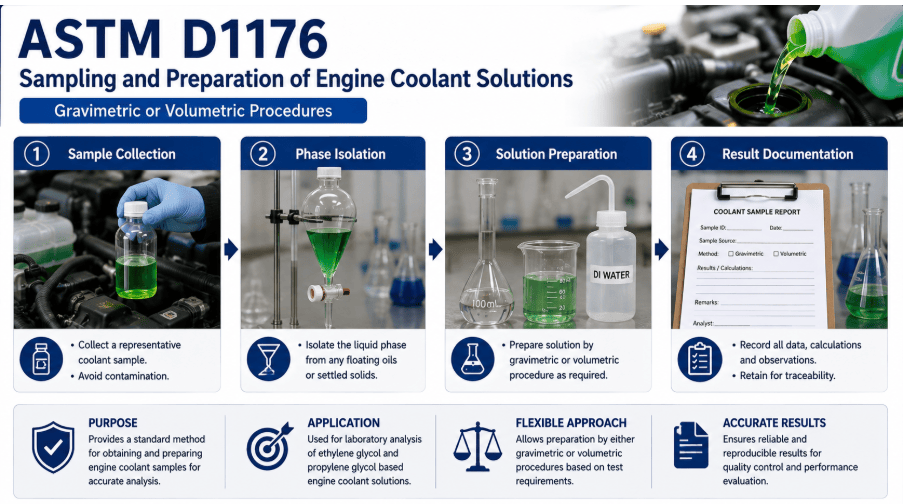
    Technicians remove a sample from a closed container, let it come to room temperature, then combine the sample by shaking or mixing it thoroughly. If a multiphase product is being used, the technician separates the desired phase by decanting, pipetting, a separatory funnel, or filtration. The technician chooses the previously determined preparation method (gravimetric or volumetric) and prepares an aqueous solution of known concentration. The lab then records a report of the sampling, preparation, and concentration for downstream testing. Technicians note the sample’s ID, preparation, concentration, and observations. 

     The image shows engine coolant sampling and solution preparation by gravimetric or volumetric procedures, including sample collection, phase isolation, solution preparation, and result documentation.
    ASTM D1176 Sampling and Preparation of Engine Coolant Solutions 

    Common Challenges and Troubleshooting

    If technicians make errors in sampling, mixing, or preparing concentrations for the test, ASTM D1176 will provide incorrect downstream results. The quality of a coolant is as good as the sample and dilution it’s made from. When the product separates out, and the sample is taken incorrectly, or if the concentration of the solution made is not known, each successive number is also contaminated. Great care should be taken to ensure that a representative sample of product is taken. The supplier and customer should mutually agree on the approach to be taken. Standard procedures are always adhered to, and mixing and concentration are always checked. If repeated measurements differ significantly, the laboratory should confirm the validity of the sampling, preparation, and concentration determination before reporting the final measurement. 

    ASTM D1176 Analysis Results and Interpretation

    The report summarizes the sampling and preparation information for the aqueous solution of engine coolant or antirust.

    Read more

    • Laboratory records keep the sampling details such as condition of the container, container mixing method, and any container separation that occurred.
    • For multiphase products, the analyst records the method of phase isolation (e.g decanting, pipetting, separatory funnel, filtration, etc.).
    • The laboratory reports either a gravimetric or volumetric (relative density or volume-percent in graduated glassware) preparation procedure.
    • The laboratory reports the concentration and verification method for the prepared solution.
    • It records the agreement between supplier and customer as to how to prepare the “product”.
    • The engineers compare the concentration of the solution prepared with the required test concentration to ensure that the test results obtained downstream are useful.

    What Factors Should You Consider for ASTM D1176 Testing?

    • Expertise: Appropriate procedures, representative sampling, and preparation of solutions should be followed by skilled technicians. Correct mixing and concentration verification are critical for beneficial downstream outcomes.
    • Speed: Sampling and preparation time varies according to the product form and the procedure used. To get accurate results, appropriate time for proper mixing and temperature equilibration is required.
    • Costs: Testing costs vary by the number of samples, the necessary preparation procedures, and the complexity of the testing program.
    • Confidentiality: Matestlab always ensures full confidentiality in the testing process and informs only the relevant parties about the results.

    Link to ASTM D1176

    FAQ

    What is ASTM D1176?
    ASTM D1176 is the standard practice for obtaining representative samples of engine coolants and antirusts and preparing accurate aqueous solutions for physical and chemical testing.
    Dilution requires ASTM D1193 Reagent Water or specified standard corrosive water depending on the requirements of the downstream test method.
    Separated liquids are isolated using a separatory funnel after standing for 16 hours, or kept under continuous mechanical stirring while drawing aliquots if tested as a combined emulsion.

    Updated on September 17, 2026

    Dr Ruchika Yogesh
    About Author
    Dr. Ruchika Yogesh is an entrepreneur, science and AI/ML enthusiast, medicinal chemistry subject matter expert (SME), scientific/medical copyeditor, and an independent researcher.
    Testimonials
    Real results
    Engineers trust us with what matters most
    Start Your Testing
    Project Today
    Define your requirements and get access to
    specialized laboratories ready to deliver results
    Partners with us
    Clients
    Vendors
    Process for testing
    • STEP 01

      You share your testing requirements

    • STEP 02

      You share your sample(s)

    • STEP 03

      We deliver your test reports

    Get your testing done

    Let us known your testing requirements and we will be right back with a solution.

      Let us root for each other. Collaborate to grow, expand, and accelerate our businesses.

      Partner with us

        Contact Us

        Discover more from Matestlab

        Subscribe now to keep reading and get access to the full archive.

        Continue reading