ASTM C623 Standard Test Method for Young’s Modulus, Shear Modulus, and Poisson’s Ratio for Glass and Glass-Ceramics by Resonance

    What is ASTM C623?

    ASTM C623 is a standard test method for determining the elastic properties of glass and glass-ceramic materials by resonance. The method determines the mechanical resonance frequencies of suitable glass and glass-ceramic specimens using the resonance-testing apparatus described in ASTM C623. The resonant frequencies are used to determine the material’s Young’s modulus, shear modulus, and Poisson’s ratio. ASTM C623 applies to glass and glass-ceramic materials that are elastic, homogeneous, and isotropic and can be prepared in suitable specimen geometries.

    Read more

    Laboratories use ASTM C623 in material development, quality control, product design, and research involving suitable glass and glass-ceramic materials. The mechanical characteristics of brittle materials can be evaluated in a nondestructive manner and require only relatively simple specimen geometries, as specified in ASTM C623. 

    Get Certified ASTM C623 Testing for Reliable Glass Elastic Property Evaluation

    The ASTM C623 standard specimen for the characterization of elastic properties of glass and glass-ceramic materials is resonance testing. Accurate resonance testing aids in quality control, material characterization, product development, structural design, and process optimization without compromising the test specimens.

    What is the Scope of ASTM C623?

    ASTM C623 sets a standard method for determining the elastic properties of glass and glass-ceramic materials by resonance. The test aims to determine the natural resonant frequencies of the specimen, and analysts calculate the elastic constants from the measured resonance frequencies, specimen dimensions, and density or mass as applicable. The standard:

    Read more

    • Calculates Young’s modulus, shear modulus, and Poisson’s ratio.
    • Applies the impulse excitation (resonance) method of non-destructive testing.
    • Measures the resonant frequency in flexural and torsional modes.
    • Supports high-temperature testing if necessary.
    • Accurately and repeatably characterizes materials for quality control.
    • ASTM C623 covers suitable glass and glass-ceramic materials that are elastic, homogeneous, and isotropic and can be prepared in suitable specimen geometries. 

    What are the Uses of ASTM C623 Test Standard?

    Glass manufacturers, research laboratories, and testing laboratories use ASTM C623 to evaluate the elastic properties of glass and glass-ceramic materials with minimal stress applied to the specimen. Engineers use the results to assess material stiffness, support product design, and evaluate whether glass products meet applicable engineering and performance requirements. Common applications include:

    • Measurement of elastic properties of glass and glass-ceramics.
    • Measurement of Young’s Modulus, Shear Modulus, and Poisson’s Ratio.
    • Assisting in the quality control process in glass production.
    • Assessment of structural glass for use in architecture.
    • Characterization of suitable glass and glass-ceramic materials for material development and evaluation.
    • Evaluation of electronic components and glass-ceramic substrates.
    • Helping develop new types of glass.
    • Optimizing material selection for high-temperature applications. 

    What is Resonance Testing in ASTM C623?

    Analysts use resonance testing to determine a material’s elastic properties from its natural vibration frequencies. The laboratory excites the glass specimen and analyzes its resonance frequencies to determine Young’s modulus, shear modulus, and Poisson’s ratio. 

    Why is Resonance Testing Important for Glass and Glass-Ceramics?

    Glass and glass-ceramics are brittle substances that require special testing methods other than conventional tensile tests to assess them without causing damage. Laboratories can evaluate their elastic properties using resonance testing without applying the larger stresses associated with conventional static loading methods. These measurements can be used to help predict the behavior of the structure, assess the vibration performance of the structure, check for thermal stresses, and enhance the reliability of the product. 

    How Does ASTM C623 Measure Elastic Properties?

    Technicians suspend the prepared specimen using a suitable support arrangement specified by ASTM C623. The test apparatus mechanically excites the specimen and produces vibrations that allow the laboratory to identify resonance frequencies. The measurement system detects the specimen’s mechanical vibrations and identifies the flexural and torsional resonance frequencies using the applicable resonance-measurement system. The frequencies, along with the dimensions and mass of the specimen, are used to determine Young’s modulus, shear modulus, and Poisson’s ratio in accordance with ASTM C623. 

    Common Challenges and Troubleshooting

    Improper dimensions, improper support positioning, poor impoundment, environmental vibrations, inaccurate mass or dimension measurements, and improperly calibrated measuring equipment are some of the factors that may affect the accuracy of ASTM C623 measurements. To improve repeatability and reliability, technicians should prepare specimens with uniform geometry, accurately measure their dimensions, locate the appropriate support points, calibrate the instrumentation, and minimize external vibration during testing. 

    ASTM C623 Equipment and Sample Preparation Guide

    The accuracy of the resonance measurement equipment, as well as appropriate specimen preparation, is essential to accurate measurement of elastic properties. To achieve repeatable and accurate results, the ASTM C623 calls for controlled specimen dimensions and calibrated instrumentation.

    Read more

    Specimen DetailsThe test applies to suitable glass and glass-ceramic specimens that are elastic, homogeneous, and isotropic and can be prepared in suitable geometry; ASTM C623 permits rectangular or circular cross sections.
    Specimen PreparationTechnicians prepare specimens with suitable dimensions and geometry and record their dimensions and mass before testing.
    Specimen ConditionTechnicians inspect specimens for surface damage, defects, and contamination that could influence vibration measurements.
    InstrumentationImpulse excitation apparatus, compliant specimen supports, impulse hammer or striker, microphone or accelerometer, FFT (Fast Fourier Transform) analyzer, precision balance, dimensional measuring instruments, programmable temperature furnace (elevated-temperature testing), and laboratory data acquisition system. 

    Testing Procedures and Requirements

    ASTM C623 defines a standard resonance testing method to understand the elastic properties of glass and glass ceramics. The specimen is suspended appropriately, excited by a controlled mechanical stress, and the resonant frequencies are recorded, which allows calculation of the necessary elastic constants.

    Read more

    Sample PreparationCut and trim a rectangular bar or a disc specimen, check the size and weight, and examine the specimen for defects prior to testing. 
    Resonance SetupTechnicians place the test piece on suitable supports and connect the vibration measurement equipment.
    Impulse ExcitationThe test piece is fired with a standardized impulse tool and the vibration signal of the specimen is captured with the microphone or accelerometer. 
    Data Recording and EvaluationAnalysts measure the resonance frequencies and calculate Young’s modulus, shear modulus, and Poisson’s ratio according to ASTM C623.

    ASTM C623 Testing Technique, Process, and Data Collection Guide

    Technicians prepare the glass or glass-ceramic specimens with suitable dimensions and measure their mass using a precision balance. Technicians suspend the specimen using an appropriate support arrangement and mechanically excite it using the resonance-testing apparatus. The measuring system measures the vibration response and processes the measured signal to determine the resonant frequencies. These frequencies are used by analysts to calculate Young’s Modulus, Shear Modulus, and Poisson’s Ratio. Typical test reports would contain the following information: Identification of the specimen, dimensions, mass, resonant frequencies, calculated elastic constants, testing conditions, equipment calibration records, and observations during testing. 

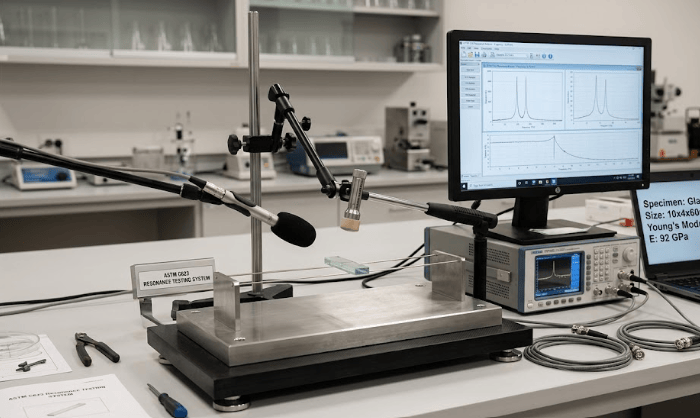
    The image shows a sonic resonance apparatus testing system used to determine the elastic properties of glass according to ASTM C623.
    ASTM C623 Sonic Resonance Apparatus

    Analysis Results and Interpretation

    • ASTM C623 provides a method for determining Young’s modulus (E), shear modulus (G), and Poisson’s ratio (ν) for suitable glass and glass-ceramic materials.
    • A higher Young’s modulus generally indicates greater resistance to elastic tensile or compressive deformation, while a higher shear modulus indicates greater resistance to elastic shear deformation.
    • Poisson’s ratio describes the ratio of lateral strain to axial strain, using the conventional sign convention for elastic deformation.
    • ASTM C623 is a standard for testing elastic properties, but acceptable properties vary for different glass compositions and applications.
    • Engineers use such measurements to assess how well a structure performs, determine the appropriate materials for a structure, predict its vibration characteristics, and enhance product design. 

    Link to ASTM C623

    Read more

    Updated on August 13, 2026

    Dr Ruchika Yogesh
    About Author
    Dr. Ruchika Yogesh is a serial entrepreneur, material science and AI/ML enthusiast, medicinal chemistry subject matter expert (SME), scientific/medical copyeditor, and a researcher.
    Know More
    Testimonials
    Real results
    Engineers trust us with what matters most
    Start Your Testing
    Project Today
    Define your requirements and get access to
    specialized laboratories ready to deliver results
    Partners with us
    Clients
    Vendors
    Process for testing
    • STEP 01

      You share your testing requirements

    • STEP 02

      You share your sample(s)

    • STEP 03

      We deliver your test reports

    Get your testing done

    Let us know your testing requirements and we will be right back with a solution.

      Let us root for each other. Collaborate to grow, expand, and accelerate our businesses.

      Partner with us

        Discover more from Matestlab

        Subscribe now to keep reading and get access to the full archive.

        Continue reading