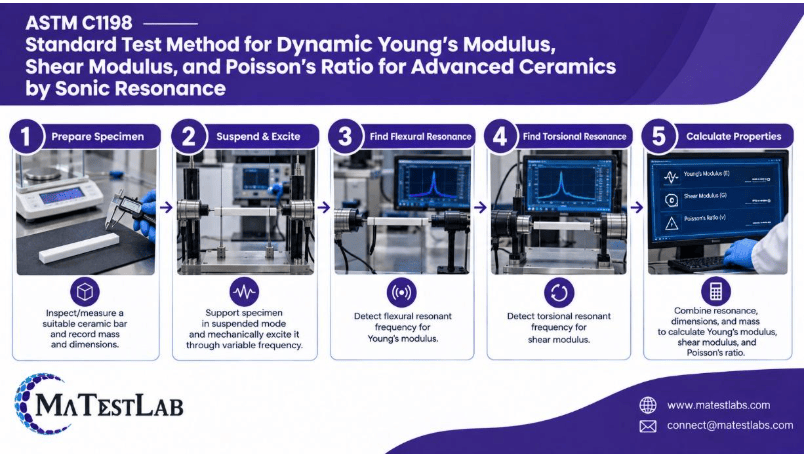
Measuring Dynamic Young’s Modulus, Shear Modulus, and Poisson’s Ratio

    ASTM C1198 Introduction

    This method is used for determining the dynamic Young’s modulus, shear modulus, and Poisson’s ratio of materials using impulse excitation techniques. These properties are critical for assessing the elastic behavior and structural integrity of ceramic, glass, and other solid materials. This method ensures the materials’ mechanical properties meet design and performance requirements in various industrial applications, such as construction and aerospace. This test employs the impulse excitation technique, where a material sample is subjected to a non-destructive impact. The vibration response generated by the impact is recorded and analyzed to determine the material’s elastic properties.

    Read more

    Get Certified ASTM C1198 for Accurate Dynamic Elastic Property Evaluation

    ASTM C1198 certification allows to verify that the determination of dynamic elastic moduli and Poisson ratio is carried out through standardized procedures of impulse excitation. Certified testing offers consistent, credible information regarding the design of materials, structural analysis, and verification of the performance.

    Scope of ASTM C1198

    •  A non-destructive test that can be done repeatedly.
    • Helps to characterize materials and quality control.
    •  Proper determination of elastic constants to be used in design.

    ASTM C1198 Equipment and Sample Preparation

    Specimen DetailsThe test samples should represent the material’s typical quality, free of cracks, voids, or other defects that may affect results.
    Specimen DimensionsSamples adhere to dimensional guidelines specific to the testing equipment and method. Uniformity in size is essential for reliable outcomes.
    Specimen PreparationThe surface of the specimen is clean and flat to ensure accurate measurements. Conditioning may involve stabilizing temperature and humidity levels to minimize environmental influences.

    Applications of ASTM C1198

    •  Composite structural components.
    •  Innovation of new materials.
    • Ceramic and brittle material is produced in terms of quality control.

    ASTM C1198 Common Challenges and Troubleshooting

    Typical problems are a lack of correct geometry of the specimen, support positioning during excitation, and damping by surface defects or internal microcracks. The resonance signals can be altered by the environmental noise and the wrong location of the impulse. By making sure that machining is accurate, suspensions are well supported, and that the testing conditions are controlled to ensure accuracy and repeatability in measurements.

    Read more

    ASTM C1198 Aggregate Testing Technique, Process, and Data Collection

    The nodal points are supported, and a light impulse of a mechanical nature is applied to the specimen to produce natural vibrations. The frequencies of the resulting vibrations are sensed or microphoned, and the analysis is used to identify the basic flexural and torsional resonance frequencies. Dynamic Young’s moduli and shear moduli are determined using dimension of the specimen, mass, and measured frequencies. It is then based on the relationship between these elastic constants in deriving the Poisson ratio. All the values and calculated measurements are recorded to be assessed.

    ASTM C1198 Testing Procedure and Requirements

    Excitation and RecordingA light tap excites vibrations in the sample, and a transducer or microphone records the resonant frequencies.
    Frequency AnalysisResonance data are used to compute the dynamic Young’s modulus, shear modulus, and Poisson’s ratio.
    AnalysisThe extracted samples are then analyzed using gas chromatography coupled with mass spectrometry (GC-MS), a highly sensitive technique for precise identification and quantification of individual PAH compounds.

    ASTM C1198 Analysis Results and Interpretation

    Reproducible resonance frequencies indicate acceptable values of elastic modulus, which indicate the stiffness and structural integrity of a material. An increase in the values of the dynamic modulus implies increased stiffness and deformation. Deviations or variations in results can be used to indicate internal defects, incorrect specimen preparation, or errors in testing set-up. Compliance provides proper evaluation of dynamic mechanical behavior to engineering design and performance analysis.

    Read more

    ASTM C1198 Problem & Solution

    The destructive technique of determining the elastic constants of brittle materials can be destructive to the specimen. ASTM C1198 is useful in determining the dynamic Young’s modulus, shear modulus, and Poisson ratio accurately

    FAQ

    Where can I get the astm c1198 tested?
    You can share your astm c1198 testing requirements with MaTestLab. MaTestLab has a vast network of material testing laboratories, spread across the USA and Canada. We support your all material testing needs ranging from specific astm c1198 test to various testing techniques.
    Please contact us for a detailed quote for your astm c1198 testing needs. Cost incurred to carry out different astm c1198 testing methodology depends on the type of raw material; number of samples, coupons, or specimens; test conditions, turn around time etc. Costs of some ASTM testing methods start from $100 and the final value depends upon the factors listed above. Please contact us for the best and latest prices.
    The required number of samples or specimens should comply with the procedure given in the astm c1198 standard. However, the MaTestLab operations team can assist you for your special requirements once you share your testing details with us.
    MaTestLab has a vast testing laboratory network, hence we bring you the best testing facilities in a cost-effective way. We offer considerable discounts (15-20%) to our returning customers based on test volume and frequency.
    The turnaround time for astm c1198 test methodology depends upon the test procedure mentioned in the standard test document. However, we at MaTestLab understand your research requirements and hence try to get your test completed within the least possible time.
    Divakar Shukla
    About Author
    Divakar Shukla
    Divakar Shukla is an Electrical and Electronics Engineer specializing in the convergence of embedded systems architecture, industrial automation, and applied artificial intelligence.
    Testimonials
    Real results
    Engineers trust us with what matters most
    Start Your Testing
    Project Today
    Define your requirements and get access to
    specialized laboratories ready to deliver results
    Partners with us
    Clients
    Vendors
    Process for testing
    • STEP 01

      You share your testing requirements

    • STEP 02

      You share your sample(s)

    • STEP 03

      We deliver your test reports

    Get your testing done

    Let us known your testing requirements and we will be right back with a solution.

      Let us root for each other. Collaborate to grow, expand, and accelerate our businesses.

      Partner with us

        Contact Us

        Discover more from MaTestLab

        Subscribe now to keep reading and get access to the full archive.

        Continue reading