ASTM C1499 Standard Test Method for Monotonic Equibiaxial Flexural Strength of Advanced Ceramics at Ambient Temperature
What is ASTM C1499?
ASTM C1499 is a standard test method for determining the monotonic equibiaxial flexural strength of advanced ceramics at ambient temperature. The method applies uniaxial force to the ceramic specimen and generates an equibiaxial stress state using concentric load and support rings. Laboratories can use machined specimens or suitable as-fabricated specimens with limited warpage. The method regulates specimen geometry, ring alignment, loading speed, deflection, data collection, and reporting. ASTM C1499 (Standard Test Method for Monotonic Equibiaxial Flexural Strength of Advanced Ceramics at Ambient Temperature) is generally used for advanced ceramics that exhibit isotropic, homogeneous, and continuous macroscopic behavior.
Get Certified ASTM C1499 Testing for Reliable Equibiaxial Flexural Strength Evaluation
Accurate equibiaxial flexural testing enables laboratories to measure the strength of advanced ceramics in multi-axial tensile stress. The ASTM C1499 defines a controlled ring-on-ring configuration that minimizes edge effects present in uniaxial flexural testing. Reproducible and accurate results require proper specimen preparation, ring alignment, dimensional measurement, loading control, and fracture-data collection. It can be used in material development, material comparison, quality assurance, and verification of design models.
What is the scope of ASTM C1499?
ASTM C1499 specifies the method for determining the equibiaxial strength of advanced ceramics at ambient temperature under monotonic uniaxial loading in concentric ring configurations. It covers specimen preparation, testing modes, loading rates, acceptable deflections, data collection, and reporting. It applies to monolithic advanced ceramics with macroscopically isotropic, homogeneous, and continuous behavior.
Material type: Advanced ceramics, primarily monolithic ceramics with macroscopically isotropic, homogeneous, and continuous behavior.
Purpose: Determination of monotonic equibiaxial flexural strength at ambient temperature.
Property measurement: Maximum 2-axis flexural strength at fracture.
Method: Continuous monotonic uniaxial loading by concentric ring-on-ring loading.
Result: Laboratories measure the fracture load and report the equibiaxial flexural strength in MPa.
Test Limitations: The method is not generally applicable to continuous fiber-reinforced ceramic composites, as they may not exhibit the required macroscopic isotropic and homogeneous behavior.
Environmental conditions: Testing is done at ambient temperature under controlled laboratory conditions.
Applications: Material development, material comparison, quality assurance, characterization, and design-code or model verification.
What are the uses of ASTM C1499 testing?
ASTM C1499 testing characterizes advanced ceramics under equibiaxial tensile stress. The ring-on-ring configuration is used in laboratories to test material strength in multiaxial stress and minimize the contribution of specimen edges. This standard-
Determines equibiaxial flexural strength of advanced ceramics.
Supports development and comparison of ceramic materials.
Provides data for quality-assurance programs.
Supports characterization of strength distributions in ceramics.
Supports the checking of design codes and analytical models
Determines the response of material to several tensile stresses.
Reduces the influence of edge preparation compared with uniaxial flexural tests.
Which Materials Can Be Tested Under ASTM C1499?
ASTM C1499 is mainly used for advanced ceramics with macroscopically isotropic, homogeneous, and continuous properties. Monolithic advanced ceramics and some whisker- or particle-reinforced ceramic composite materials are suitable for use in laboratories if they satisfy these behavioral assumptions.
Why is ASTM C1499 important?
ASTM C1499 is a standard for measuring the strength of ceramics in equibiaxial stress. Engineering applications often expose ceramics to multiaxial tensile stresses, so equibiaxial testing can provide information that uniaxial flexural tests cannot provide. The technique also reduces specimen edge effects since generated stresses are lowest near specimen edges.
ASTM C1499 Equipment and Sample Preparation Guide
ASTM C1499 lists a suitable mechanical testing machine, concentric load and support rings, dimension-measuring equipment, and suitable alignment and friction-control components. Ring alignment is important to carefully control in the laboratory as it may influence the strength determined.
Technicians prepare advanced ceramic specimens, circular or square test specimens, according to the geometry requirements of ASTM C1499. The method considers machined specimens and suitable as-fabricated specimens with limited warpage.
Specimen Preparation
Technicians prepare specimens with controlled dimensions, surfaces, and flatness. They should minimize warpage and surface damage because these factors can influence fracture behavior.
Specimen Dimensions
ASTM C1499 does not prescribe one universal specimen size. Laboratories select specimen thickness h, specimen diameter or dimensions, and support-ring diameter Dₛ based on the expected fracture strength and elastic modulus.
Instrumentation
Laboratories use a universal/mechanical testing machine, concentric load and support rings, micrometers or other dimensional-measuring devices, and, when required, suitable deflection or displacement measurement equipment.
Testing Procedures and Requirements for ASTM C1499
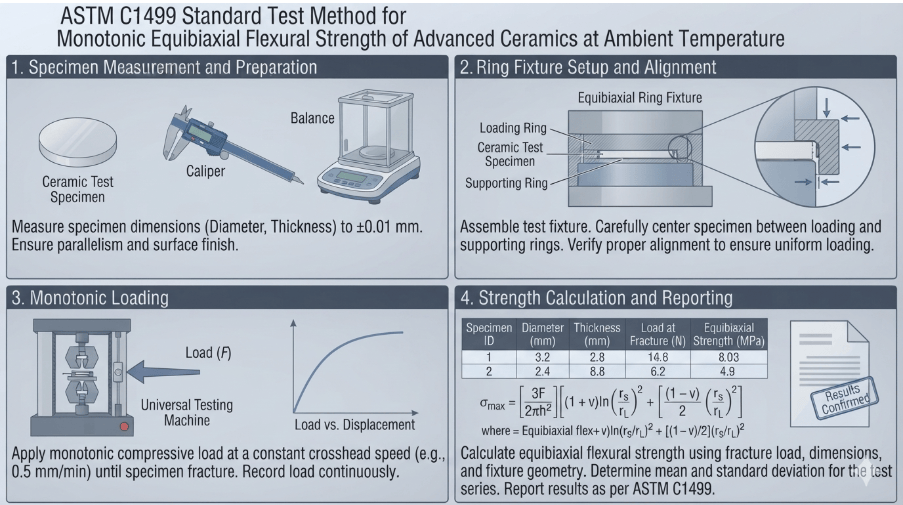
ASTM C1499 uses concentric ring loading to apply a continuously increasing monotonic load until the advanced ceramic specimen fractures. Technicians measure the specimen and fixture dimensions, ensure proper alignment, control loading rate, record fracture load, and calculate equibiaxial flexural strength. Other reference ASTM documents include C1145, C1239, C1259, C1322, E4, E6, E83, E337, and F394. The complete procedure for ADTM C1499 is given as:
Technicians measure specimen diameter or width and length and determine thickness at specified locations. Dimensional-measuring devices must provide the required accuracy and resolution. The specimen should have the required geometry and flatness criteria.
Ring Fixture Setup and Alignment
Technicians install the load and support rings concentrically and position the specimen between them. The load and support rings must align within the specified tolerance, and the specimen must remain concentric with the rings.
Monotonic Loading
They apply a continuous uniaxial load at the specified constant rate without load reversals. Technicians record the applied load and relevant displacement information until the specimen fractures.
Strength Calculation and Reporting
Analysts use the measured specimen and ring dimensions and the maximum fracture load to calculate equibiaxial flexural strength. Laboratories report the strength in MPa together with the specimen, fixture, loading, and test-conditioning information.
ASTM C1499 Testing Process and Data Collection
Technicians first identify the advanced ceramic, prepare the required test specimens, determine specimen size, check flatness and surface, and select appropriate load and support rings based on specimen dimensions, expected strength, and elastic modulus. Technicians center the sample between the support and load rings and check for alignment. The testing machine imposes a monotonically increasing load until fracture occurs. Analysts record the maximum fracture load and relevant dimensional data. They then calculate the equibiaxial flexural strength and document the fracture and test conditions.
ASTM C1499 Testing Procedure Using Universal Testing Machine (UTM)
Common Challenges and Troubleshooting
For reproducible and accurate results, the dimensions of specimens, flatness, alignment of the rings, the loading of the specimen, and the friction between the specimen and the ring must be controlled. Typical difficulties are specimen warpage, ring misalignment, too much deflection, contact stresses, friction between rings and specimen, inaccurate thickness measurement, and early fracture caused by surface damage. Use accurate dimensional instruments: check fixture alignment before testing, minimize friction in the instrument, control loading rate, and protect operator from ceramic fragments. ASTM C1499 suggests using polycarbonate shielding or equivalent protection due to potential for ceramic fracture and release of fragments at loads and strain energies.
ASTM C1499 Analysis Results and Interpretation
The report provides a summary of the monotonic equibiaxial flexural strength of the advanced ceramic specimens whose response was tested at ambient temperature, under a concentric ring loading configuration. The results provide engineers with the ability to evaluate the strength and deformation of ceramics when subjected to multiaxial tensile stress, and to compare the measured results to applicable material or product specifications.
Laboratories report ASTM C1499 results for equibiaxial flexural strength in MPa, specimen dimensions in mm, and load ring and support ring dimensions in mm.
Technicians document the load at fracture, specimen dimensions, type of specimen, loading configuration, and the test conditions.
For testing, the test configuration, specimen identification, specimen fabrication condition, fracture location and characteristics, and relevant observations are documented.
Engineers compare the measured equibiaxial flexural strength and failure behavior with applicable material or product requirements to evaluate the tested advanced ceramic’s flexural performance.
The advanced ceramic test specimen is subjected to equibiaxial flexural strength testing in accordance with ASTM C1499, typically reported in MPa.
What test method does ASTM C1499 use?
This method is based on a concentric ring-on-ring configuration. The mechanical testing machine applies continuous monotonic uniaxial loading with the load ring, and the support ring supports the specimen.
Which equipment does ASTM C1499 use?
An appropriate mechanical testing machine, concentric load and support rings, dimensional-measuring equipment (micrometers), and alignment and displacement equipment are required for this test.
Dr. Ruchika Yogesh is a serial entrepreneur, material science and AI/ML enthusiast, medicinal chemistry subject matter expert (SME), scientific/medical copyeditor, and a researcher. Know More
Testimonials
Real results
Engineers trust us with what matters most
“We had a great experience working with this company for our ASTM E84 testing. They were the first company to respond to our inquiry within just a few minutes of submitting it. From start to finish, the communication was excellent, and the entire process was swift, straightforward, and hassle-free.”
Ivars FancyWalls
United States
“Very good communication, testing associates were very patient with delays on our end. Reasonable turnaround time for results and nicely detailed report. Analysts were also quick to answer any follow-up questions. Happy with results.”
Skye Henderson
United States
“Matestlab connected us with an accredited lab within days, cutting weeks off our product validation timeline.”
Rebecca Kozodoy-Pins
United States
Why Choose Matestlab?
Matestlab is a unified testing services partner based in the USA. Matestlab offers raw material and product testing services through accredited, expert laboratories primarily based in the USA. Matestlab supports physical, thermal, chemical, electrical, mechanical, environmental, and characterization testing needs through its global network of 2200+ accredited testing laboratories. Matestlab's in-house materials science experts curate and design comprehensive testing programs matched to the sample material and specific testing need, with regulatory requirements and confidentiality in mind.
If you are looking for a managed and trusted testing partner to achieve your research goals, feel free to schedule a meeting with us or send us a request at connect@matestlabs.com to learn more about our services. For a quick quote, call us at (302)244-7710. We are happy to serve you.
Start Your Testing Project Today
Define your requirements and get access to specialized laboratories ready to deliver results