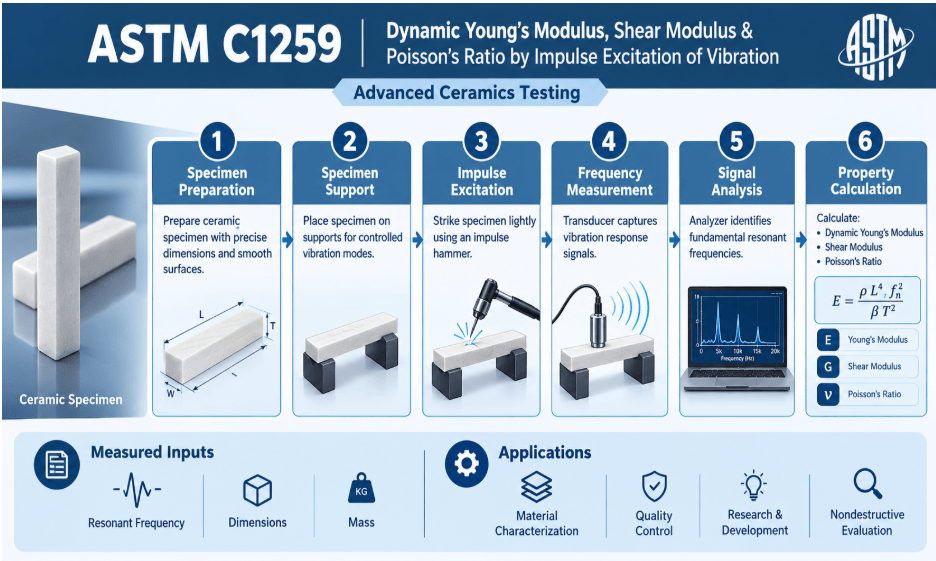
ASTM C1259 specifies the method for determining the dynamic elastic properties of advanced ceramics at ambient temperatures using impulse excitation of vibration. The standard applies to materials that are elastic, homogeneous, and isotropic. Labs use an impulse tool to excite vibrations of the test specimen in a flexure- and torsion-supported mode in order to measure resonant frequencies in flexure and torsion.
The scope of ASTM C1259 includes:
- Material type: ASTM C1259 covers advanced ceramics that are elastic, homogeneous, and isotropic, including bar, rod, and disc geometries.
- Purpose: ASTM C1259 is used for material development, characterization, generation of design data, and quality control to determine the dynamic Young’s modulus, shear modulus, and Poisson’s ratio.
- Properties measured: Dynamic Young’s modulus (flexural mode), Dynamic shear modulus (torsional mode), and Poisson’s ratio (calculated from flexural and torsional modes).
- Method: ASTM C1259 is for determining the velocity of transient vibrations using impulse excitation of vibration from a single elastic strike from an impulse tool, and supports of the specimen, locations of the impulse and pick-up points are selected to excite specific modes of transient vibrations.
- Result: The testing laboratory obtains dynamic elastic property data from the specimens it tests.
- Test Limitations: The test method is specifically applicable to advanced ceramics that are elastic, homogeneous, and isotropic; flat plates and disks may be similarly measured, but the equations required are not discussed in the main body.
- Environmental conditions: The test is conducted at ambient temperatures; however, it is modified for a cryogenic or high-temperature environment if necessary, with appropriate changes in the test equipment.
- Applications: ASTM C1259 is used by engineers in the development, characterization, design data generation, and quality control of advanced ceramic materials.
What are the Uses of ASTM C1259 Testing?
ASTM C1259 testing enables various properties, such as dynamic elastic properties, to be measured reliably in advanced ceramics during testing. These results are beneficial to engineers and manufacturers for material development, design validation, and quality control. This standard-
- Elastic properties of advanced ceramics for structural applications: Characterization of elastic properties of advanced ceramics for structural applications.
- Insert a probe into the vessel to measure the resonant frequency that is indicative of the uniformity of the product to determine consistency.
- Comparing materials for stiffness, rigidity, and elastic behavior
- Inspecting changes in resonant frequencies due to differences in specimen geometry, mass, and internal imperfections.
- Development of advanced ceramic materials and technologies to enable their use in a variety of applications and production methods.
- Design Data for Engineering Applications that need accurate elastic constants
Which materials can be tested under ASTM C1259?
The ASTM C1259 standard is used for advanced ceramics that are elastic, homogeneous, and isotropic. The test method involves bar, rod, and disc specimens. The geometry of the rod and bar is discussed in the main body, and the geometry of the disc is dealt with in Annex A1.
Why is ASTM C1259 Important?
ASTM C1259 provides a non-destructive method for determining the dynamic elastic properties of advanced ceramics. The test method is non-destructive. It is used for specimens prepared for other tests. The specimens are strained to a very small extent, and the moduli are therefore measured near the origin of the stress-strain curve and just above the limit of fracture. Compared with the complex support systems needed with elaborate setup and alignment, the impulse excitation test required only simple supports for the test specimen and an impact tool. This standard is used for material qualification, for generation of design data, and assists industries in guaranteeing structural integrity in challenging applications.