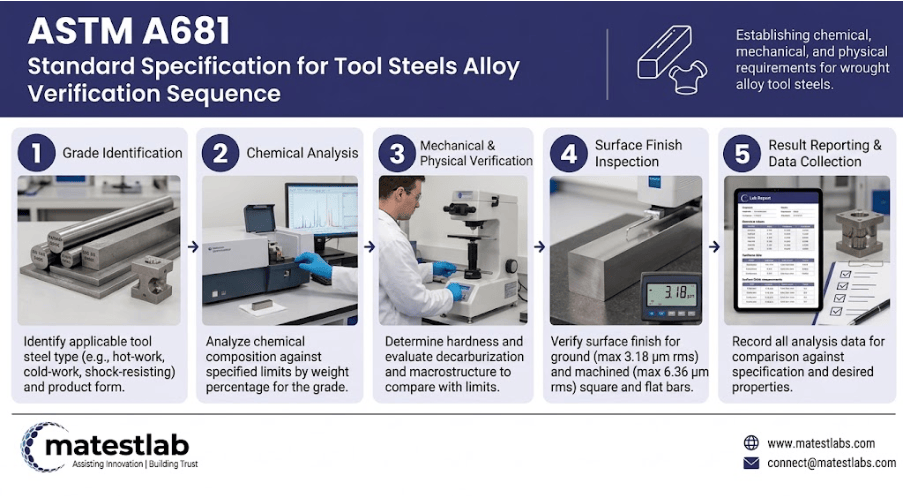
ASTM A681 covers the chemical, mechanical, and physical requirements for available wrought alloy tool steel products made by an electric melting process. The specification establishes requirements for wrought alloy tool steel products, while material selection for a particular application depends on design, service conditions, and desired properties.
The scope of ASTM A681 includes-
- Material type: Wrought alloy tool steel products, including hot- or cold-finished bar, plate, sheet, strip, rod, wire, or forgings.
- Purpose: Establishing chemical, mechanical, and physical requirements for tool steel products used in tools, dies, and fixtures.
- Properties evaluated: Chemical composition, hardness, macrostructure, and decarburization, as well as other mechanical and physical requirements for the appropriate tool steel type.
- Requirements: The standard sets out the chemical, mechanical, and physical requirements for the appropriate wrought alloy tool steel products.
- Results: Chemical composition values and mechanical property requirements for the appropriate tool steel types and grades.
- Test limitations: Material choice depends on the design, service conditions, and desired properties because no single tool steel grade is suitable for all applications.
- Use conditions: The standard applies to wrought alloy tool steel products supplied in the specified product forms and tested in accordance with the applicable requirements for their tool steel type, condition, size, and intended use.
- Applications: Tool, die, and fixture manufacturing where alloy tool steels require specified chemical, mechanical, and physical characteristics.
What are the Uses of ASTM A681?
ASTM A681 gives manufacturers a standardized reference for selecting and verifying tool steel products across a range of service conditions.
- Engineers rely on the specification’s classifications to match a tool steel grade to its intended application.
- The specification establishes chemical composition limits for wrought alloy tool steel products.
- Defines mechanical and physical requirements specific to each tool steel classification. Supports selection between hot-work, cold-work, shock-resisting, and special-purpose tool steel grades.
- Assists manufacturers in verifying incoming tool steel material against specification requirements.
- Supports quality control throughout tool, die, and fixture manufacturing.
Which materials can be tested under ASTM A681?
ASTM A681 applies to wrought alloy tool steel products supplied as hot- or cold-finished bar, plate, sheet, strip, rod, wire, or forgings. The standard covers a number of tool steel types, including hot-work, cold-work, shock-resisting, special-purpose, and other tool steels. Engineers rely on the standard to choose an appropriate wrought alloy tool steel type according to the intended design, service conditions, and desired properties.
Why is ASTM A681 Important?
ASTM A681 gives manufacturers a consistent way to verify that a tool steel product meets the chemical and mechanical requirements suited to its intended classification. Tool steels see extreme mechanical pressure, heat exposure, and repeated friction in service, so a material that falls short of its specified composition or mechanical properties can wear, crack, or fail earlier than expected. The specification provides requirements that help manufacturers and engineers evaluate tool steel products according to their applicable requirements and intended use.