ASTM A479 Standard Specification for Stainless Steel Bars and Shapes for Use in Boilers and Other Pressure Vessels

    What is ASTM A479?

    ASTM A479/A479M is the standard specification for stainless steel boiler and pressure vessel bars and shapes. It defines the manufacturing and quality standards of stainless-steel bars and structural shapes for use in pressure-retaining parts in extreme mechanical, thermal, and corrosive service loads. The specification includes hot and cold finished rounds, squares and hexagons, hot rolled or extruded angles, tees and channels. It covers austenitic, duplex, ferritic, and martensitic stainless steel grades and specifies requirements for chemical composition, tensile properties, yield strength, elongation, hardness, heat treatment, and, where applicable, corrosion testing for certain grades.

    Read more

    Get Certified ASTM A479 Testing for Stainless Steel Bars and Shapes

    Boiler and pressure vessel parts made of stainless steel should retain the quality of their resistance to corrosion, dimensional stability, and strength over extended periods of service. When stainless steel bars and shapes are required to serve a critical function, ASTM A479 testing is a means to ensure they meet the required chemical, mechanical, and metallurgical properties. Certification testing can prove product quality and reliability, minimize component failure risk, and meet industry and customer specifications.

    What is the Scope of ASTM A479 Test Standard?

    ASTM A479 specifies the manufacturing, inspection, and testing requirements for stainless steel bars and shapes used in boilers and other pressure vessel applications. The specification outlines the acceptable stainless-steel grades, heat treatment specifications and conditions, mechanical properties, and quality verification procedures to provide reliable performance for pressure and high-temperature service. The ASTM A479 standard-

    Read more

    • Covers hot- and cold-finished stainless-steel bars. 
    • Covers rounds, squares, hexagons, angles, tees, and channels.
    • Includes austenitic, duplex, ferritic, and martensitic stainless steels. 
    • Specifies chemical composition requirements for each stainless steel grade.
    • Sets tensile, hardness, and heat treatment specifications. 
    • Supports the construction of boilers and pressure vessels.
    • Covers hot-finished and cold-finished bars and structural shapes supplied in a variety of product forms, including rounds, squares, hexagons, flats, angles, tees, and channels.

    What is the Use of ASTM A479 Testing? 

    ASTM A479 testing is used to verify that stainless steel bars and shapes possess the required chemical composition, mechanical properties, and heat treatment condition for use in boilers, pressure vessels, and other pressure-containing equipment. The testing process assures that the material has the necessary level of strength, hardness, corrosion resistance, and dimensional accuracy prior to being used in critical industrial systems. Meeting ASTM A479 ensures a more reliable product, meets regulatory standards, and delivers long-term performance in challenging conditions. The ASTM A479 standard-

    • Makes stainless steel bars suitable for use in boilers and pressure vessels. 
    • Ensures that the chemical composition and mechanical properties meet the specified requirements.
    • Validates appropriate heat treatment of suitable stainless-steel grades. 
    • Tests for hardness and tensile strength before acceptance of products. 
    • Supports quality assurance during the manufacture of stainless steel bars and shapes.
    • Supports material certification for industrial, petrochemical, and pressure vessel applications.
    • Provides reliable performance under high-temperature and corrosive service conditions.
    • ASTM A479 materials are widely used in power generation, petrochemical processing, chemical manufacturing, food processing, pharmaceutical equipment, pulp and paper industries, marine applications, and pressure vessel fabrication.

    Which materials can be tested according to ASTM A479? 

    ASTM A479 specifies the requirements for hot-finished and cold-finished stainless-steel bars and shapes used for boilers, pressure vessels, heat exchangers, valves, flanges, fittings and other pressure-containing equipment. The specification covers austenitic, ferritic, martensitic and austenitic-ferritic (duplex) stainless steel in various rounds, squares, hexagons, angles, channels, tees and other structural shapes. These materials are chosen where high strength, superior corrosion resistance, and high temperature and pressure performance are desired.

    Why is ASTM A479 Important for Pressure Vessel Applications? 

    Pressure-retaining components are subjected to high temperatures, corrosion, and high mechanical loads, and failure of these components will cause serious safety and operational problems. Stainless steel bars and shapes must meet stringent requirements, and ASTM A479 sets standards for both chemical composition and heat treatment, mechanical properties, and quality verification. Adhering to the specification ensures equipment reliability and longevity, helps ensure compliance with regulations, and minimizes the likelihood of premature failure in boilers, pressure vessels, and industrial processing equipment.

    Common Challenges and Troubleshooting 

    To obtain accurate ASTM A479 test results, representative sampling and proper specimen preparation are essential, as are testing equipment calibration and strict compliance with the referenced ASTM testing procedure. Typical problems are poor heat treatment, inaccurate chemical composition analysis, specimen preparation flaws, hardness measurement inaccuracies, and dimensional variability. 

    ASTM A479 Testing Process and Data Collection Guide

    Testing starts with sampling representative stainless-steel bars or shapes of a production lot. The samples are cut to meet the required ASTM mechanical testing specifications and undergo chemical composition testing, tensile testing, hardness testing, and corrosion testing if necessary. In the testing process, the chemical composition, yield strength, tensile strength, elongation, hardness values, heat treatment condition, dimensional measurements, and inspection observations are recorded in the laboratory. Prior to certification and release, the collected data are compared to the acceptance requirements as detailed in ASTM A479.

    ASTM A479 Equipment and Sample Preparation Guide

    Proper specimen preparation is essential to accurately evaluate the mechanical properties and quality of stainless-steel bars and shapes covered by ASTM A479. Representative samples are prepared in accordance with mechanical testing standards cited in the specification, and laboratory equipment is calibrated to meet the requirements of chemical, mechanical, hardness, and corrosion resistance testing.

    Read more

    Sample and Specimen DetailsRepresentative hot- or cold-finished stainless-steel bars and structural shapes are chosen from the production lot.
    Specimen Dimensions The tensile and hardness specimens are prepared according to the specified ASTM test methods. The dimensions may vary based on the product size and test procedure used.
    Specimen preparation Test specimens are cut from the finished product and prepared according to the applicable ASTM mechanical testing standards without introducing surface defects.
    Instrumentation Universal Testing Machine (UTM), Optical Emission Spectrometer (OES), Hardness Tester, Corrosion Testing Apparatus (where applicable), Vernier Caliper, Micrometer.

    Testing Procedures and Requirements for ASTM A479 

    ASTM A479 specifies inspection and testing methods for stainless steel bars and shapes to possess the required chemical composition, mechanical properties, heat treatment condition, hardness, and corrosion resistance prior to acceptance for use in pressure vessels. The specification requires specific heat treatment conditions for each stainless steel grade to achieve the required mechanical properties and corrosion resistance.

    Read more

    Other referenced ASTM documents include A262, A370, A484, A751, E112, and E527.

    Chemical Composition AnalysisChemical analysis is used to confirm the chemical composition requirements of the stainless-steel grade to the appropriate chemical analysis method.
    Mechanical Property Testing (MPT)Performs tensile testing to obtain yield strength, tensile strength, and elongation as per the referenced ASTM mechanical testing standard.
    Hardness and Heat TreatmentVerifies that the material has received the required heat treatment and satisfies the specified hardness requirements for its grade.
    Corrosion and Final InspectionAustenitic stainless steels are subjected to corrosion testing if necessary, and dimensional, visual, and quality inspection prior to acceptance.
    Dimensional InspectionDimensional inspection verifies that bars and structural shapes satisfy the tolerances specified in ASTM A484/A484M.
    Surface Finish InspectionSurface quality is visually examined to identify defects such as seams, laps, cracks, excessive scale, or other surface imperfections that could affect service performance.
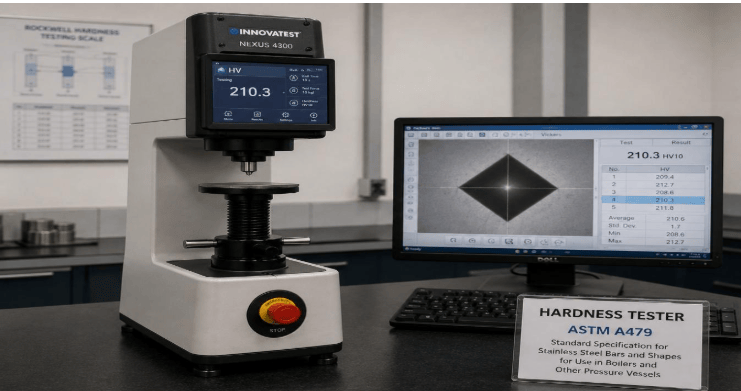
    The image shows a hardness tester measuring the hardness of a stainless-steel sample for ASTM A479.
    ASTM A479 Hardness Tester 

    Analysis Results and Interpretation 

    • ASTM A479 specifies requirements for evaluating the chemical composition, mechanical properties, heat treatment condition, and hardness of stainless steel bars and shapes.
    • The typical units for reporting test results include weight percent (wt.%) for chemical composition, megapascals (MPa) or pounds per square inch (psi) for yield and tensile strength, percentage (%) for elongation, Brinell (HBW) or Rockwell (HRB / HRC) or other appropriate hardness scales depending upon the specified grade. 
    • Materials that satisfy all specified chemical composition, mechanical property, heat treatment, hardness, and inspection requirements are considered acceptable under ASTM A479.
    • Mill test reports (MTRs) are issued to document the chemical composition, mechanical properties, heat-treatment condition, and inspection results for each production lot.

    Link to ASTM A479

    Read more

    FAQ

    Where can I get the astm a479 tested?
    You can share your astm a479 testing requirements with MaTestLab. MaTestLab has a vast network of material testing laboratories, spread across the USA and Canada. We support your all material testing needs ranging from specific astm a479 test to various testing techniques.
    Please contact us for a detailed quote for your astm a479 testing needs. Cost incurred to carry out different astm a479 testing methodology depends on the type of raw material; number of samples, coupons, or specimens; test conditions, turn around time etc. Costs of some ASTM testing methods start from $100 and the final value depends upon the factors listed above. Please contact us for the best and latest prices.
    The required number of samples or specimens should comply with the procedure given in the astm a479 standard. However, the MaTestLab operations team can assist you for your special requirements once you share your testing details with us.
    MaTestLab has a vast testing laboratory network, hence we bring you the best testing facilities in a cost-effective way. We offer considerable discounts (15-20%) to our returning customers based on test volume and frequency.
    The turnaround time for astm a479 test methodology depends upon the test procedure mentioned in the standard test document. However, we at MaTestLab understand your research requirements and hence try to get your test completed within the least possible time.
    Suyog Kamble
    About Author
    Suyog Kamble
    Suyog Kamble is an Operations Associate at MaTestLab Inc. and holds a postgraduate degree in Organic Chemistry.
    Testimonials
    Real results
    Engineers trust us with what matters most
    Start Your Testing
    Project Today
    Define your requirements and get access to
    specialized laboratories ready to deliver results
    Partners with us
    Clients
    Vendors
    Process for testing
    • STEP 01

      You share your testing requirements

    • STEP 02

      You share your sample(s)

    • STEP 03

      We deliver your test reports

    Get your testing done

    Let us known your testing requirements and we will be right back with a solution.

      Let us root for each other. Collaborate to grow, expand, and accelerate our businesses.

      Partner with us

        Contact Us

        Discover more from MaTestLab

        Subscribe now to keep reading and get access to the full archive.

        Continue reading