ASTM A29 Standard Specification for General Requirements for Steel Bars, Carbon and Alloy, Hot-Wrought

    What is ASTM A29? 

    ASTM A29 is a standard specification that covers a group of general requirements for the various types of carbon and alloy steel bars covered under several different ASTM specifications, including hot-rolled carbon steel bars, cold-finished carbon steel bars, hot-rolled alloy steel bars, and cold-finished alloy steel bars, unless otherwise specified in the purchase order or in an individual specification. This specification describes hot-wrought steel bars as steel bars made by hot working, and sets out general requirements relating to chemical composition, manufacturing practice, mechanical properties, inspection and marking. ASTM A29 (Standard Specification for General Requirements for Steel Bars, Carbon and Alloy, Hot-Wrought) is used as a baseline specification for reference by other bar-grade specifications, and provides consistent base requirements for a wide variety of round, square, flat, hexagon, and octagon bar shapes. This specification applies to U.S. Department of Defense agencies and follows principles set forth by the Technical Barriers to Trade Committee of the World Trade Organization. 

    Read more

    Get Certified ASTM A29 Testing for Reliable Hot-Wrought Steel Bar 

    Basic raw material characteristics matter for all grades and shapes of hot-wrought carbon and alloy steel bars, as they serve a wide range of structural, mechanical, and industrial applications. Certified ASTM A29 testing ensures that the chemical composition, size, and manufacturing of a steel bar product conform to the general requirements specified by this standard. Accredited laboratory testing for mill certification, incoming material inspection, and quality assurance programs for steel bar manufacturers and fabricators. Certified ASTM A29 testing allows the purchaser to ensure that the bar stock delivered to production will satisfy the common requirements that underlie the individual bar stock ASTM A29 specification. 
    What is the Scope of ASTM A29?

    ASTM A29 provides a set of common requirements that apply to carbon and alloy steel bars in each of some individual ASTM specifications unless so designated in the specific ASTM purchase order or individually specified in a separate ASTM specification. This specification applies to hot-rolled carbon steel bars, cold-finished carbon steel bars, hot-rolled alloy steel bars, and cold-finished alloy steel bars, and is applicable in any other ASTM specification that requires this specification or parts of it. The scope of ASTM A29 includes:  

    Read more

    • Material type: Hot-wrought carbon and alloy steel bars (hot-rolled and cold-finished). 
    • Purpose: To establish common general requirements to be applied to several individual steel bar specifications. 
    • Properties measured: Grade-dependent (Chemical composition: carbon, manganese, phosphorus, sulfur, silicon, nickel, chromium, and molybdenum). 
    • Method: Heat analysis and product analysis of representative bar material. 
    • Result: Chemical composition results vs. requirements for the applicable grade. 
    • Test Limitations: This specification applies unless the purchase order or an individual specification states otherwise. 
    • Environmental conditions: Bar shape, dimensional tolerance, and heat treatment condition affect compliance with the general requirements. 
    • Applications: Structural bar stock procurement, mechanical component manufacturing, forging stock supply, and general engineering bar applications.

    What are the Uses of ASTM A29 Specification?

    ASTM A29 testing is used to ensure that hot-wrought carbon and alloy steel bars conform to the common general requirements for individual grade specifications. Purchasers and fabricators then use the results to confirm material suitability before further processing. This standard-

    • Sets standard chemical composition specifications for carbon and alloy steel bars.
    • Specifies dimensional coverage of rounds, squares, round-cornered squares, flats, hexagons and octagons.
    • Indicates heat analysis verification and product analysis verification of carbon steel bar grades.
    • Provides heat analysis and product analysis verification of alloy steel bars.
    • Gives a consistent baseline to be referenced to various individual ASTM bar specifications.
    • Supports the mills and buyers with general inquiries regarding requirements not covered by a particular specification. 

    What Materials Can Be Tested Under ASTM A29? 

    ASTM A29 tests hot-wrought carbon and alloy steel bars in a variety of specified sizes and in the form of round, square, and round-cornered square, flat, round-cornered flat, hexagon, and octagon. The specification applies to hot-rolled carbon steel bars, cold-finished carbon steel bars, hot-rolled alloy steel bars, and cold-finished alloy steel bars, unless otherwise specified in the purchase order or individual specification. 

    Why is ASTM A29 Important? 

    ASTM A29 provides a common baseline of requirements to which individual steel bar specifications refer, thereby fostering consistency among manufacturers and grades. If there were no common base to reference chemical composition, manufacturing practices, and inspection needs, buyers would deal with varying expectations for carbon and alloy steel bars when placed under different individual specifications. The general requirements of this specification contribute to a predictable performance of hot-rolled steel bars for structural and mechanical use. Manufacturers and purchasers use this standard to maintain consistent quality expectations across the many individual bar-grade specifications that invoke it. 

    ASTM A29 Equipment and Sample Preparation Guide

    ASTM A29 requires standard chemical analysis equipment for heat and product analysis and dimensional measuring tools suitable to the shape of the bar being tested. Technicians select representative bar samples from each heat or lot for verification. 

    Read more

    Sample and Specimen DetailsTechnicians test representative samples of carbon and alloy steel bars, hot-wrought, prepared for controlled mechanical, chemical, and grain size testing.
    Specimen PreparationTechnicians machine test specimens from the steel bars for mechanical testing. They prepare samples for chemical analysis and grain size determination.
    Specimen DimensionsTechnicians select specimen size according to the bar shape and dimension range specified, such as rounds from 7/32 to 10.0 in. (5.5 to 250 mm) or flats up to 8 in. (200 mm) in width with a maximum thickness of 4 in. (100 mm). 
    InstrumentationTechnicians use a universal testing machine for mechanical testing, chemical analysis equipment for composition determination, grain size testing equipment, and dimensional measurement tools.

    Testing Procedures and Requirements for ASTM A29  

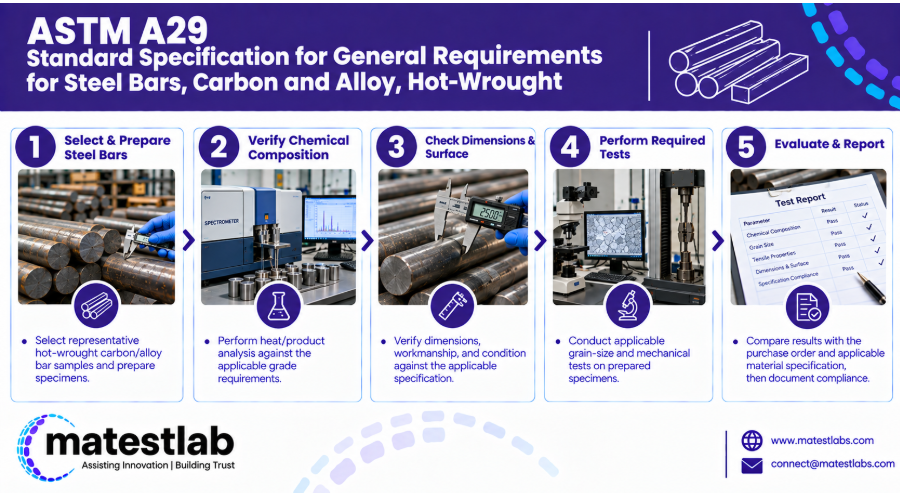
    ASTM A29 testing confirms that hot-wrought carbon and alloy steel bars meet the common general requirements referenced by their individual grade specification. Laboratories perform heat analysis and product analysis to verify chemical composition against the applicable grade’s requirements. This specification includes standards such as ASTM A108, A304, A311, A321, A322, A370, A434, A499, A575, A576, A663, A675, A689, A696, A700, A739, A751, E29, and E112.

    Read more

    Chemical Composition Analysis Technicians perform heat and product analyses to determine the composition for carbon, manganese, phosphorus, and sulfur in carbon steels. For alloy steels, they also determine silicon, nickel, chromium, and molybdenum.
    Grain Size Test Technicians perform grain size testing to verify conformity to specified grain size requirements 
    Mechanical Testing Technicians perform mechanical tests on steel test specimens to determine mechanical properties 
    Property Verification Technicians compare test results to specified requirements for the applicable material specification. 
    Result Reporting Laboratories report chemical composition, grain size, and mechanical property values. Values are reported in either SI units or inch-pound units, used independently  

    ASTM A29 Testing Process and Data Collection

    The verification process starts with the analysis of the heat during the steelmaking process for heat analysis, which means that the chemical composition of the steel is checked during the heatmaking process using a sample of the heat. Technicians then undertake product analysis to ensure that the material meets composition requirements in the final product. The operator checks the measured content of carbon, manganese, phosphorus, sulfur, and, for alloy grades, silicon, nickel, chromium, and molybdenum against the requirements for the applicable grade. Technicians also check the bar’s dimensions against the shape and size requirements, such as rounds, square, flats, hexagons, or octagons. Laboratories use this data to facilitate certification for the mill, to perform incoming material testing, and to support quality assurance programs. 

     The image shows a technician performing chemical composition analysis on a hot-wrought carbon steel bar sample as per ASTM A29
    ASTM A29 Chemical Analysis of a Hot-Wrought Steel Bar Sample

    Common Challenges and Troubleshooting

    Common issues in ASTM A29 verification are inconsistent heat sampling, variance in heat-to-product analysis, and dimensional measurement error between bar shapes. These issues cause conflicts over grade compliance between the purchaser and the producer. Inconsistent sampling during heat analysis produces results that do not represent the actual composition of the finished bar. If there is any mismatch between heat and product analysis, this means segregation or contamination in the processing stage. Measurement errors occur between different bar shapes, rounds, squares, or flats, which result in an incorrect dimensional compliance determination. These are minimized by proper sampling, consistent analytical technique, and calibrated dimensional measuring tools. 

    ASTM A29 Analysis Results and Interpretation

    This report summarizes the tested hot-rolled steel bar chemical composition and dimensional verifications. These results are compared with the requirements set out in the relevant individual grade specification.

    Read more

    • The laboratory provides heat analysis reports for the carbon, manganese, phosphorus, sulfur, silicon, nickel, chromium, and molybdenum levels in alloy steel bar grades.
    • The laboratory provides product analysis results that are used to verify the compliance of the product’s composition at the point of sale.
    • The results determine if the measured bar conforms to the dimensional specifications of its geometry: rounds, squares, flats, hexagons, or octagons.
    • The laboratory records which individual ASTM specification governs the tested material. 
    • Laboratories achieve reliable and comparable results from heat to heat and lot to lot when the sampling and testing protocol is consistent. 

    Link to ASTM A29 

    FAQ

    What bar shapes does ASTM A29 cover?
    This specification covers rounds, squares, round-cornered squares, flats, hexagons, and octagons of hot-wrought carbon and alloy steel bars within a set of specified dimensions.
    Heat analysis verifies the chemical composition of a sample taken during steel production, while product analysis verifies composition from a sample taken from the finished bar to confirm compliance carried through to the final product.
    Yes, this specification refers to hot-rolled carbon steel bars, cold-finished carbon steel bars, hot-rolled alloy steel bars, and cold-finished alloy steel bars, but does not include requirements specific to stainless steel bars, which are covered by other specifications.

    Updated on September 25, 2026

    Divakar Shukla
    About Author
    Divakar Shukla is an Electrical and Electronics Engineer specializing in the convergence of embedded systems architecture, industrial automation, and applied artificial intelligence.
    Know More
    Testimonials
    Real results
    Engineers trust us with what matters most
    Why Choose Matestlab?
    Matestlab is a unified testing services partner based in the USA. Matestlab offers raw material and product testing services through accredited, expert laboratories primarily based in the USA. Matestlab supports physical, thermal, chemical, electrical, mechanical, environmental, and characterization testing needs through its global network of 2200+ accredited testing laboratories. Matestlab's in-house materials science experts curate and design comprehensive testing programs matched to the sample material and specific testing need, with regulatory requirements and confidentiality in mind.

    If you are looking for a managed and trusted testing partner to achieve your research goals, feel free to schedule a meeting with us or send us a request at connect@matestlabs.com to learn more about our services. For a quick quote, call us at (302)244-7710. We are happy to serve you.
    Start Your Testing
    Project Today
    Define your requirements and get access to
    specialized laboratories ready to deliver results
    Partners with us
    Clients
    Vendors
    Process for testing
    • STEP 01

      You share your testing requirements

    • STEP 02

      You share your sample(s)

    • STEP 03

      We deliver your test reports

    Get your testing done

    Let us know your testing requirements and we will be right back with a solution.

      Let us root for each other. Collaborate to grow, expand, and accelerate our businesses.

      Partner with us