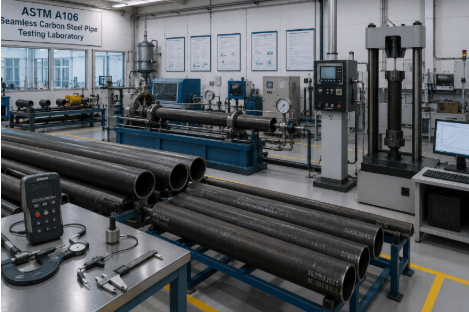
ASTM A106 specifies the requirements for seamless carbon steel pipes intended for high-temperature and high-pressure applications. The standard defines the materials, dimensions, and testing requirements needed to ensure reliable performance in demanding industrial environments. The scope includes:
- Designates seamless carbon steel nominal wall pipe for high-temperature applications.
- Seamless carbon steel pipe (Grades A, B, and C).
- Adaptable for bending, welding, and flanging.
- Sets specifications for chemical composition and mechanical properties.
- Includes hydrostatic testing and optional nondestructive examination.
- Usable for power plants, refineries, petrochemical facilities, and industrial piping systems.
What are the Uses of ASTM A106?
ASTM A106 testing helps manufacturers verify that seamless carbon steel pipes meet the performance requirements for critical industrial applications. The test results support product certification, quality control, and safe operation in pressure-containing systems. Common applications include:
- Steam distribution systems
- Power generation plants
- Piping systems used in oil and gas processing facilities
- Petroleum refineries
- Chemical processing plants
- Boiler piping systems
- Heat exchangers
- Pressure vessels
- Industrial process piping
- High-pressure fluid transportation
What Materials Can Be Tested Under ASTM A106?
ASTM A106 applies to seamless carbon steel nominal wall pipe designed for use at extended temperatures. Typical applications include steam lines, boiler piping, refinery piping, petrochemical plants, power plants, heat exchangers, condensate systems, and high-temperature process piping.
Why is ASTM A106 Important for High-Temperature Service?
ASTM A106 specifies minimum mechanical properties, dimensional and testing requirements for seamless carbon steel pipe intended for high-temperature service. The specification establishes testing requirements to help verify compliance and reduce the risk of material defects.
Common Challenges and Troubleshooting
Typical problems encountered are hydrostatic leaks, surface cracking, internal laminations, insufficient tensile strength, unsuitable chemical composition, and not enough thickness in the wall. These problems can be reduced by effective manufacturing controls, properly calibrated inspection equipment, nondestructive testing as appropriate, and quality assurance.
ASTM A106 Testing Process and Data Collection
The testing process starts with a representative sample of pipes taken from each lot of production. The dimensional measurements are performed before the tensile, flattening, bend, hydrostatic, hardness, and visual examinations of the specimens. Optional ultrasonic or electromagnetic examinations are used to detect internal or surface discontinuities without damaging the pipe.