Introduction
Tack-Free Time (TFT) is a critical performance characteristic of adhesives, coatings, and sealants, representing the time it takes for a surface to cure and no longer be tacky. It is particularly important in building, automotive, and industrial coatings, where initial surface cure affects ease of handling, resistance to dirt and dust, and long-term durability. Specific testing standards commonly determine TFT, such as ASTM C679 for elastomeric sealants and ASTM D2377 for caulking compounds. These tests mimic practical scenarios by determining the time a material remains vulnerable to contamination or damage.
TFT measurement is crucial for determining the right time to apply, enhancing product performance, and guiding formulation development. It also aids in quality assurance and meeting performance standards under various conditions.
Scope
- Determines the tack-free (surface cure) time of adhesives, coatings, and sealants
- Applies to both single- and multi-component systems
- It covers elastomeric sealants, caulking compounds, and coating films
- Suitable for self-leveling and non-sag materials
Principle
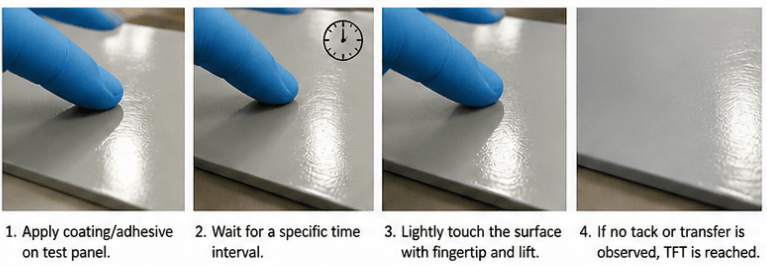
The TFT test measures how a material surface changes from tacky (sticky) to non-tacky during curing. The analyst places a sample under controlled conditions and lightly touches the sample surface with a reference material, such as a polyethylene strip or probe, at certain intervals. If the surface does not stick or transfer material, it is tack-free. This duration from the initial coating defines the tack-free time. This method identifies the surface curing characteristics of the material and its resistance to further contamination, deformation, or damage.
Test Procedure Overview
TFT testing involves applying the adhesive or coating to a substrate, conditioning it under controlled conditions, and periodically checking the surface until it becomes non-sticky. The test specimen consists of a freshly prepared and well-mixed sample of adhesive, coating, or sealant. The analyst applies a uniform layer of this material onto a specified test panel, such as a metal plate or glass substrate, according to standard specifications. Tack-Free Time reported in minutes (min) or hours (h).
Significance
TFT is an important test to evaluate whether adhesives and coatings are suitable for application and curing. It tells you how rapidly a material becomes resistant to dirt, dust, and touch, which is important for maintaining a high-quality surface. TFT is a quality control indicator to compare different batches and predict performance. It is also used to establish safe touch time, recoat time, and maximum exposure. TFT is also related to surface cure and, therefore, can be used as a measure of formulation efficiency and application in various environmental conditions.
Application
The construction, automotive, aerospace, electronics, and coatings industries apply Tack-Free Time tests. In the construction industry, these tests guarantee that sealants and caulking materials resist contamination immediately after application. The automotive and aerospace industries use TFT to assess the strength and quick-setting properties of coatings and adhesives. In electronics and furniture manufacturing, TFT testing enhances coating efficiency and yield. Additionally, TFT results guide product development efforts to formulate products with faster curing or improved surface properties based on their intended use.