

Introduction to Tempered Glass Identification
To make tempered glass, manufacturers heat it to a very high temperature and then cool it at a very high rate to increase its strength and safety. In industries, they extensively use tempered glass in windows, doors, car glass, and electronic devices. Nonetheless, manufacturers and inspectors should be keen to distinguish between tempered and normal glasses, particularly in quality assurance, installation, and compliance checks. The quality identification methods will help the manufacturers and the inspectors to identify the type of glass, eradicate misuse, and enforce the international safety standards.
Why is identifying tempered glass important?
It is important to detect tempered glass, as it directly affects the safety and performance of glass products. Applications of non-tempered glass in certain settings where tempered glass is needed may result in serious problems, such as breakages and injuries. Appropriate identification meets the requirements of safety rules, averts structural failures, and ensures the reliability of products in business sectors like construction and motor vehicle production.
Instrumentation
Testing of tempered glass entails specialized equipment and materials used to assess the pattern of stress, strength, and fracture behavior. Standard tools are a polarised light source, strain viewers, impact testing systems, and optical inspection devices.
Key Testing Standards
- ASTM C1048 – Standard Specification of Flat Glass, Heat-treated.
- ASTM C1172 – Laminated Architectural Flat Glass. International Organization for Standardization.
- ISO 12543 – Laminated Glass and Safety Glazing. European Committee on Standardization.
- EN 12150 – Safety Glass Thermally Toughened.
Scope of Tempered Glass Identification Tests
- Determines whether the tempered or annealed glass.
- Adhere to safety standards in glass testing.
- Assess the mechanical strength and durability of glass.
Principle and Methodology of Identification Tests
Tempered glass identification relies on physical, optical, and mechanical characteristics. Among the most popular non-destructive techniques is the observation of stress patterns under polarized light. It has stress fringes because of compressive forces within it. Fracture analysis is another method. During testing, tempered glass produces blunt fragments that are small as compared to annealed glass, which produces sharp fragments. Impact resistance testing measures the strength of the glass in controlled conditions.
Reliable Methods
1. Polarized Light Test
The patterns of stress are unique to tempered glass using polarized light or a strain viewer. These can be seen as dark lines or fringes on the surface.
2. Edge Inspection
Tempered glass is normally finished with smooth edges because it is pre-processed before tempering.
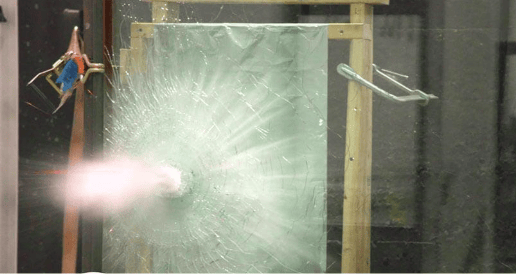
3. Fragmentation Test (Destructive)
Tempered glass breaks into small, cube-like pieces when it breaks, rather than sharp pieces.
Strengths
These testing procedures give precise identification and safety standards, and contribute to the quality of products. Polarized light testing is a non-destructive method that can be used to inspect materials briefly and, therefore, is best suited for industrial settings.
Uses
Tempered glass testing is applicable in construction, automobile manufacturing, electronics, and furniture. It ensures that the safety glass is well installed in buildings, vehicles, and consumer products.


