Last updated 12th March 2026

ASTM D1784 Standard Classification System and Basis for Specification for Rigid PVC and CPVC Compounds

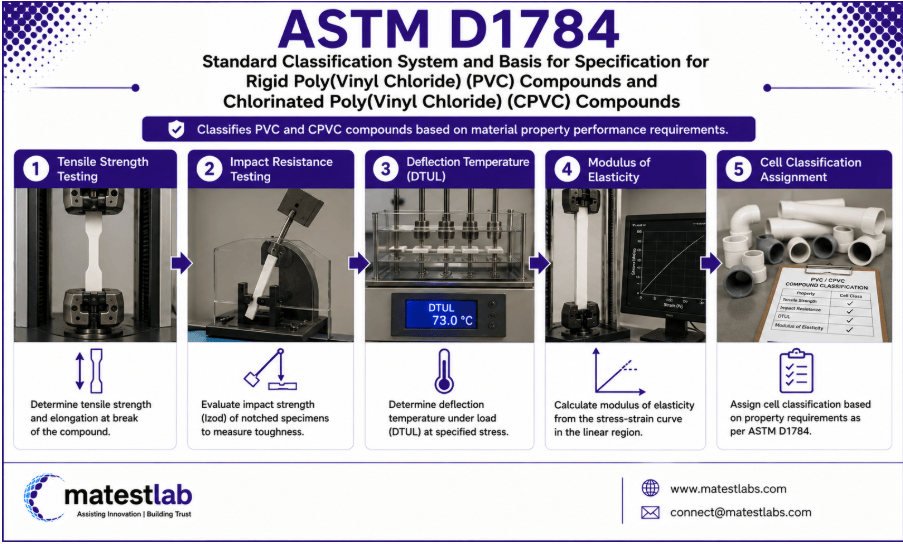
ASTM D1784 is a way to identify and specify the compounds of Rigid Poly (Vinyl Chloride) (PVC) and Chlorinated Poly (Vinyl Chloride) (CPVC) based on their physical, mechanical, and thermal qualities. As a result, the standards set the basic requirements for tensile strength, Izod impact resistance, deflection temperature, and flammability. It conducts compound in cell classification, where each cell digit matches a specific property range. Manufacturers, engineers, and purchasing professionals rely on ASTM D1784 to ensure compatibility between compound properties and application requirements. Standard piping, construction, and equipment for material verification and quality assurance are fundamental in manufacturing industries.

Read More

GET STARTED

    Share your requirements *

    Provide your contact information *

    ASTM D1784 Introduction

    PVC and CPVC are thermoplastic materials that are widely used in pressure piping, electrical, drain, and chemical transport systems due to their excellent mechanical strength, chemical resistance, and process capacity. ASTM D1784 serves as a universal classification system that allows producers and users to match material characteristics with intended applications. The classification uses a six-conductive “cell classification” to represent the required performance metrics. Each digit corresponds to the exclusive test results for the effect resistance, tensile power, modulus of elasticity, deflection temperature, flammability, and weather. It also creates the basis for multiple product specifications by connecting standard compound performance to regulator and application requirements. By clearly defining these properties, the ASTM D1784 enables standardized material selection and simplifies communication in the supply chain.

    Get Certified ASTM D1784 for Material Compliance

    ASTM D1784 certification is used to ascertain that rigid PVC or CPVC compounds comply with performance requirements. Certification facilitates regulatory conformity and interchangeability and builds trust between contractors, engineers, and manufacturers.

    Service NameRemarks
    ASTM D1784 Testing
    Contact US

    ASTM D1784 Classification System and Requirements

    Tensile Strength TestConducted using a universal testing machine, specimens are pulled at a controlled rate until failure to measure maximum stress.
    Deflection Temperature (HDT)The sample is subject to 264 psi under heat, at which point the temperature at which the sample deforms by 0.25 mm is registered.
    Izod Impact ResistanceNotched specimens are impacted with the pendulum arm; the energy applied is in ft-lb/in of impact toughness.

    Scope of ASTM D1784

    • It offers a numerical descriptive characterization of performance attributes.
    • It promotes specifications of products in pipes, fittings, and molded products.
    • It is used to provide consistency and comparability amongst materials of other manufacturers.

    ASTM D1784 Equipment and Sample Preparation

    Tensile Specimen PreparationDogbone-shaped specimens are die-cut with dimensions of 165 mm in length, 13 mm in width, and 3.2 mm in thickness.
    HDT Test SpecimensFlat bars of dimensions 127 mm × 12.7 mm × 3.2 mm are prepared and conditioned at 23°C for 40 hours.
    Izod Impact Bars63.5 mm × 12.7 mm × 3.2 mm notched bars are machined; the V-notch is centered and 2.54 mm deep.

    Applications of ASTM D1784

    • Water distribution piping systems are made of plastic.
    •  Fittings and piping in industrial processes.
    • Electrical conduit systems.
    • Structural plastic components, profiles, and sheets.
    • Material purchase and engineering specifications.

    ASTM D1784 Common Challenges and Troubleshooting

    The typical problems are the lack of proper preparation of the specimen, changes in processing conditions, and inappropriate measurement of the property. Because the category is formed under the influence of various mechanical and thermal tests, any variation in the test results can lead to the misdesignation of cells. Strict compliance with the test standards and calibration enhances reliability.

    ASTM D1784 Aggregate Testing Technique, Process, and Data Collection

    Sampling of materials is done, and they are subjected to the mentioned ASTM mechanical and thermal test procedures. The property values that have been measured are matched within the classification table with defined ranges. Depending on these values, many cell classifications are given by a multi-digit number. All the test data and results of classification are recorded to be specified and compliant.

    ASTM D1784 Analysis Results and Interpretation

    The larger the number of the cell classification, the greater the mechanical strength, stiffness, impact resistance, or thermal performance, depending on the category of the numbers. The classification is applied by engineers so that the chosen compound is of the required level of performance in a certain application. If the test results are not within the required ranges, reformulation or reprocessing might be necessary to bring about compliance.

    ASTM D1784 Problem & Solution

    Lack of consistency in the description of materials and variation of properties may result in the inappropriate choice of materials, failure of the product, and non-compliance with regulatory requirements. ASTM D1784 offers a classification of rigid PVC and CPVC compounds, which classifies performance based on measurable criteria on which to classify the materials to ensure reliable material selection and specification.

    Factors to Consider for ASTM D1784

    Speed
    The decision-making process relies on the completion of various tests on the property, which can take a considerable amount of laboratory time.

    Expertise
    Laboratory staff with extensive experience are needed to carry out mechanical and thermal property testing to an acceptable level of accuracy and read classification tables correctly.

    Cost
    ASTM D1784 can help to avoid expensive mismatches of materials, product failure, and performance problems in pipeline systems that are essential in critical applications.

    FAQ's

    Where can I get the astm d1784 tested?

    You can share your astm d1784 testing requirements with MaTestLab. MaTestLab has a vast network of material testing laboratories, spread across the USA and Canada. We support your all material testing needs ranging from specific astm d1784 test to various testing techniques.

    How much do I need to pay for the astm d1784 test?

    Please contact us for a detailed quote for your astm d1784 testing needs. Cost incurred to carry out different astm d1784 testing methodology depends on the type of raw material; number of samples, coupons, or specimens; test conditions, turn around time etc. Costs of some ASTM testing methods start from $100 and the final value depends upon the factors listed above. Please contact us for the best and latest prices.

    How many samples are required for astm d1784?

    The required number of samples or specimens should comply with the procedure given in the astm d1784 standard. However, the MaTestLab operations team can assist you for your special requirements once you share your testing details with us.

    How much discount can I get on the astm d1784 test?

    MaTestLab has a vast testing laboratory network, hence we bring you the best testing facilities in a cost-effective way. We offer considerable discounts (15-20%) to our returning customers based on test volume and frequency.

    How many days will it take to complete the astm d1784 test?

    The turnaround time for astm d1784 test methodology depends upon the test procedure mentioned in the standard test document. However, we at MaTestLab understand your research requirements and hence try to get your test completed within the least possible time.

    Where can I get the astm d1784 tested?

    You can share your astm d1784 testing requirements with MaTestLab. MaTestLab has a vast network of material testing laboratories, spread across the USA and Canada. We support your all material testing needs ranging from specific astm d1784 test to various testing techniques.

    POPULAR TESTS
    ONE-STOP FOR ALL
    MATERIAL TESTING NEEDS
    MaTestLab Inc. offers accessible, quick, and affordable material testing, product testing, and failure analysis services. We support your on-demand testing and expert consultation needs with the help of our extensive network of material testing laboratories situated in the US and other parts of the world.
    MATERIAL TESTING
    We offer destructive and non-destructive tests over a range of mechanical, electrical, chemical, thermal, optical, corrosion, radiation, and biological testing methodologies defined by ASTM, ISO and other organizations.
    PRODUCT TESTING
    We help you evaluate and ensure your product quality and performance with standard and custom-made testing solutions. All the tests are done at well-equipped testing laboratories using standard testing methods for best output and satisfaction.
    FAILURE ANALYSIS
    Failure analysis ensures high levels of quality in every manufacturing process. We help you with getting the best failure or root cause analysis to determine the cause of the failure. The results help you identify means to prevent failure recurrences.
    Process for testing
    • STEP 01

      You share your testing requirements

    • STEP 02

      You share your sample(s)

    • STEP 03

      We deliver your test reports

    Get your testing done

    Let us known your testing requirements and we will be right back with a solution.

      Let us root for each other. Collaborate to grow, expand, and accelerate our businesses.

      Partner with us

        close

        Please share your requirement with us

          ×

          Contact Us

          Discover more from MaTestLab

          Subscribe now to keep reading and get access to the full archive.

          Continue reading