ASTM F594 Standard Specification for Stainless Steel Nuts

    What is ASTM F594?

    ASTM F594 is a standard specification for stainless steel nuts 0.25 to 1.50 in. in nominal diameter made from alloys intended for general corrosion resistance service. The specification classifies the alloys into seven alloy groups and establishes requirements for chemical composition, mechanical tests, and corrosion resistance tests. Engineers and buyers use ASTM F594 (Standard Specification for Stainless Steel Nuts) to specify, purchase, and verify stainless steel nuts. Analysts compare test results with the requirements of the selected alloy group. For related iron and steel product testing, engineers can evaluate material properties such as strength and corrosion resistance.

    Read more

    Get Certified ASTM F594 Testing for Reliable Stainless Steel Nut Performance

    Stainless steel nuts are used in applications that require general corrosion resistance; therefore, a nut made of an incorrect alloy or an inappropriate condition may lead to early failure. ASTM F594 provides buyers and manufacturers with one specification for alloy groups, chemical composition, mechanical properties, and corrosion resistance. Test results demonstrate that a particular lot of stainless steel nuts meets the specified requirements before being placed in service. Optional supplementary requirements apply when the manufacturer and the purchaser agree on them.

    What is the Scope of the ASTM F594 Standard?

    ASTM F594 is a standard specification for stainless steel nuts, 0.25 to 1.50 in. nominal diameter, for service that requires a general level of corrosion resistance. The standard defines seven classes of alloys. The standard measurement system is the inch-pound system, and SI values in parentheses are provided for information only.

    Read more

    The scope of ASTM F594 includes:

    • Material type: Stainless steel nuts from 0.25 to 1.50 in. nominal diameter, in seven alloy groups.
    • Purpose: Specification of requirements for stainless steel nuts used where general corrosion resistance is needed.
    • Properties evaluated: Chemical composition, mechanical properties, and corrosion resistance.
    • Testing method: Chemical tests, mechanical tests, and corrosion resistance tests that confirm conformance to the requirements of the alloy group.
    • Results: Observed or calculated values are rounded in accordance with ASTM E29 when determining conformance with specified limits.
    • Test limitations: The specification covers nuts only, and bolts, hex cap screws, and studs fall under ASTM F593. Supplementary requirements apply only when the manufacturer and the purchaser agree.
    • Use conditions: Technicians work in inch-pound units, with SI values given for information only, and round values before comparing them with the limits.
    • Applications: Ordering, quality control, and acceptance of stainless steel nuts for corrosion-resistant service.

    What are the Uses of ASTM F594 Testing?

    ASTM F594 testing helps buyers and manufacturers confirm that stainless steel nuts match the alloy group and requirements they ordered. Engineers then use the results to accept or reject a lot.

    • Confirms conformance of stainless steel nuts from 0.25 to 1.50 in. nominal diameter.
    • Verifies the chemical content of the selected alloy group.
    • Verifies the mechanical properties of the nuts.
    • Verifies corrosion resistance for general service.
    • Applies optional supplementary requirements when the manufacturer and the purchaser agree.
    • Supports conformance evaluation by applying the specified rounding practice before comparing results with acceptance limits.

    Which materials can be tested under ASTM F594?

    ASTM F594 covers stainless steel nuts in seven alloy groups identified by alloy and condition and in sizes of 0.25 to 1.50 in. nominal diameter. This specification is suitable for nuts that are designed to provide service requiring general corrosion resistance. Hex cap screws, bolts, or studs are not covered by this specification but are specified by ASTM F593. Before testing, a technician identifies the alloy group and condition of the nuts and the requirements that apply to that group.

    Why is ASTM F594 Important?

    ASTM F594 is important because stainless steel nuts come in different alloys and conditions, and each one behaves differently in service. The specification gives buyers and manufacturers a clear standard for the requirements of each alloy group. It also sets a standard rounding practice for observed and calculated values, so two analysts using the same data compare the same number against the same limit. In addition, supplementary requirements are optional, and when the manufacturer and the purchaser agree on them, they allow a more extensive examination of the nuts.

    ASTM F594 Equipment and Sample Preparation Guide

    ASTM F594 uses stainless steel nuts from seven alloy groups and the equipment needed for chemical, mechanical, and corrosion resistance tests. Technicians select the tests according to the alloy group and the requirements the purchaser specifies.

    Read more

    Sample DetailsEngineers select stainless steel nuts from one of the seven alloy groups. They identify the alloy and condition listed for that group.
    Sample PreparationTechnicians prepare the nuts for the chemical, mechanical, and corrosion resistance tests that the selected alloy group requires. They add any supplementary requirements that the manufacturer and the purchaser agree on.
    Sample DimensionsThe specification covers nuts from 0.25 to 1.50 in. nominal diameter. Inch-pound units are the standard, and SI values in parentheses serve for information only.
    InstrumentationTechnicians use equipment suitable for the required chemical, mechanical, and corrosion resistance tests for the selected alloy group.

    Testing Procedures and Requirements for ASTM F594

    This specification sets the alloy groups and the chemical, mechanical, and corrosion resistance requirements for stainless steel nuts. Technicians refer to other ASTM documents, including ASTM F593 for the bolts, hex cap screws, and studs that pair with these nuts, and ASTM E29 for rounding observed and calculated values. The ASTM F594 specification comprises the following requirements. 

    Read more

    Alloy Group SelectionEngineers select one of the seven alloy groups, which the specification lists by alloy and condition. The nuts range from 0.25 to 1.50 in. nominal diameter and serve where general corrosion resistance is needed.
    Chemical and Mechanical TestsAnalysts perform chemical tests to confirm the alloy composition. They also perform mechanical tests to confirm the requirements of the selected group.
    Corrosion Resistance TestsAnalysts perform corrosion resistance tests to confirm that the nuts meet the requirements for general service. The results link back to the alloy group under evaluation.
    Supplementary RequirementsManufacturers and purchasers agree on any supplementary requirements. These requirements apply only when both parties accept them.
    Compliance RoundingAnalysts round observed or calculated values in accordance with ASTM E29 when determining conformance with specified limits.

    ASTM F594 Testing Process and Data Collection

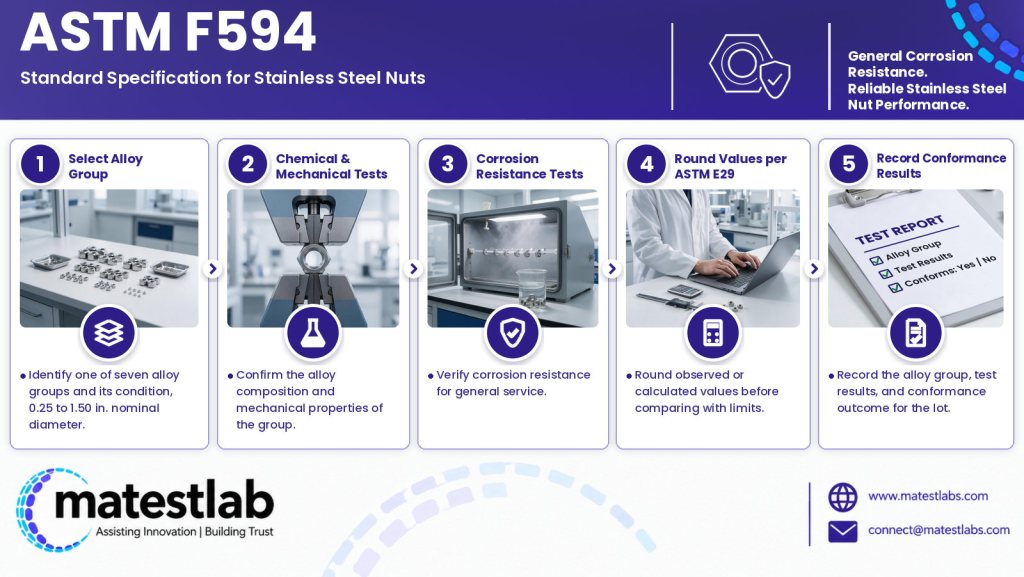
    Engineers identify the alloy group and condition of the stainless steel nuts and confirm the nominal diameter, which ranges from 0.25 to 1.50 in. Technicians prepare the nuts for the required tests. Analysts carry out the required chemical, mechanical, and corrosion resistance tests, including any supplementary tests agreed upon by the manufacturer and purchaser. Analysts then apply ASTM E29 rounding when determining whether the results meet the specified limits. Analysts record the alloy group, test results, and conformance outcome for the lot.

     The image shows the ASTM F594 sequence, from selecting the alloy group through chemical, mechanical, and corrosion resistance tests, rounding of values, and recording of conformance results.
    ASTM F594 Conformance Testing Sequence for Stainless Steel Nuts

    Common Challenges and Troubleshooting

    Accurate ASTM F594 results depend on the matching of the nuts to the correct alloy group and condition. Mixing groups can lead to a nut that passes one set of limits and fails another. Teams also read the unit statement carefully, as the standard uses inch-pound units and provides SI values for information only. Rounding errors can affect conformance decisions, so analysts apply the specified rounding practice consistently when comparing results with the applicable limits. Supplementary requirements are excluded from the evaluation unless the manufacturer and the purchaser have agreed to them.

    ASTM F594 Analysis Results and Interpretation

    ASTM F594 reports whether stainless steel nuts conform to the requirements of their alloy group. The analyst compares each rounded value with the limit that applies to the group.

    Read more

    • The analyst reports the alloy group and condition tested.
    • The analyst reports chemical, mechanical, and corrosion resistance results for the lot.
    • Engineers compare values rounded in accordance with ASTM E29 with the applicable specification limits.
    • Engineers apply supplementary requirements only when both parties agree to them.
    • Engineers read dimensions in inch-pound units, with SI values given for information only.

    Link to ASTM F594

    FAQ

    What nut sizes does ASTM F594 cover?
    ASTM F594 covers stainless steel nuts from 0.25 to 1.50 in. nominal diameter. The nuts serve in applications that need general corrosion resistance.
    ASTM F594 includes seven alloy groups. The specification lists each group by alloy and condition.
    ASTM F594 applies supplementary requirements only when the manufacturer and the purchaser agree on them. They stay optional otherwise.
    ASTM F594 uses inch-pound units as the standard. It gives SI values in parentheses for information only.

    Updated on October 22, 2026

    Davis Scott
    About Author
    Davis Scott is an Electrical and Electronics Engineer specializing in multidisciplinary validation, quality assurance, and comprehensive electro-mechanical testing.
    Know More
    Testimonials
    Real results
    Engineers trust us with what matters most
    Why Choose Matestlab?
    Matestlab is a unified testing services partner based in the USA. Matestlab offers raw material and product testing services through accredited, expert laboratories primarily based in the USA. Matestlab supports physical, thermal, chemical, electrical, mechanical, environmental, and characterization testing needs through its global network of 2200+ accredited testing laboratories. Matestlab's in-house materials science experts curate and design comprehensive testing programs matched to the sample material and specific testing need, with regulatory requirements and confidentiality in mind.

    If you are looking for a managed and trusted testing partner to achieve your research goals, feel free to schedule a meeting with us or send us a request at connect@matestlabs.com to learn more about our services. For a quick quote, call us at (302)244-7710. We are happy to serve you.
    Start Your Testing
    Project Today
    Define your requirements and get access to
    specialized laboratories ready to deliver results
    Partners with us
    Clients
    Vendors
    Process for testing
    • STEP 01

      You share your testing requirements

    • STEP 02

      You share your sample(s)

    • STEP 03

      We deliver your test reports

    Get your testing done

    Let us know your testing requirements and we will be right back with a solution.

      Let us root for each other. Collaborate to grow, expand, and accelerate our businesses.

      Partner with us