ASTM E2491 Standard Guide for Evaluating Performance Characteristics of Phased-Array Ultrasonic Testing Instruments and Systems

    What is ASTM E2491?

    ASTM E2491 is a standard guide that describes procedures for evaluating certain performance characteristics of phased-array ultrasonic examination instruments and systems. Technicians evaluate the instrument or system using selected test blocks and position encoders. Engineers and quality teams use ASTM E2491 (Standard Guide for Evaluating Performance Characteristics of Phased-Array Ultrasonic Testing Instruments and Systems) to compare instruments and systems or identify long-term changes in a given system. Analysts compare repeated evaluation results to detect drift that may indicate potential failure. Engineers also consider broader ultrasonic testing equipment verification when planning maintenance and inspection programs.

    Read more

    Get Certified ASTM E2491 Testing for Reliable Phased-Array Performance Evaluation

    A phased array system can drift gradually, and performance changes can be hard to notice until an inspection result is questioned. A documented evaluation gives engineers a baseline to compare against. ASTM E2491 provides a means for comparing instruments and for detecting long-term changes in a system. Significant change can be an indicator of imminent failure and the need for corrective maintenance.

    What is the Scope of the ASTM E2491 Standard?

    ASTM E2491 is a standard guide that covers procedures for verifying certain performance characteristics of phased-array ultrasonic examination instruments and systems. The guide is intended for phased-array flaw-detecting instruments with a nominal frequency range of 1 MHz to 20 MHz. Its procedures can also be applied to instruments operating at higher frequencies, when using components that have a much broader frequency response. The guide applies to systems utilizing a pulsed-wave train and A-scan presentation, either video or RF. The guide sets no performance limits, so the users specify their own acceptance criteria. It does not replace instrument calibration or standardization.

    Read more

    The scope of ASTM E2491 includes:

    • System type: Phased-array ultrasonic examination instruments and systems, including search units, instruments, interconnections, scanner fixtures, connected alarms, and auxiliary devices
    • Purpose: Evaluation of performance characteristics to compare instruments and systems, or to detect long-term changes in a given instrument or system.
    • Properties evaluated: User-selected performance characteristics, with parameters, conditions, and testing frequency set by the user.
    • Testing method: Technicians evaluate selected performance characteristics using the chosen test blocks and position encoders. Users may repeat evaluations periodically to monitor long-term changes.
    • Results: Report data defined by the user, compared between systems or against earlier results from the same system.
    • Test limitations: The guide establishes no performance limits and does not replace calibration or standardization. Alternate procedures require customer approval.
    • Use conditions: The user selects the parameters, conditions, test frequency, and report data. SI units are standard.
    • Applications: Comparing phased-array instruments and systems, and periodically monitoring a given system for long-term change.

    What are the Uses of ASTM E2491?

    ASTM E2491 helps equipment users assess how a phased-array system performs and changes over time. This guide:

    • Evaluates performance characteristics of phased-array ultrasonic instruments and systems.
    • Compares instruments and systems against each other.
    • Detects long-term changes in a given instrument or system through periodic repetition.
    • Applies to a complete examination system, from search units to auxiliary devices.
    • Leaves acceptance criteria to the using parties.

    Which Systems Can Be Evaluated Under ASTM E2491?

    ASTM E2491 applies to phased-array ultrasonic examination instruments and systems rather than to a product or material. Users can evaluate a complete examination system or selected components, including search units, instruments, interconnections, scanner fixtures, connected alarms, and auxiliary devices. The system must use pulsed-wave trains with A-scan presentation, either RF or video.

    Why is ASTM E2491 Important?

    Inspection results are only as reliable as the instrument used to perform it. A phased-array system constantly changes, and even a minor change may impact the results of an inspection. ASTM E2491 allows engineers to conduct repeatable comparisons of systems and recognize changes in them. As there are no limitations set by the guide,  users define what is acceptable for their particular application. Additionally, a series of repeated evaluations will show when maintenance is required.

    ASTM E2491 Equipment and Sample Preparation Guide

    ASTM E2491 requires test apparatus in addition to the system under evaluation. The guide lets users select the test blocks and conditions that match the characteristics they want to evaluate.

    Read more

    Phased-Array SystemTechnicians evaluate the phased-array instrument together with its search units and interconnections. The evaluation covers the complete examination system when the user selects it.
    Test BlocksTechnicians use selected test blocks as required apparatus. The blocks match the performance characteristics that the user chose to evaluate.
    Position EncodersTechnicians use position encoders as required apparatus. The encoders work with the test blocks and the system to record position during the evaluation.
    Scanner Fixtures and Auxiliary DevicesTechnicians include scanner fixtures, alarms, and auxiliary devices when the evaluation covers the complete system. These items are evaluated together with the instrument and search units.

    Testing Procedures and Requirements for ASTM E2491

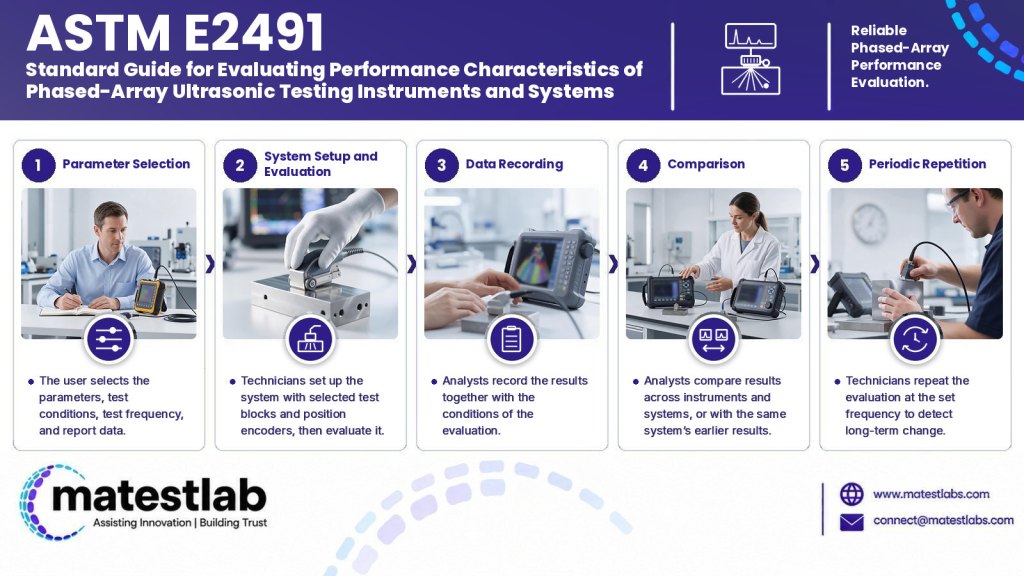
    ASTM E2491 describes procedures for evaluating selected performance characteristics of phased-array ultrasonic testing instruments and systems. It also refers to ASTM E1065 for evaluating ultrasonic search-unit characteristics and ASTM E1324 for measuring certain electronic characteristics of ultrasonic testing instruments. Users determine the specific parameters, test conditions, testing frequency, and reporting requirements according to their evaluation plan. The evaluation process can be summarized in the following steps-

    Read more

    Parameter SelectionThe user selects the parameters to evaluate, test conditions, test frequency, and reporting data. These choices set what technicians measure and how analysts compare the data later. 
    System Setup and EvaluationTechnicians assemble the system with the selected test blocks and position encoders. They then evaluate the instrument’s or system’s chosen characteristics.
    Data RecordingAnalysts record the results along with the evaluation conditions.
    ComparisonAnalysts compare the results between instruments and systems, or against earlier results from the same system.
    Periodic RepetitionTechnicians repeat the evaluation at the set frequency. Analysts use the repeated data to detect long-term change.

    ASTM E2491 Testing Process and Data Collection

    The user first decides which characteristics to evaluate and how often. Technicians then set up the phased-array system with the chosen test blocks and position encoders and run the evaluation under the selected conditions. Analysts record the results and the conditions in the report format the user defined. Later evaluations follow the same conditions so that the data stays comparable. Analysts compare each new set of results with the earlier record to find gradual change. Alternative procedures may be used only with customer approval, as specified in ASTM E2491.

     The image shows an ASTM E2491 evaluation, with a phased-array instrument and search unit on a test block, a position encoder, and recorded performance data.
    ASTM E2491 Performance Evaluation of a Phased-Array Ultrasonic Testing System

    Common Challenges and Troubleshooting

    ASTM E2491 results are most useful when evaluations are repeated under consistent conditions. Technicians should record the test blocks, selected parameters, and setup used so analysts can interpret changes against earlier results. Because the guide sets no performance limits, users should establish suitable acceptance criteria when they need to determine whether a result is acceptable. Users should also define the test frequency before evaluations begin. Engineers should treat the guide as a performance-monitoring tool, not as a replacement for instrument calibration or standardization.

    ASTM E2491 Analysis Results and Interpretation

    ASTM E2491 results describe how a phased-array instrument or system performs under the selected test conditions. Analysts compare results between systems or with earlier measurements from the same system to identify significant changes. Because the guide establishes no universal performance limits, users interpret results against acceptance criteria defined for their application.

    Read more

    • Analysts compare results between instruments and systems.
    • Analysts compare repeated results from one system to detect long-term changes.
    • Engineers review significant changes because they may indicate impending failure.
    • Engineers and maintenance teams consider corrective action when results exceed the acceptance limits established by the user.
    • Analysts report the data in the format defined by the user.

    Link to ASTM E2491

    FAQ

    How does ASTM E2491 show that a phased-array system is changing?
    ASTM E2491 repeats the evaluation on the same system at a set frequency. Analysts compare each result with the earlier ones. Significant changes may indicate impending failure and may require corrective maintenance if they exceed the applicable acceptance limits.
    ASTM E2491 applies to examination systems that use pulsed-wave trains and A-scan presentation, either RF or video. Users can evaluate a complete system or its individual parts.
    ASTM E2491 requires selected test blocks and position encoders in addition to the system under evaluation. Users choose the blocks that match the characteristics they want to evaluate.
    ASTM E2491 sets no performance limits. The using parties specify their own acceptance criteria. Alternate procedures need customer approval.
    ASTM E2491 does not replace instrument calibration or standardization. It supports comparison between systems and detection of long-term change.

    Updated on October 22, 2026

    Davis Scott
    About Author
    Davis Scott is an Electrical and Electronics Engineer specializing in multidisciplinary validation, quality assurance, and comprehensive electro-mechanical testing.
    Know More
    Testimonials
    Real results
    Engineers trust us with what matters most
    Why Choose Matestlab?
    Matestlab is a unified testing services partner based in the USA. Matestlab offers raw material and product testing services through accredited, expert laboratories primarily based in the USA. Matestlab supports physical, thermal, chemical, electrical, mechanical, environmental, and characterization testing needs through its global network of 2200+ accredited testing laboratories. Matestlab's in-house materials science experts curate and design comprehensive testing programs matched to the sample material and specific testing need, with regulatory requirements and confidentiality in mind.

    If you are looking for a managed and trusted testing partner to achieve your research goals, feel free to schedule a meeting with us or send us a request at connect@matestlabs.com to learn more about our services. For a quick quote, call us at (302)244-7710. We are happy to serve you.
    Start Your Testing
    Project Today
    Define your requirements and get access to
    specialized laboratories ready to deliver results
    Partners with us
    Clients
    Vendors
    Process for testing
    • STEP 01

      You share your testing requirements

    • STEP 02

      You share your sample(s)

    • STEP 03

      We deliver your test reports

    Get your testing done

    Let us know your testing requirements and we will be right back with a solution.

      Let us root for each other. Collaborate to grow, expand, and accelerate our businesses.

      Partner with us