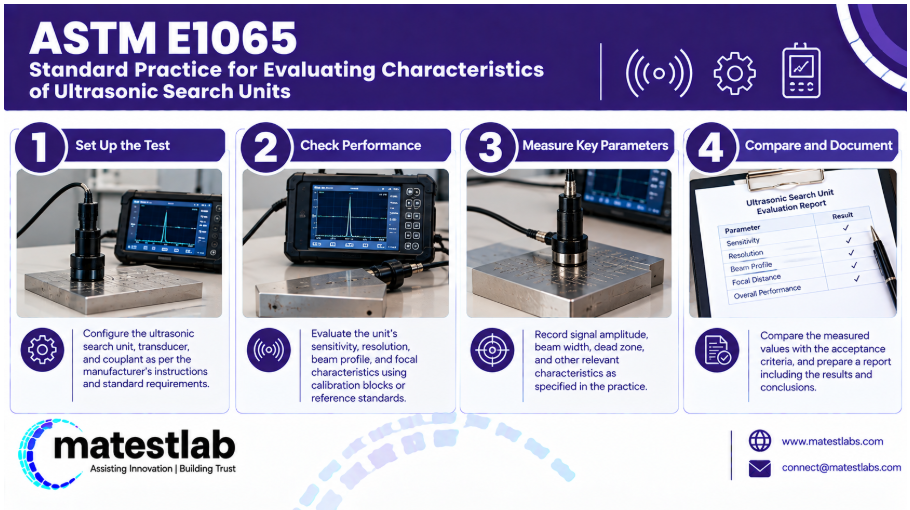
ASTM E1065 Standard Practice for Evaluating Characteristics of Ultrasonic Search Units

    What is ASTM E1065? 

    ASTM E1065 is a standard practice that provides procedures for measurement of certain characteristics of ultrasonic search units (also called “transducers” or “probes”) employed with ultrasonic examination instrumentation. The practice is performed by exciting the search unit with a pulse generator of adequate rise time, pulse length, and spectrum to encompass the bandwidth of the search unit, because if the search unit is not excited with a pulse of adequate rise time, pulse length, and spectrum, then time distortion and/or erroneous results are possible. Using ASTM E1065 (Standard Practice for Evaluating Characteristics of Ultrasonic Search Units), laboratories determine the frequency response, time response, and sound beam profile of a search unit to provide standardized characterization data. This practice does not specify performance and acceptance criteria, but it provides the measurement data on which acceptance criteria may be derived separately for a specific application. Engineers compare the results with the equivalent characterization method in ISO 10375, which addresses ultrasonic search units and sound field characterization internationally. 

    Read more

    Get Certified to ASTM E1065 for Reliable Ultrasonic Search Unit Characterization 

    Certification confirms that the characteristics of an ultrasonic search unit meet the requirements of the applicable ASTM E1065 measurement procedures, including the selection of an appropriate pulse generator and determination of frequency response. ASTM E1065-certified testing is used to gather characterization data for a search unit prior to acceptance for qualification or field use by nondestructive testing teams. Testing and certification help ensure conformance to ASTM E1065 requirements and minimize the possibility of false readings on ultrasonic inspections. 

    What is the Scope of ASTM E1065 Standard? 

    ASTM E1065 establishes measurement procedures for determining certain characteristics of ultrasonic search units, or transducers and probes. It tests frequency response, time response, and sound beam characteristics using a controlled pulse generator and measurement system. This standard covers measurement procedures for characterizing ultrasonic search units which are employed with ultrasonic examination instrumentation. This practice is employed in industries for the qualification of nondestructive testing equipment, selection of search units, and ultrasonic inspection quality assurance.

    Read more

    The scope of ASTM E1065 includes 

    • Material type: Ultrasonic examination instrumentation, ultrasonic search units (transducers or probes). 
    • Purpose: To determine the characteristics of ultrasonic search units to produce performance data. 
    • Properties measured: Frequency response, time response, and sound beam profile characteristics. 
    • Method: The search unit is excited from a pulse generator with a rise time of a minimum of 400ns, a pulse duration of at least 100 ns, and a spectral content sufficiently high to span its bandwidth, and the resultant response is measured. 
    • Result: Results provide frequency response, time response, and beam profile data rather than pass/fail acceptance criteria. 
    • Test Limitations: This practice does not establish performance and acceptance criteria; it offers data from which such criteria are established separately.  
    • Environmental conditions: Pulse generator characteristics and measurement system bandwidth can significantly affect the accuracy of the evaluated search unit data. 
    • Applications: Nondestructive testing equipment qualification, selection of search unit for ultrasonic testing, ultrasonic inspection quality assurance, sound field characterization. 

    What are the Uses of ASTM E1065?

    ASTM E1065 provides nondestructive testing laboratories with standardized measurement procedures to characterize search units for ultrasonic testing. Engineers then apply the resulting data to select search units appropriate for particular inspection applications, and to set their own acceptance criteria. This standard-

    • Evaluates frequency response of ultrasonic search units over their entire bandwidth.
    • Operates on search units by exciting them artificially with a controlled pulse generator having adequate rise time and spectral content.
    • Evaluates time response to determine possible distortion problems.
    • Measures sound beam profiles of contact straight-beam search units.
    • Aids in evaluating higher frequency immersion search units.
    • Helps to produce data that can be used to develop performance and acceptance criteria.
    • Supports selection of search units appropriate to an ultrasonic inspection application 

    What Materials Are Covered Under ASTM E1065? 

    ASTM E1065 is applicable to ultrasonic search units with ultrasonic examination or testing instrumentation, such as contact straight-beam search units and immersion search units of higher frequency. Common applications are nondestructive testing machines in manufacturing, welding inspection, and materials evaluation industries. The technicians select the pulse generator and the measurement configuration required as per the type of search unit and frequency range tested. 

    Why is ASTM E1065 Important? 

    ASTM E1065 provides a generic set of measurement procedures that provides the nondestructive testing profession with consistent and comparable information about search unit performance. This practice is used in laboratories since it does not require specific acceptance criteria, so that the user can define the acceptance criteria suitable to his inspection needs and still use measurement data from a standards body. 

    ASTM E1065 Equipment and Sample Preparation Guide

    ASTM E1065 is a standard that requires an ultrasonic search unit to be excited and characterized by a pulse generator and measurement system. A pulse generator is selected with a rise time, duration, and spectrum that match the bandwidth of the search unit. Specific annexes are also provided for higher-frequency immersion search unit evaluation and sound beam profile measurement of contact straight-beam search units.

    Read more

    Sample and Specimen DetailsTechnicians test ultrasonic search units, including contact straight-beam and higher-frequency immersion types, prepared for controlled frequency and time response measurement. 
    Specimen PreparationTechnicians connect the search unit to the pulse generator and measurement system, verifying proper coupling and configuration before beginning the characterization procedure. 
    Pulse Generator Requirements Technicians select a pulse generator with rise time, duration, and spectral content sufficient to excite the search unit over its full bandwidth, since inadequate characteristics can cause time distortion and erroneous results. 
    InstrumentationPulse generator, oscilloscope or waveform capture system, sound beam profiling equipment, and a reference target or immersion tank for beam profile measurement. 

    Testing Procedures and Requirements for ASTM E1065  

    Technicians connect the search unit to a pulse generator designed to push the search unit fully across its bandwidth, and then record and study the output frequency and time response. They take measurements of sound beam profiles for contact straight-beam search units and use the specific annex procedures of the practice when higher frequency immersion search units are used. Other referenced ASTM documents include ASTM E1316.

    Read more

    Pulse Generator Selection Technicians select a pulse generator with adequate rise time, duration, and spectral content to excite the search unit across its full bandwidth. 
    Frequency Response Measurement Technicians excite the search unit and capture its frequency response using an oscilloscope or waveform capture system. 
    Time Response Measurement Technicians measure the search unit’s time response, checking for distortion that inadequate pulse characteristics could introduce. 
    Sound Beam Profile Measurement Analysts measure the sound beam profile in metals for contact straight-beam search units, or apply immersion-specific procedures for higher frequency units. 
    Result Reporting Laboratories report frequency response, bandwidth, sensitivity, and other measured characteristics in the test report. 

    ASTM E1065 Process and Data Collection

    The testing process starts with the technician attaching the ultrasonic search unit to a pulse generator that has been specially designed to fully excite the unit over its frequency range. The technician checks that the pulse generator rise time, pulse duration, and spectral content are within the requirements for time distortion to be avoided. The technician then takes a frequency response and time response of the search unit with an oscilloscope or a waveform capture system. The contact straight-beam search unit measures the sound-beam profile in metals, and higher-frequency immersion units use the dedicated annex procedure in the practice. Finally, the frequency response, time response, and beam profile data are combined into a standardized characterization result for the search unit. 

     The image shows an ultrasonic search unit connected to a pulse generator for frequency and time response characterization under ASTM E1065.
    ASTM E1065 Frequency Response Testing of an Ultrasonic Search Unit

    Common Challenges and Troubleshooting

    Time distortion and inaccuracy are common problems resulting from the inadequacy of the pulse generator characteristics because the practice explicitly cautions that the inadequacy of the rise time, duration, or spectral content of the pulse can produce a failure to sweep the search unit across its bandwidth. The actual performance of the search unit can also introduce measurement errors into the measured results if the coupling between the search unit and the test setup is not proper. Confusing this characterization data with fixed acceptance criteria may lead to misapplication, since the practice explicitly states it provides data rather than pass/fail limits. Laboratories solve these problems by selecting a pulse generator with verified properties appropriate to the pulse excitation needs of the practice, using appropriate coupling prior to measurement, and setting their own application acceptance criteria in parallel to the basic set of properties. 

    ASTM E1065 Analysis Results and Interpretation

    The laboratory report summarizes the measured frequency response, time response, and sound beam profile of the tested ultrasonic search unit. ASTM E1065 characterizes the search unit, not overall material performance.

    Read more

    • Test results report the frequency and time response obtained from the indicated pulse generator and measurement system.
    • Technicians identify whether the search unit being tested is a contact straight-beam or a higher-frequency immersion type.
    • Analysts record a profile of the sound beam under the given conditions and correlate the output with the tested search unit.
    • Engineers consider the pulse generator’s adequacy, the coupling quality, and the search unit type when interpreting the characterization results.
    • Nondestructive testing teams use the characterization data to develop their own performance and acceptance criteria for a specific inspection application. 

    Link to ASTM E1065 

    FAQ

    Does ASTM E1065 tell a lab whether a search unit passes or fails?
    No, this practice does not define performance or acceptance criteria, but it does allow for standardized measurement procedures and data, and users set their acceptance criteria based on the characterization data that this practice produces.
    Inadequate pulse characteristics can lead to the introduction of time distortion in the search unit, which will result in incorrect frequency and time response. The pulse generator should have a sufficiently large rise time, duration, and spectral content to ensure that the search unit is excited over the entire bandwidth.
    ASTM E1065 is designed to test the properties of a single-element piezoelectric search unit. The procedures are intended for measuring these units independently of the ultrasonic test instrument.

    Updated on October 1, 2026

    Davis Scott
    About Author
    Davis Scott is an Electrical and Electronics Engineer specializing in multidisciplinary validation, quality assurance, and comprehensive electro-mechanical testing.
    Know More
    Testimonials
    Real results
    Engineers trust us with what matters most
    Why Choose Matestlab?
    Matestlab is a unified testing services partner based in the USA. Matestlab offers raw material and product testing services through accredited, expert laboratories primarily based in the USA. Matestlab supports physical, thermal, chemical, electrical, mechanical, environmental, and characterization testing needs through its global network of 2200+ accredited testing laboratories. Matestlab's in-house materials science experts curate and design comprehensive testing programs matched to the sample material and specific testing need, with regulatory requirements and confidentiality in mind.

    If you are looking for a managed and trusted testing partner to achieve your research goals, feel free to schedule a meeting with us or send us a request at connect@matestlabs.com to learn more about our services. For a quick quote, call us at (302)244-7710. We are happy to serve you.
    Start Your Testing
    Project Today
    Define your requirements and get access to
    specialized laboratories ready to deliver results
    Partners with us
    Clients
    Vendors
    Process for testing
    • STEP 01

      You share your testing requirements

    • STEP 02

      You share your sample(s)

    • STEP 03

      We deliver your test reports

    Get your testing done

    Let us know your testing requirements and we will be right back with a solution.

      Let us root for each other. Collaborate to grow, expand, and accelerate our businesses.

      Partner with us