ASTM F24 Standard Test Method for Measuring and Counting Particulate Contamination on Surfaces

    What is ASTM F24?

    ASTM F24 is a standard test method for measuring and counting particulate contamination on surfaces. It was developed specifically for evaluating particulate contamination on small electron-device components. Although similar cleanliness testing is important in many industries, including microelectronics, aerospace, and medical device manufacturing, the scope of ASTM F24 is limited to electronic device components. Foreign particles, even microscopic ones, can decrease product reliability, form weak spots, or compromise sterility. ASTM F24 offers a methodological tool to quantify and enumerate such particles so as to set a standard regarding the permissible amounts of contamination. The test procedure is conducted with the help of special methods, which are designed to guarantee precise evaluation of various materials and conditions.

    Read more

    Get Certified ASTM F24 for Accurate Surface Cleanliness and Contamination Control

    ASTM F24 certification guarantees adherence to a surface’s particle count and particle size distribution cleanliness. In industries where surface cleanliness is a critical factor in product performance and reliability, laboratory testing confirms a material or component has been produced and handled under conditions that control particulate contamination, which is an important element of quality assurance.

    What is the Scope of ASTM F24?

    ASTM F24 provides a test method to measure and count particulate contamination of small electron-device component surfaces. The standard provides uniform methods for sampling, measuring, and reporting particles, providing a reliable measurement of cleanliness. The ASTM F24 standard-

    Read more

    • Determines particulate pollution on surfaces.
    • Applies to particulate contamination on, or washed from, the surfaces of small electron-device components.
    • Provides data on particle count and size distribution.
    • Favors cleanliness check and control.
    • Applied in sensitive and precision industries.

    What are the uses of ASTM F24 Testing? 

    ASTM F24 testing assists manufacturers in confirming that surfaces produced are clean to a specific level prior to their assembly, packaging, or product release. The test can be used for quality control, contamination monitoring, and validation of cleaning procedures. 

    Common applications include:

    • ASTM F24 is a test that verifies the surfaces meet the specified particulate cleanliness requirements with particle count and particle size distribution testing.
    • ASTM F24 testing is used by semiconductor manufacturers to assess the surfaces of wafers, electronic components, and manufacturing equipment for very small (micro) particle contamination. 
    • Primarily used for small electron-device components. 
    • Aerospace manufacturers use ASTM F24 testing for aircraft parts, hydraulic systems, and precision assemblies to ensure parts are clean before they are put into the aircraft. 
    • ASTM F24 testing is used to guarantee that optical components, precision engineering parts, and assemblies do not contain particulate contaminants.  

    What Materials Can Be Tested Under ASTM F24?

    ASTM F24 can be used for a variety of materials and manufactured products that need to be evaluated for cleanliness of the particles. Common examples of materials used include stainless steel, aluminum alloys, titanium alloys, polymers, ceramics, glass, semiconductor wafers, medical devices, optical components, aerospace hardware, electronic assemblies, pharmaceutical processing equipment, and other components created to an extremely high degree of accuracy where the presence of particles can impact product performance, reliability, sterility, or safety.  

    Why is ASTM F24 Important for Surface Cleanliness?

    ASTM F24 provides a standardized method for evaluating particulate contamination that may compromise product performance, reliability, sterility, or safety. Standardized cleanliness testing enables manufacturers to validate cleaning processes, reduce contamination risks, improve manufacturing consistency, and maintain compliance with quality requirements in highly controlled production environments.

    ASTM F24 Common Challenges and Troubleshooting

    The most frequent problems are incomplete extraction of the particles, contamination of samples during handling, incorrect filtration, and inaccuracies in the results of the microscopic analysis that may influence the credibility of the outcomes.

    ASTM F24 Equipment and Sample Preparation Guide 

    Accurate sample preparation and equipment use are necessary for proper results. Proper expertise in sample preparation and instrumentation will ensure reliable and reproducible laboratory results.

    Read more

    Specimen DetailsExamples of representative parts are flat or shaped parts produced from metals, polymers, ceramics, glass, semiconductor materials, medical devices, aerospace parts, optical parts, and other precision-engineered parts and components that require a particulate cleanliness evaluation. 
    Specimen PreparationCleanroom techniques and contamination-free tools are used in handling the test specimens. Surfaces are prepared in a controlled environment to avoid contamination of surfaces before extraction and analysis by foreign particles. 
    Specimen DimensionsThe size of the specimens varies with the product being tested. The size of the flat specimens typically ranges from 25 mm x 25 mm to 100 cm2 in surface area, and larger or irregular specimens are assessed using specified representative surface areas in accordance with laboratory procedures. 
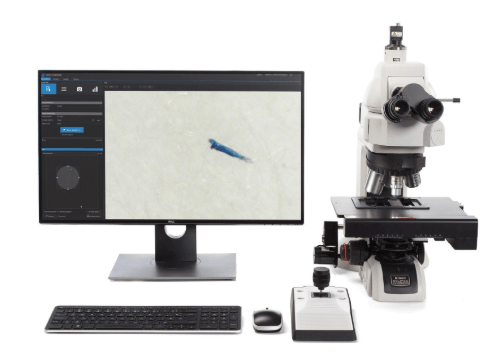
    InstrumentationEquipment includes solvent rinse apparatus, membrane filtration units, optical microscopes, automated particle-counting systems, cleanroom workstations, calibrated imaging systems, and precision laboratory instruments used for particle sizing and quantitative contamination analysis.

    ASTM F24 Testing Process and Data Collection

    ASTM F24 is a procedure that entails rinsing the test surface, filtering the extracted particles, and then examining them under the microscope. The procedure involves counting particles, measuring size distribution, testing surface area, and noting environmental conditions, which ensures standard reporting and comparability.

    The image shows a laboratory setup with membrane filtration equipment, an optical microscope, and particle-counting instruments used for ASTM F24 surface cleanliness testing.
    ASTM F24 Surface Particle Collection and Optical Particle Counting System

    Testing Procedures and Requirements for Particulate Contamination on Surfaces 

    ASTM F24 determines the size distribution of particulate contamination 5 μm or larger either on or washed from the surface of small electron-device components. The standard measures existing particulate contamination to ensure the surfaces are clean according to the necessary cleanliness specifications for sensitive manufacturing applications. The following is a brief description of the testing process: 

    Read more

    Other ASTM standards mentioned in this specification are ASTM E2088, ASTM F303, and ASTM F312.

    Sample/Surface PreparationThe analyst establishes and prepares the surface area to collect the particles in a controlled and low-contamination environment. 
    Particle CollectionASTM F24 measures particles on the surface or washed from the surface. Specific collection procedures should follow the standard; methods such as tape lift are not generally specified by ASTM F24.
    Filtration and CaptureForces the solvent that  removes the particles through a filter with a membrane that removes the particles. 
    Microscopic or Optical ExaminationStudies the particles collected under an optical microscope and/or an automated particle counting system to assess size and count of the collected particles. 
    Particle Sizing and CountingClassifies particles into certain sizes and determines them by the number of particles per unit surface area or per component. 
    Data Recording and EvaluationCounts particles and their size distribution, measured and reported to known and specified cleanliness criteria. 
    Documentation and CertificationVerifies the cleanliness of the tested surface is in compliance with the cleanliness requirements referenced by ASTM F24.

    Analysis Results and Interpretation

    • The results are given in terms of the number of particles per square area.
    • The particle size distribution is expressed by the range of particle sizes, according to the specified ranges.
    • The higher the number, the more inadequate the cleaning and/or the more contamination that has occurred during the manufacturing process.
    • If the particles are larger, this can be due to process contamination or handling of materials.
    • The results are contrasted with the cleanliness specifications to check if it is compliant.
    • If the results are not in compliance, they may need to be corrected by cleaning or process changes.

    Link to ASTM F24

    Read more

    Updated on August 16, 2026

    Dr Ruchika Yogesh
    About Author
    Dr. Ruchika Yogesh is a serial entrepreneur, material science and AI/ML enthusiast, medicinal chemistry subject matter expert (SME), scientific/medical copyeditor, and a researcher.
    Know More
    Testimonials
    Real results
    Engineers trust us with what matters most
    Start Your Testing
    Project Today
    Define your requirements and get access to
    specialized laboratories ready to deliver results
    Partners with us
    Clients
    Vendors
    Process for testing
    • STEP 01

      You share your testing requirements

    • STEP 02

      You share your sample(s)

    • STEP 03

      We deliver your test reports

    Get your testing done

    Let us know your testing requirements and we will be right back with a solution.

      Let us root for each other. Collaborate to grow, expand, and accelerate our businesses.

      Partner with us

        Discover more from Matestlab

        Subscribe now to keep reading and get access to the full archive.

        Continue reading