
ASTM F2096 Test Method for Detecting Gross Leaks in Packaging by Internal Pressurization

    What is ASTM F2096?

    ASTM F2096 is a standard test method for gross leak detection of packages by internal pressurization. The method uses air pressure and observation of bubbles under water to detect leaks caused by package defects (bubble test). The method offers a practical way of assessing package integrity and checking packages for gross leaks. This standard is applicable to tray and pouch packages and provides for conditions of internal air pressure that will indicate leakage. Technicians watch the package while it is underwater and look for any air bubbles to tell if there is a leak. Procedures for porous and nonporous packaging are also provided in ASTM F2096.

    Read more

    Get Certified ASTM F2096 Testing for Reliable Package Integrity Evaluation

    Package integrity plays a crucial role in the protection of products from contamination and the desired package barrier. According to ASTM F2096, the standard test method for gross leak detection of packages, a standardized approach is given for identifying gross leaks that can affect package performance. This test can be applied in laboratories for determining leak points and package integrity. The results can be used to determine gross leakage paths such as substrate holes, channels, and so on by engineers and manufacturers.

    What is the Scope of the ASTM F2096 Test Standard?

    ASTM F2096 is a test for gross leaks in packaging by internal pressurization. It is applicable to packages in trays or pouches and has a sensitivity of 250 μm (0.010 inches) with 81% probability under the specified conditions. The standard applies to destructive testing since technicians have to enter the package to provide the air pressure inside. It also provides separate procedures for porous and nonporous packaging. The ASTM F2096 standard-

    Read more

    • Identifies large leaks in packaging.
    • Assesses the performance of package trays and pouches.
    • Detects leaks by means of air pressure.
    • Locates holes and channels in the substrate.
    • Delivers sensitivity to 250 μm (0.010 inches) under certain conditions.
    • Covers procedures for porous and nonporous packaging.
    • Helps assess the integrity of packages.
    • Offers a useful way to test large or long parcels that might not fit other test apparatus.

    What are the Uses of ASTM F2096 Testing?

    The ASTM F2096 test helps laboratories detect gross leaks that can impact package integrity. The analysis outcome can be used by engineers to assess the performance of packaging, to investigate the leakage, and for quality control. This standard-

    • Identifies large leaks in packaging.
    • Recognizes holes and channels in the substrate.
    • Evaluates package integrity.
    • Assists in QC for packaging.
    • Assists in determining the location of leaks.
    • Helps test tray and pouch packaging.
    • A good solution for bulky or lengthy packages.

    Which materials can be tested under ASTM F2096?

    ASTM F2096 calls for the testing of tray and pouch packages. The standard provides procedures for porous and nonporous packaging, but it has not been tested for porous packaging other than spunbonded polyolefin or for nonporous packaging.

    Why is ASTM F2096 Important?

    ASTM F2096 describes a standardized method for testing gross leaks in packaging using internal pressurization. The results help manufacturers assess package integrity and determine whether any package failures may affect product protection. Another benefit is that it works when package material or size is not suitable for other package-integrity test apparatus.

    ASTM F2096 Equipment and Sample Preparation Guide

    ASTM F2096 calls for equipment to introduce the internal air pressure and to watch for leakage from the submerged package. Analysts choose suitable equipment and prepare the package according to the applicable test procedure.

    Read more

    Sample Type and DetailsRepresentative tray or pouch packages are tested for gross leakage and package integrity in laboratories.
    Specimen PreparationTechnicians prepare the package to allow them to inject internal air pressure to check for bubbles that may be escaping the package.
    Specimen DimensionsASTM F2096 does not specify a single specimen size since the test may be used to determine the size of various packages and package configurations.
    InstrumentationFor the test, internal air-pressure equipment, pressure-monitoring equipment, a suitable package-entry device, and a water container are used.

    Testing Procedures and Requirements for ASTM F2096

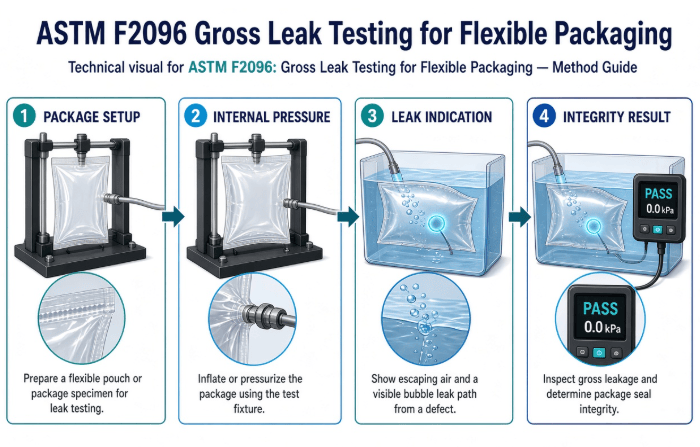
    This test method involves pressurizing the package internally and observing it from underwater for gross leaks. Technicians choose the right procedure for the porous or nonporous package. ASTM F2096 test procedure is given below-

    Read more

    Internal PressurizationTechnicians blow air into the package to create the pressure needed to check for leaks.
    Package ImmersionTechnicians then immerse the pressurized package and check the surface of the package for bubbles of air escaping from the package.
    Leak DetectionTechnicians detect the continuous streams of bubbles, which represent gross leakage through the package or seal.
    Leak LocationOperators note and document the position of leakage observed on the package.
    Result ReportingLaboratories record the test conditions, package data, leakage observed, and test results. 

    ASTM F2096 Testing Process and Data Collection

    The analysts choose representative packages and determine the appropriate ASTM F2096 procedure. After that, the package is set up for inflation with internal air, and test conditions are determined. Then, technicians blow air into the package and immerse it for visual examination. Analysts are looking at the package for any ongoing stream of bubbles that would show gross leakage. Finally, technicians determine where the leak is and make notes of the package condition and test observations. These results are used in laboratories to determine the integrity of the package and possible leakage pathways.

    This image shows a packaging specimen undergoing underwater bubble testing to detect gross leaks according to ASTM F2096.
    ASTM F2096 Internal Pressurization Bubble Test

    Common Challenges and Troubleshooting

    The pressure used, specimen preparation, and bubble-formation observation are important for accurate ASTM F2096 results. Porous packaging can allow air to pass through the packaging material, and technicians cannot distinguish this from leakage due to package defects. Technicians should establish proper test conditions and thoroughly examine the package to find the real leakage position. Having the equipment set up properly also helps to eliminate inconsistent observations.

    ASTM F2096 Analysis Results and Interpretation

    The report summarizes whether the tested sample exhibits gross leakage under the imposed pressurization conditions. The observed leakage and test information are documented in the laboratory.

    Read more

    • ASTM F2096 generates leak-detection results specific to a package, not a material property.
    • Laboratories can be used to determine whether leakage is observed or not and to locate the leakage point.
    • Under certain conditions, test sensitivity can be as high as 250 μm (0.010 inches) and have an 81% probability of success.
    • The reported results are to be accompanied by test pressure and package information.
    • Laboratories can produce reliable results through consistent specimen preparation, pressure control, and visual inspection.

    Link to ASTM F2096

    FAQ

    Where can I get the astm f2096 tested?
    You can share your astm f2096 testing requirements with MaTestLab. MaTestLab has a vast network of material testing laboratories, spread across the USA and Canada. We support your all material testing needs ranging from specific astm f2096 test to various testing techniques.
    Please contact us for a detailed quote for your astm f2096 testing needs. Cost incurred to carry out different astm f2096 testing methodology depends on the type of raw material; number of samples, coupons, or specimens; test conditions, turn around time etc. Costs of some ASTM testing methods start from $100 and the final value depends upon the factors listed above. Please contact us for the best and latest prices.
    The required number of samples or specimens should comply with the procedure given in the astm f2096 standard. However, the MaTestLab operations team can assist you for your special requirements once you share your testing details with us.
    MaTestLab has a vast testing laboratory network, hence we bring you the best testing facilities in a cost-effective way. We offer considerable discounts (15-20%) to our returning customers based on test volume and frequency.
    The turnaround time for astm f2096 test methodology depends upon the test procedure mentioned in the standard test document. However, we at MaTestLab understand your research requirements and hence try to get your test completed within the least possible time.
    Dr Ruchika Yogesh
    About Author
    Dr Ruchika Yogesh
    Dr. Ruchika Yogesh is an entrepreneur, science and AI/ML enthusiast, medicinal chemistry subject matter expert (SME), scientific/medical copyeditor, and an independent researcher.
    Testimonials
    Real results
    Engineers trust us with what matters most
    Start Your Testing
    Project Today
    Define your requirements and get access to
    specialized laboratories ready to deliver results
    Partners with us
    Clients
    Vendors
    Process for testing
    • STEP 01

      You share your testing requirements

    • STEP 02

      You share your sample(s)

    • STEP 03

      We deliver your test reports

    Get your testing done

    Let us known your testing requirements and we will be right back with a solution.

      Let us root for each other. Collaborate to grow, expand, and accelerate our businesses.

      Partner with us

        Contact Us

        Discover more from MaTestLab

        Subscribe now to keep reading and get access to the full archive.

        Continue reading