ASTM E96 Gravimetric Determination of Water Vapor Transmission Rate of Materials

    What is ASTM E96?

    ASTM E96 is a standardized laboratory test method that is used for the measurement of water vapor transmission rate (WVTR) and moisture vapor permeability (MVP) of materials. The test measures the resistance or permeability of a material in relation to water vapor when the test conditions involve controlled temperature and humidity.

    Read more

    It is used for a wide variety of packaging materials, waterproofing membranes, building materials, textiles, films, coatings and laminates, and vapor barriers. ASTM E96 can assist manufacturers in optimizing their moisture protection, enhancing product durability, comparing the performance of materials, and ensuring compliance with industry specifications. Test results are reported in SI units (the internationally used system of measurement), allowing laboratories to compare results reliably and consistently. 

    Get Certified ASTM E96 Testing for Accurate Moisture Barrier Performance Evaluation

    ASTM E96 testing demonstrates the measured water vapor transmission characteristics of materials under specified laboratory conditions. Water vapor transmission rate and moisture permeability are laboratory tested in a controlled environment. ASTM E96 test results support product development, quality assurance, manufacturing consistency, and material selection by providing standardized water vapor transmission measurements. 

    What is the Scope of ASTM E96 Test Standard?

    ASTM E96 provides guidelines for testing materials for water vapor transmission under controlled conditions by gravimetric method. For many industrial applications, the standard covers evaluation of the moisture barrier properties. This standard test method 

    Read more

    • Measures the water vapor transmission rate (WVTR) of materials.
    • Calculates the material’s moisture vapor permeability when required.
    • Evaluates moisture barrier performance under controlled environmental conditions.
    • Helps ensure quality control and product improvement.
    • Applicable in packaging, construction, textile, and coating industries.
    • Establishes standardized procedures for comparing the water vapor transmission properties of different materials.

    What are the Uses of ASTM E96 Testing?

    ASTM E96 testing is useful for manufacturers to assess the moisture barrier properties of packaging, construction materials, fabrics, and protective coatings. These results assist with product development, quality assurance, material selection, and meeting industry standards.

    • Packaging manufacturers use ASTM E96 to assess the moisture resistance of films, laminates, and flexible packaging used to protect food, pharmaceuticals, and consumer goods. Measuring WVTR accurately improves the shelf life of the product and package performance.
    • ASTM E96 is used to evaluate vapor barriers, roofing membranes, insulation systems, waterproof coatings, and building materials. Moisture control in building envelopes and long-term structural durability is achieved through reliable testing.
    • Textile manufacturers use the ASTM E96 test for breathable fabrics, waterproof clothing, protective wear, and outdoor performance textiles. The outcomes are used to help balance the moisture resistance and wearer comfort.
    • Coating manufacturers use ASTM E96 to compare the effectiveness of protective coatings and surface treatments in preventing moisture entry and preserving coating durability.
    • Research laboratories use ASTM E96 to compare new barrier materials, multilayer films, and advanced membrane technologies.

    What Materials Can Be Tested Under ASTM E96?

    ASTM E96 can be used to test a variety of materials for which moisture vapor transmission properties need to be assessed. They are used in a wide variety of applications such as protective clothing, pharmaceutical packaging, food packaging, composite products, adhesives and sealants, construction barriers, waterproof coatings, insulation materials, paper products, polymer membranes and plastic films, and many more where moisture control is essential to long-term product performance. 

    Why is ASTM E96 Important for Moisture Barrier Evaluation?

    ASTM E96 offers a standardized test for measuring water vapor transmission in order to allow manufacturers to fairly compare moisture barrier performance. Accurate WVTR information can be used to enhance product durability, design packaging to achieve optimal performance, avoid product failures related to moisture, assist in material selection, meet industry regulations, and ensure product consistency and quality under different environmental conditions. 

    Common Challenges and Troubleshooting

    Improper specimen sealing, leaks around the test cup, environmental conditions, balance calibration, specimen conditioning, and operator error are all potential factors that could lead to inaccurate ASTM E96 test results. Reliable and repeatable water vapor transmission measurements are achieved through specimen preparation, sealing, calibrated equipment, controlled humidity and temperature, and trained laboratory staff. 

    ASTM E96 Equipment and Sample Preparation Guide

    Proper specimen preparation and calibrated laboratory equipment are essential for obtaining accurate and repeatable water vapor transmission measurements.

    Read more

    Specimen DetailsRepresentative materials include packaging films, waterproof barrier systems, building membranes, coatings, plastic sheets, textiles, paper products, insulation, and other materials. 
    Specimen PreparationTechnicians cut the specimens to the required size, condition them under controlled temperature and humidity, and carefully place them on standard test cups to minimize edge leakage during testing.
    Specimen DimensionsSpecimens are usually square or round and sized to fit snugly in the standard test cup opening. ASTM E96 defines the exposed test area for the specimen.
    InstrumentationTypical test equipment for ASTM E96 testing includes an environmental conditioning chamber, ASTM E96 test cups, an analytical balance, a humidity control system, a temperature monitoring system, sealing wax or gaskets, specimen cutters, and computer software to acquire data.

    Testing Procedures and Requirements for Water Vapor Transmission Rate (WVTR)

    ASTM E96 measures the transfer of water vapor between a material and its environment in a controlled atmosphere, a process that is expressed as a rate. There are two tests that are included in the standard according to the direction of moisture movement. Standardized lab procedures guarantee accurate and repeatable measurements. 

    Read more

    Other ASTM standards mentioned in this specification are ASTM D1653, D1434, and D3574.

    Specimen Conditioning and Method SelectionTechnicians condition the specimens at a controlled temperature and RH and select the Desiccant Method (Dry Cup) or Water Method (Wet Cup) according to ASTM E96.
    Test Cell Preparation and Environmental ExposureTechnicians seal the specimen around the test cup, assemble the test cells, and place them in a controlled environment chamber at the specified temperature and relative humidity.
    Periodic Weighing and WVTR CalculationTechnicians measure moisture gain or loss at regular intervals, record weight changes, and calculate the water vapor transmission rate and moisture vapor permeability.
    Documentation and ReportingThe laboratory report documents the WVTR, calculated permeability (when applicable), environmental conditions, specimen identification, and other information required by ASTM E96/E96 M.

    ASTM E96 Testing Process and Data Collection

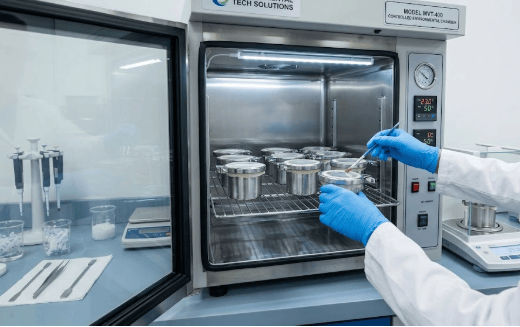
    Testing starts by conditioning a sample of the material that is representative of the product before securely mounting it above a standard sample cup of either water or desiccant. The sealed assemblies are then placed in a controlled environmental chamber, and the temperature and relative humidity are controlled throughout the test. The moisture gain or loss is measured with a precision analytical balance by the technicians at regular intervals, weighing the test cups. The weight change over time is used to calculate the water vapor transmission rate (WVTR), moisture permeability, environmental conditions, dimensions of the specimen, and test duration. 

    The image shows a laboratory setup with sealed water vapor transmission test cups inside a controlled environmental chamber for WVTR measurement according to  ASTM E96
    ASTM E96 Controlled Environmental Test Cells

    Analysis Results and Interpretation

    • The results of the tests are presented as Water Vapor Transmission Rate (WVTR) and are generally reported as g/m²/day.
    • Moisture vapor permeability can also be expressed as perms or ng/(Pa·s·m²) based on project requirements.
    • Generally, a lower WVTR will signify better moisture barrier performance, and a higher WVTR will signify more vapor permeability.
    • The results are analyzed to determine the suitability of the material according to customer specifications, industry standards, and product performance.
    • Relatively constant WVTR values indicate steady manufacturing processes and moisture barrier performance.
    • When deciding which ASTM E96 test to use, there are some factors that must be considered. 

    Link to ATSM E96

    Read more

    Updated on August 17, 2026

    Rohit Dhembare
    About Author
    Rohit Dhembare is an Operations Associate at Matestlab Inc., holds a postgraduate degree in Organic Chemistry and is trained in Materials Science testing techniques.
    Know More
    Testimonials
    Real results
    Engineers trust us with what matters most
    Start Your Testing
    Project Today
    Define your requirements and get access to
    specialized laboratories ready to deliver results
    Partners with us
    Clients
    Vendors
    Process for testing
    • STEP 01

      You share your testing requirements

    • STEP 02

      You share your sample(s)

    • STEP 03

      We deliver your test reports

    Get your testing done

    Let us know your testing requirements and we will be right back with a solution.

      Let us root for each other. Collaborate to grow, expand, and accelerate our businesses.

      Partner with us

        Discover more from Matestlab

        Subscribe now to keep reading and get access to the full archive.

        Continue reading