ASTM E90 Standard Test Method for Laboratory Measurement of Airborne Sound Transmission Loss of Building Partitions and Elements

    What is ASTM E90?

    ASTM E90 is a laboratory test for airborne sound transmission loss of building partitions and elements. It measures the ability of a test specimen to decrease the sound transmission between two reverberation rooms with nearly diffuse sound fields. The procedure includes measuring sound pressure levels in the source and receiving rooms and determining transmission loss across frequency bands based on the sound absorption of the receiving room and the specimen area. ASTM E90 (Standard Test Method for Laboratory Measurement of Airborne Sound Transmission Loss of Building Partitions and Elements) applies to walls, operable partitions, floor-ceiling assemblies, doors, windows, roofs, panels, and other space-division elements. 

    Read more

    Get Certified ASTM E90 Testing for Reliable Sound Transmission Loss Evaluation

    ASTM E90 testing is a certified test useful for building sound insulation of elements and partitions for airborne sound. The test quantifies the effectiveness of a specimen in blocking sound transmission under laboratory-controlled conditions. The results are used by engineers to compare acoustic performance to support product development, verify material designs, and demonstrate compliance with project requirements. The test is used for walls, floors, doors, windows, partitions, and other building elements. ASTM E90 testing helps ensure accurate measurements, consistent procedures, and dependable sound transmission loss evaluation.

    What is the Scope of the ASTM E90 Test Standard?

    ASTM E90 is a laboratory test used to measure the airborne sound transmission loss of building partitions and other space-dividing elements. Test rooms are set up to make the specimen the main sound transmission path between the test rooms and to ensure that the sound fields are diffuse and approximately so during the test. This method should not be used for field tests, as other transmission paths may affect sound isolation. The scope of ASTM E90 includes:

    Read more

    • Building Partitions: Covers walls, operable partitions, floor-ceiling assemblies, and other separating elements.
    • Building Elements: Applies to doors, windows, roofs, panels, and similar construction elements.
    • Sound Transmission: Measures airborne sound transmission loss under controlled laboratory conditions.
    • Test Environment: Uses two adjacent reverberation rooms with approximately diffuse sound fields.
    • Transmission Path: Requires the test specimen to constitute the primary significant sound transmission path.
    • Frequency Range: Standard measurements use one-third-octave bands from 100 to 5000 Hz; applicable façade measurements extend from 80 to 5000 Hz.
    • Laboratory Testing: Provides controlled measurements rather than direct field sound-isolation measurements.
    • Measurement Output: Calculates sound transmission loss as a decibel value that is dependent on frequency.

    What are the Uses of ASTM E90 Testing?

    The airborne sound transmission loss of building partitions and assemblies can be evaluated using the controlled laboratory procedure outlined in ASTM E90. Consequently, engineers can use the results to assess how effectively walls, floors, doors, windows, and other building elements reduce airborne sound transmission. The ASTM E90 standard-

    • Measures acoustic transmission loss of building partitions in the air.
    • Measures acoustic performance in selected frequency ranges.
    • Describes how sounds are transmitted through wall and floor-ceiling assemblies.
    • Evaluates doors, windows, roofs, panels, and other building components.
    • Facilitates comparison of similar construction systems under controlled conditions.
    • Delivers frequency-dependent transmission loss data for acoustic evaluation.
    • Calculates applicable single-number acoustic ratings from transmission-loss data.
    • Assists engineers in assessing the direct sound transmission of building elements.

    Which materials can be tested under ASTM E90?

    ASTM E90 is applicable to building partitions and elements that are made of materials and assemblies designed to divide spaces or prevent the transmission of airborne sound. The method can be used to evaluate whole walls, floor-ceiling assemblies, doors, windows, roofs, panels, operable partitions, and other space-dividing constructions if they can be installed in the same way they will be in their intended construction and mounting condition.

    Why is ASTM E90 Important?

    The significance of ASTM E90 is that it provides a set of controlled laboratory data for airborne sound transmission loss of building partitions and elements. The method sets up conditions that limit the presence of alternate transmission paths and approximate diffuse sound fields, which enables engineers to characterize the transmission through the tested specimen. However, ASTM notes that laboratory results do not directly represent building sound isolation because field installations can introduce flanking transmission paths.

    ASTM E90 Equipment and Sample Preparation Guide

    ASTM E90 requires a specialized sound transmission loss facility housing two appropriate reverberation rooms, an acoustic source system, microphones, analyzers, and equipment for receiving-room sound absorption. The specimen is installed in such a way that its construction and perimeter sealing will be as intended.

    Read more

    Sample and Specimen DetailsTechnicians test walls, floor-ceiling assemblies, doors, windows, roofs, panels, operable partitions, and other building elements that can be installed between the two test rooms.
    Specimen PreparationTechnicians mount and prepare the specimen to demonstrate its normal construction, constraints, fastening and joints, perimeter sealing, and constructional elements.
    Specimen DimensionsWall and floor specimens must have a minimum dimension of 2.4 m excluding thickness. Doors, office screens, and other smaller elements use their customary sizes, while office-screen specimens require a minimum area of 2.3 m².
    InstrumentationThe equipment consists of a controlled sound source, appropriate random-incidence microphones, one-third-octave-band analysis equipment, sound level measurement equipment, and equipment for measuring the sound absorption of receiving rooms.

    Testing Procedures and Requirements for ASTM E90

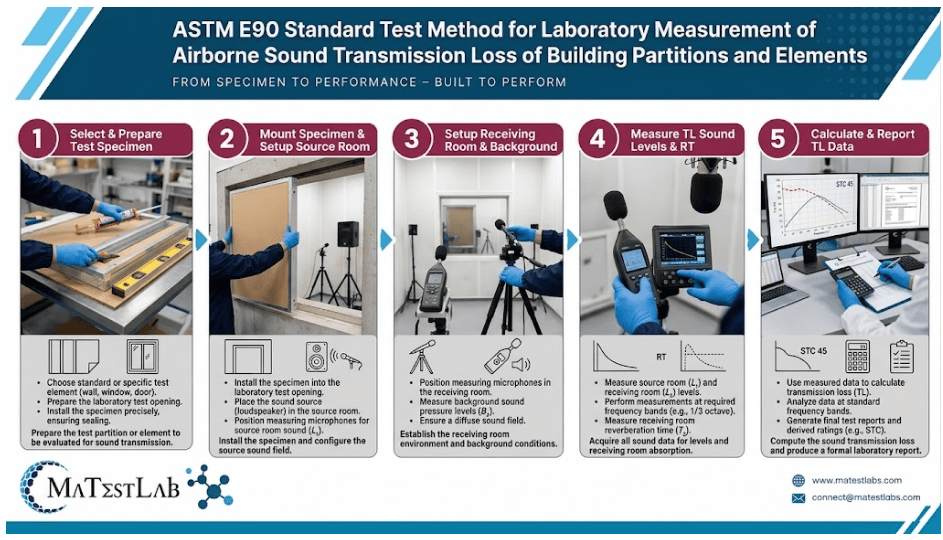
    ASTM E90 requires that the test specimen is positioned between two adjacent reverberation rooms and the resulting acoustic response is measured for the sound transmitted through the test specimen. Average sound pressure levels are measured in both rooms, and sound absorption of the receiving room is measured before sound transmission loss is calculated for each frequency band.

    Read more

    The procedure outlined in ASTM E90 is as follows-

    Specimen InstallationTechnicians install the test specimen between the source and receiving rooms and seal the perimeter to reproduce the intended construction and minimize unwanted transmission paths.
    Acoustic Field GenerationThe sound source produces an approximately diffuse sound field in the source room, with the specimen transmitting airborne acoustic energy into the receiving room.
    Sound Pressure MeasurementTechnicians use the microphone and measurement system to measure the space- and time-averaged sound pressure level in the source room and receiving room.
    Background Noise MeasurementThe receiving-room background noise is measured and evaluated to determine whether noise interference affects the usable transmission-loss results.
    Room Absorption MeasurementThe receiving-room background noise is measured and evaluated to determine whether noise interference affects the usable transmission-loss results.
    Result ReportingEngineers measure source level, receiving level, specimen area, and receiving-room absorption, which are used to calculate sound transmission loss in one-third-octave bands.

    ASTM E90 Testing Process and Data Collection

    ASTM E90 testing involves technicians creating a controlled sound field in the source room and measuring the sound pressure levels in both the source room and the receiving room. The absorption in the receiving room and the area of the exposed specimens are also calculated. The sound transmission loss is calculated by the analysts based on the measured acoustic values for each 1/3 octave. When measurements are performed in both directions, the corresponding transmission-loss values are averaged to obtain the direction-averaged result.

     Building partition installed between two reverberation rooms for ASTM E90 airborne sound transmission loss testing.
    ASTM E90 laboratory measurement of airborne sound transmission loss through a building partition.

    Common Challenges and Troubleshooting

    Many of the common problems encountered in ASTM E90 testing are related to flanking transmission, sealing of the specimen, background noise, lack of diffuse sound fields, microphone response error, and measurement errors of receiving room absorption. Before testing, technicians should check the transmission limits, specimen mounting, perimeter sealing, acoustic field uniformity, microphone performance, and background noise in the laboratory. Additionally, the temperature and relative humidity in the receiving room shall not exceed the above during measurements made when appropriate.

    ASTM E90 Analysis Results and Interpretation

    ASTM E90 results indicate the sound transmission loss in decibels, as a function of frequency. Engineers use these results to determine how well the partition or element they tested will block the transmission of airborne sound over the range of frequencies.

    Read more

    • The laboratory reports mean values of the sound pressure levels in the source room and in the receiving room for each one-third-octave band.
    • When calculating transmission loss, the analyst takes into account receiving-room sound absorption and exposed specimen area.
    • The reported transmission-loss curve shows changes in acoustic isolation across the measured frequency range.
    • When the laboratory tests in both directions (transmission and receive), the engineers check the directional measurements and average them.
    • The results can support calculation of applicable single-number ratings and comparison of similar building elements under controlled laboratory conditions.

    Link to ASTM E90

    FAQ

    Why is ASTM E90 important?
    ASTM E90 is important because it provides controlled laboratory measurements of airborne sound transmission loss through building partitions and elements.
    ASTM E90 is a test method for measuring the airborne sound transmission loss of walls, floor-ceiling assemblies, doors, windows, roofs, panels, and other space-dividing surfaces.
    ASTM E90 specifies the average sound-pressure levels of the source room and receiving room and the absorption in the receiving room and the area of the specimen to calculate sound transmission loss in decibels.

    Updated on September 24, 2026

    Malhar Khole
    About Author
    Malhar Khole is a Material Testing Associate at Matestlab Inc. and holds a postgraduate degree in Material Science and Technology from IIT (BHU), Varanasi.
    Know More
    Testimonials
    Real results
    Engineers trust us with what matters most
    Start Your Testing
    Project Today
    Define your requirements and get access to
    specialized laboratories ready to deliver results
    Partners with us
    Clients
    Vendors
    Process for testing
    • STEP 01

      You share your testing requirements

    • STEP 02

      You share your sample(s)

    • STEP 03

      We deliver your test reports

    Get your testing done

    Let us know your testing requirements and we will be right back with a solution.

      Let us root for each other. Collaborate to grow, expand, and accelerate our businesses.

      Partner with us

        Discover more from Matestlab

        Subscribe now to keep reading and get access to the full archive.

        Continue reading