
ASTM E814 Fire Tests of Penetration Firestop Systems

    Introduction 

    ASTM E814 establishes a systematic procedure for conducting fire tests on penetration firestop systems. These systems maintain building compartmentalization and prevent flames, smoke, and hot gases from passing through openings created by pipes, conduits, cables, and other penetrations. Effective firestops contain fires and protect occupants and property. This method subjects a test assembly to a controlled fire on one side, followed by a subsequent hose stream, to simulate real-life firefighting conditions. The procedure rates the system’s performance based on its ability to block flames (F), limit heat transfer (T), and prevent leakage (L) of gases or smoke. These ratings ensure that buildings comply with fire safety codes and withstand emergency conditions.

    Read more

    Get Certified ASTM E814 Testing for Reliable Fire Containment Systems

    ASTM E814 certification enables manufacturers, contractors, and testing labs to assess and qualify firestop systems as sufficient to meet building code standards. Adherence to the requirements will help to confirm that penetration seals will not lose their fire-resistance classification, even when heated by extreme temperatures. The certified firestop systems contribute to occupants’ life safety by limiting the spread of fire and ensuring the facility’s compartmentation design. They also protect critical infrastructure and minimize insurance, operational, and structural risks associated with fire damage.
    Scope of the ASTM E814 Test

    • Covers penetration firestop systems that reinstate fire resistance in floor and wall assemblies penetrated by mechanical, electrical, or plumbing systems.
    • Applies to metallic or nonmetallic pipes, bundles of conductors, cables, ducts, insulated piping, and mixed-penetration arrangements.
    • Determines fire-resistance performance attributes such as F ratings (flame passage), T ratings (temperature rise), and optional L ratings (air leakage).
    • Represents real building fire conditions using controlled furnace exposures and pressure differentials.

    ASTM E814 Equipment and Sample Preparation

    Test system detailsThe technician constructs the penetration firestop system specimen using a fire-rated assembly containing the specific penetration.
    System sizeThe application and construction components determine the size of the penetration firestop system specimen.
    Test set-up detailsTechnicians construct the penetration firestop system specimen in accordance with the specified design and use the appropriate firestop materials.

    Uses of Firestop System Testing

    • Fire-testing labs, firestop product manufacturers, building code officials, architects, and engineers use this standard to certify firestop systems for rated construction.
    • Facilitates product qualification, regulatory standard development, fire-safety design, and the creation of installation and inspection procedures.
    • Penetrations in fire-rated components create significant risks of fire spread, making this procedure critical for hospitals, high-rise buildings, industrial facilities, and commercial buildings.

    Common Challenges and Troubleshooting

    Common pitfalls include incorrect firestop installation, misjudged spacing or annular rounding, insufficient sealant curing, and a lack of field-condition simulation. Premature flame movement causes test failure. Cracking of the firestop material also causes failure. Inadequate intumescence or excessive heat gain on the unexposed face can also lead to failure. Pressure discrepancies in the furnace produce uneven flame exposure.

    Read more

    Testing Technique, Process, and Data Collection

    Technicians prepare the penetration assembly and mount it on the furnace. They then commence the standard fire-exposure curve to raise the furnace temperature. Heat enters the assembly, testing the integrity of the firestop system. Collected data on the time to visible flame passage, the temperature increase on the unexposed surface, structural material changes, and pressure differentials. They also monitor the uncovered area for cracks, smoke emission, charring, and local hot spots. Operators perform a water-stream impact test after the exposure time ends. This test assesses the assembly’s endurance under mechanical shock.

    ASTM E814 Testing Procedure and Requirements

    System SetupThe analyst positions the penetration firestop system specimen in a test furnace or furnace chamber. Then heat the furnace according to a predetermined fire exposure curve, typically based on the time-temperature relationship for standard fire tests.
    Test TerminationDuring the test, the analyst measures temperatures on both the exposed and unexposed sides of the specimen. The team terminates the test once the system reaches the prescribed fire duration or meets the specific temperature-rise criteria.
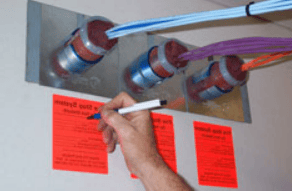
    The image shows the fire stop system.
    Fire Stop System 

    Analysis, Results, and Interpretation


    F ratings measure the time it takes for flames to pass through, while T ratings represent thermal transmission. Assessments also include L ratings for air leakage control. A high fire-resistance rating signifies that a system sustains compartmentation and postpones fire spread. Experts base their interpretation on the penetrant, installation design, firestop material chemistry, and assembly thickness. Discrepancies in intumescence behavior, sealant viscosity, material expansion under heat, or structural compatibility often cause performance variations. Engineers use premature failures to detect design flaws or installation anomalies that require rectification.

    Read more

    FAQ

    Where can I get the astm e814 tested?
    You can share your astm e814 testing requirements with MaTestLab. MaTestLab has a vast network of material testing laboratories, spread across the USA and Canada. We support your all material testing needs ranging from specific astm e814 test to various testing techniques.
    Please contact us for a detailed quote for your astm e814 testing needs. Cost incurred to carry out different astm e814 testing methodology depends on the type of raw material; number of samples, coupons, or specimens; test conditions, turn around time etc. Costs of some ASTM testing methods start from $100 and the final value depends upon the factors listed above. Please contact us for the best and latest prices.
    The required number of samples or specimens should comply with the procedure given in the astm e814 standard. However, the MaTestLab operations team can assist you for your special requirements once you share your testing details with us.
    MaTestLab has a vast testing laboratory network, hence we bring you the best testing facilities in a cost-effective way. We offer considerable discounts (15-20%) to our returning customers based on test volume and frequency.
    The turnaround time for astm e814 test methodology depends upon the test procedure mentioned in the standard test document. However, we at MaTestLab understand your research requirements and hence try to get your test completed within the least possible time.
    Rohit Dhembare
    About Author
    Rohit Dhembare
    Rohit Dhembare is an Operations Associate at MaTestLab Inc. and holds a postgraduate degree in Organic Chemistry.
    Testimonials
    Real results
    Engineers trust us with what matters most
    Start Your Testing
    Project Today
    Define your requirements and get access to
    specialized laboratories ready to deliver results
    Partners with us
    Clients
    Vendors
    Process for testing
    • STEP 01

      You share your testing requirements

    • STEP 02

      You share your sample(s)

    • STEP 03

      We deliver your test reports

    Get your testing done

    Let us known your testing requirements and we will be right back with a solution.

      Let us root for each other. Collaborate to grow, expand, and accelerate our businesses.

      Partner with us

        Contact Us

        Discover more from MaTestLab

        Subscribe now to keep reading and get access to the full archive.

        Continue reading