
ASTM E810 Standard Test Method for Coefficient of Retroreflection of Retroreflective Sheeting

    What is ASTM E810?

    ASTM E810 is a standard test method that defines an instrumental approach to assess the retroreflective performance of retroreflective sheeting for a given entrance and observation angle. The measured values indicate the visual effect of the retroreflective sheeting on light sources, including vehicle headlamps. The method employs a coplanar measurement geometry with the illumination and observation directions confined to the same plane. When appropriate geometry and reference standards are employed, ASTM E810 (Standard Test Method for Coefficient of Retroreflection of Retroreflective Sheeting Utilizing the Coplanar Geometry)  is suitable for use with appropriate laboratory equipment or portable/bench retroreflection instruments.

    Read more

    Get Certified ASTM E810 Testing

    ASTM E810 testing aids manufacturers, traffic-sign manufacturers, material suppliers, engineers, technicians, and quality-control professionals in the assessment of the optical characteristics of retroreflective sheeting. The measurement gives quantitative data that can be used for comparison of materials as well as for testing performance at given observation and entrance angles. Expert testing is especially useful in the case of materials used for traffic control, where night visibility is important. By controlling the geometry of the measurement apparatus, illumination, the receiver response, stray light, specimen positioning, and the reference standards, analysts can obtain reliable retroreflections.
    What is the scope of ASTM E810 testing?

    ASTM E810 describes an instrumental measurement of the retroreflective performance of retroreflective sheeting. The user specifies the entrance and observation angles and may also specify rotation angles. The method is intended primarily for laboratory measurements and requires a sufficiently dark facility so that stray light does not influence the results.  The scope includes:

    Read more

    • Material Type: Retroreflective sheeting used to return incident light toward its source. 
    • Property Measured: Coefficient of retroreflection. 
    • Measurement Geometry: Coplanar geometry between the illumination and observation system. 
    • Entrance Angle: The angle at which illumination reaches the retroreflective specimen. 
    • Observation Angle: The angle between the illumination direction and the observation direction. 
    • Rotation Angle: May be specified by the user where applicable. 
    • Measurement Range: The method has been found useful at observation angles from approximately 0.1° to 2.0° and entrance angles up to 60°. 
    • Laboratory Conditions: The measurement facility must be sufficiently dark to minimize stray-light effects. 
    • Portable Equipment: Portable and bench instruments may be used when the specified geometry and appropriate substitution reference panels are used. 

    What are the Uses of ASTM E810 testing?

    ASTM E810 provides quantitative retroreflection data for evaluating how effectively retroreflective sheeting returns incident light toward an observer located near the light source. The results are particularly relevant to nighttime visibility and the optical performance of traffic-control materials. The method can be used for:

    • Retroreflective Performance: Determine the coefficient of retroreflection of sheeting. 
    • Material Comparison: Compare the optical performance of different retroreflective sheetings. 
    • Quality Control: Monitor consistency of manufactured retroreflective materials. 
    • Product Development: Evaluate changes in sheeting construction, optical elements, or processing. 
    • Traffic-Sign Materials: Characterize sheeting intended for traffic-control signs and devices. 
    • Performance Verification: Generate data for comparison with applicable specifications. 
    • Reference Standards: Establish or use measured reference panels for suitable retroreflection instruments. 
    • Research and Development: Investigate the effects of material construction and measurement geometry on retroreflection. 

    Which Materials Can Be Tested According to ASTM E810?

    ASTM E810 is intended for retroreflective sheeting whose optical performance can be measured using the specified coplanar geometry. The method does not prescribe one particular sheeting construction; different retroreflective technologies can be evaluated when they can be appropriately mounted and measured. Suitable materials may include:

    • Glass-Bead Retroreflective Sheeting: Sheeting that uses glass-bead optical elements. 
    • Microprismatic Sheeting: Sheeting that uses microprismatic optical structures. 
    • Traffic-Control Sheeting: Retroreflective materials intended for traffic signs and related devices. 
    • Flexible Retroreflective Films: Sheet materials suitable for the required measurement setup. 
    • Experimental Sheeting: Newly developed retroreflective materials evaluated during research and development. 
    • Production Sheeting: Manufactured material evaluated for quality control or performance verification. 

    Why is ASTM E810 Testing Important?

    ASTM E810 is significant because it is the requirement for the sheeting used to make signs and other materials more visible when lit at night. The coefficient of retroreflection gives a quantitative index that can be correlated with the visual effect produced with a given measurement geometry. The method is also important for quality control and material comparison because retroreflective performance can vary with optical construction, specimen orientation, measurement angles, and instrument conditions. Standardized geometry and controlled stray light allow analysts to make more meaningful comparisons between measurements.

    ASTM E810 Equipment and Sample Preparation Guide

    ASTM E810 requires a retroreflection measurement system capable of achieving the specified coplanar geometry. The test facility is dark enough to prevent stray light from affecting the receiver. Suitable portable and bench instruments can also be used when they employ the required geometry and properly measured substitution reference panels. 

    Read more

    Coplanar geometry fixtureThe expert positions the illumination and observation system according to the required geometry.
    Reference standard panelThe technician provides a suitable substitution reference for instrument measurement and calibration.
    Specimen holderExperts position the retroreflective sheeting securely and consistently.
    Angle-positioning systemEstablishes the specified entrance, observation, and applicable rotation angles.
    Darkened test facilityExpert minimizes stray light that could affect low-level retroreflection measurements.
    Dimensional and specimen-preparation equipmentExpert cuts, positions, and verifies the test specimen as required by the measurement setup.
    Specimen DimensionsThe technician should record the specimen identification, material orientation, dimensions in mm, surface condition, and any preparation applied before measurement. Specimen orientation should remain consistent when measurements at different entrance or rotation angles are compared.

    ASTM E810 Testing Procedures and Requirements

    ASTM E810 measures retroreflective performance by directing controlled illumination onto the sheeting and measuring the amount of light returned toward the receiver under the specified coplanar geometry. The user defines the entrance and observation angles before testing. The testing process includes the following steps.

    Read more

    Specimen Identification and PreparationTechnicians identify the retroreflective sheeting and mount a representative specimen without damaging or distorting its surface.
    Instrument and Geometry VerificationThe expert establishes the specified coplanar geometry, reference condition, entrance angle, and observation angle.
    Retroreflection MeasurementTechnicians measure the returned light from the specimen at the specified geometric conditions.
    Calculation and EvaluationThe expert determines the coefficient of retroreflection and evaluates the result against the applicable requirement or comparison material.

    ASTM E810 Testing Process and Data Collection

    The technician positions the specimen in the measurement apparatus and establishes the specified entrance and observation angles. The receiver measures the returned light, and the analyst determines the coefficient of retroreflection from the measured photometric response and applicable instrument/reference information. The technician records specimen identification, sheeting type, specimen dimensions in mm, orientation, entrance angle, observation angle, rotation angle where applicable, instrument information, reference-standard information, and test conditions. The analyst documents the measured retroreflection values and calculated RA values.

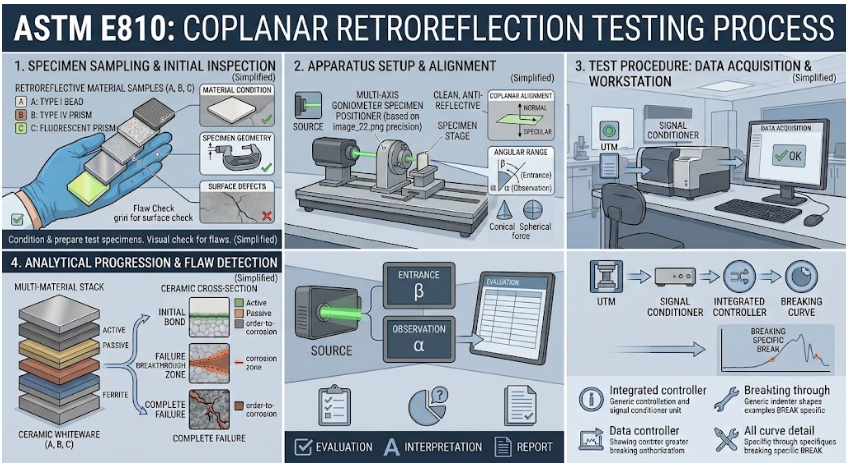
     The image shows retroreflective sheeting mounted in a darkened retroreflectometer with the light source and receiver positioned in coplanar geometry for coefficient of retroreflection measurement.
    ASTM E810 coplanar retroreflection testing process

    Common Challenges and Troubleshooting

    Stray light is one of the biggest sources of error in ASTM E810 tests, especially when testing materials with low coefficients of retroreflection. The test facility should be dark enough, and the instrument should be tested for unwanted light reaching the receiver. ASTM also emphasizes the importance of taking special care of stray light when measuring very low \(R_A\) values. Incorrect entrance or observation angles can also produce results that cannot be meaningfully compared with measurements obtained under different geometry. Technicians should verify the instrument configuration and confirm all specified angles before collecting data. The analyst should use representative, clean specimens and maintain consistent orientation throughout comparative testing.

    Analysis Results and Interpretation

    The ASTM E810 test results provide information about the retroreflective performance of the tested sheeting under a specified coplanar measurement geometry. Analysts should report the measured coefficient of retroreflection together with specimen information, entrance and observation angles, and test conditions for proper interpretation and comparison.

    Read more

    • The main result is the coefficient of retroreflection \(R_A\), which is the retroreflective performance of the specimen under the specified geometry. ASTM E810 correlates the measured values with visual effects for a specified geometric configuration, and the entrance and observation angles are factors to consider when interpreting and comparing results.
    • The technician records specimen identification, sheeting description, specimen dimensions in mm, orientation, entrance angle, observation angle, rotation angle where applicable, instrument information, reference-standard information, and measurement conditions. The analyst documents measured photometric values, calculated RAvalues, and any relevant observations concerning specimen or instrument performance.
    • The report contains the specimen identification, retroreflective sheeting description, dimensions, measurement geometry, entrance angle, observation angle, rotation angle where applicable, reference-standard information, measured values, calculated coefficient of retroreflection, and applicable test conditions.
    • The coefficient of retroreflection is commonly reported in cd·lx⁻¹·m⁻². Angular conditions are reported in degrees (°), while specimen dimensions are recorded in mm.
    • These standardized specimen preparation, coplanar geometry and angle control, reference-standard measurement, illumination, receiver calibration, stray-light control, and data evaluation procedures enable technicians and analysts to consistently deliver reliable and comparable ASTM E810 results.

    Link to ASTM E810

    FAQ

    What is the coefficient of retroreflection?
    The coefficient of retroreflection is a quantitative measure of how effectively a retroreflective surface returns incident light toward the source under a defined geometry.
    The user specifies the entrance and observation angles and may also specify rotation angles. ASTM reports that the method has been found useful for observation angles from approximately 0.1° to 2.0° and entrance angles up to 60°.
    Yes. ASTM E810 permits portable and bench retroreflection equipment when the required geometry and appropriate substitution standard reference panels are used.

    Updated on September 22, 2026

    Rohit Dhembare
    About Author
    Rohit Dhembare is an Operations Associate at Matestlab Inc., holds a postgraduate degree in Organic Chemistry and is trained in Materials Science testing techniques.
    Know More
    Testimonials
    Real results
    Engineers trust us with what matters most
    Why Choose Matestlab?
    Matestlab is a unified testing services partner based in the USA. Matestlab offers raw material and product testing services through accredited, expert laboratories primarily based in the USA. Matestlab supports physical, thermal, chemical, electrical, mechanical, environmental, and characterization testing needs through its global network of 2200+ accredited testing laboratories. Matestlab's in-house materials science experts curate and design comprehensive testing programs matched to the sample material and specific testing need, with regulatory requirements and confidentiality in mind.

    If you are looking for a managed and trusted testing partner to achieve your research goals, feel free to schedule a meeting with us or send us a request at connect@matestlabs.com to learn more about our services. For a quick quote, call us at (302)244-7710. We are happy to serve you.
    Start Your Testing
    Project Today
    Define your requirements and get access to
    specialized laboratories ready to deliver results
    Partners with us
    Clients
    Vendors
    Process for testing
    • STEP 01

      You share your testing requirements

    • STEP 02

      You share your sample(s)

    • STEP 03

      We deliver your test reports

    Get your testing done

    Let us know your testing requirements and we will be right back with a solution.

      Let us root for each other. Collaborate to grow, expand, and accelerate our businesses.

      Partner with us