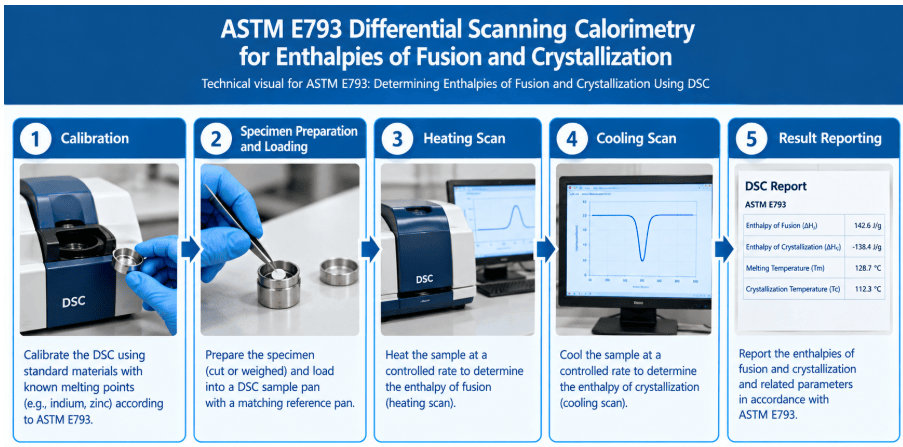
ASTM E793 is a test method that specifies how to use differential scanning calorimetry to measure the enthalpy of fusion and crystallization. It measures enthalpy changes associated with first-order transitions during heating and cooling of a sample through the melting or crystallization point. This standard offers a fast and uniform testing procedure to quantify these thermal transitions under controlled heating and cooling conditions with a DSC instrument.
The main objective of ASTM E793 is to determine the enthalpy of fusion and crystallization of thermally stable materials that exhibit well-defined transition behavior. This test is employed for quality control, specification acceptance, and in materials research in industry.
- Material type: Solid samples in granular form, or in any fabricated shape, and liquid samples that crystallize within the operating range of the instrument.
- Purpose: To determine the enthalpy of fusion and crystallization.
- Properties evaluated: Enthalpy (heat) of fusion and enthalpy of crystallization.
- Testing Method: Heating or cooling of a specimen in a DSC instrument until it reaches the transition temperature to measure heat flow and to calculate the enthalpy value from the area of the transition peak.
- Result: The units of measurement for enthalpy are J/g.
- Test Limitations: In general, the test standard applies to thermally stable materials with well-defined endothermic or exothermic characteristics; results may vary with specimen shape and size.
- Use conditions: Enthalpy values measured are influenced by specimen mass, specimen shape, and heating or cooling rate.
- Applications: Polymer and material quality control, specification acceptance testing, thermal transition research, accredited materials testing.
What are the Uses of ASTM E793 Testing?
ASTM E793 testing helps laboratories to establish the enthalpic variations associated with a material’s melting or crystallization transition. Engineers use these results to ensure quality control and to understand the fit of a material’s transition behavior to a set specification. This standard-
- Compares the enthalpy of fusion of solid and liquid substances.
- Manually alters the heating and cooling rates of a DSC instrument.
- Calculates the value of the enthalpy of crystallization as a material cools through its transition point.
- Helps ensure quality control throughout production runs.
- Facilitates specification acceptance testing of thermally stable materials.
- Helps with materials research and characterization of thermal behavior.
- Supports selection of consistent, predictable transition behavior in materials
What Materials Can Be Tested Under ASTM E793?
ASTM E793 is applicable to solid samples in granular form or to any fabricated shape from which a suitable specimen can be cut by the technician. It also applies to liquid samples that crystallize within the instrument’s operating range. This test method is suitable for most thermally stable materials that have clearly defined endothermic or exothermic transitions; technicians select a specimen form and mass appropriate to the instrument and the transition under evaluation.
Why is ASTM E793 Important?
ASTM E793 is significant as it is a quick and standardized method for measuring enthalpic variations associated with a material’s first-order thermal transitions. Manufacturers and researchers use these measured enthalpy values for quality control, specification acceptance, and materials research.