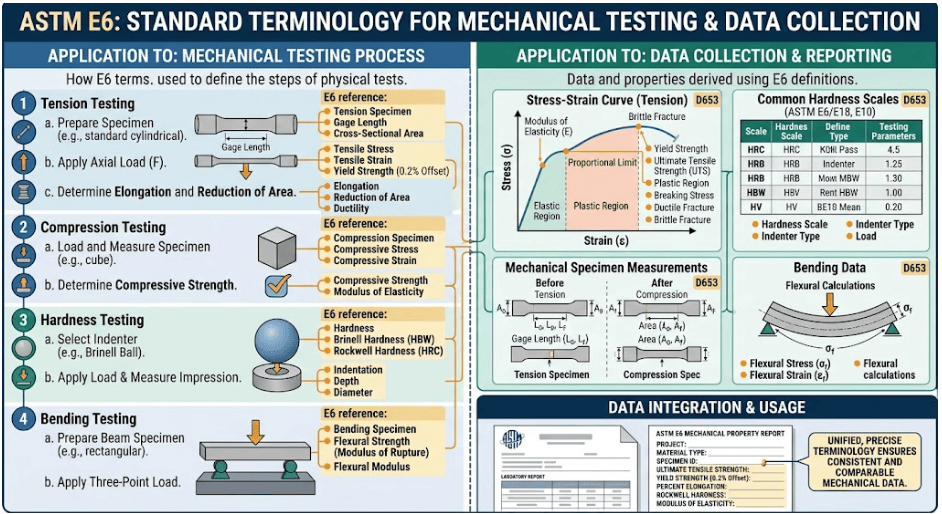
ASTM E6 is a terminology standard that defines the terms associated with the main methods of mechanical testing of solids. The definitions are meant for use in standards that demand or involve mechanical tests and to encourage uniformity in product specifications. The scope of ASTM E6 includes:
- Mechanical testing: Covers principal terminology associated with mechanical testing of solid materials.
- Technical definitions: Provides standardized definitions for terms used in mechanical test standards.
- Solid materials: Applies terminology to the mechanical testing of solid materials and products.
- Test specifications: Support uniform terminology in product specifications and mechanical testing documentation.
- Technical interpretation: Restricts and interprets general definitions when necessary for mechanical testing applications.
- Terminology consistency: Promotes consistent technical communication among engineers, technicians, analysts, and manufacturers.
- Fatigue and fracture: Terms relating specifically to fatigue and fracture testing are defined in ASTM E1823.
What are the Uses of ASTM E6 Testing?
ASTM E6 ensures engineers and analysts use a common language to describe mechanical tests performed on solid materials. The terminology facilitates test methods, product specifications, material characterization, engineering analysis, and reporting activities related to mechanical properties.
- Helps present consistent terminology for mechanical testing.
- Helps with clear descriptions of mechanical properties and test conditions.
- Helps engineers prepare product specifications using uniform technical terms.
- Facilitates uniformity of test terminology.
- Helps analysts understand technical terms in mechanical testing standards.
- Improves consistency in documenting specimens, measurements, and test results.
- Facilitates communication between testing teams, manufacturers, engineers, and material suppliers.
Which materials can be tested under ASTM E6?
ASTM E6 does not specify a physical test for a particular material or specimen. Rather, its terminology is generally applicable to solid materials and products subjected to mechanical testing. Conduct physical testing in accordance with the specific ASTM test method for the material, property, loading condition, and application under consideration.
Why is ASTM E6 Important?
ASTM E6 is significant because it provides a common set of definitions for mechanical testing information, allowing engineers and analysts to interpret it consistently. The terminology aids in the application of test methods, product specifications, material characterization, engineering analysis, and technical reports. The standard helps ensure that terms used to describe mechanical testing have a consistent meaning when applied within ASTM standards. However, technical terms may be used in senses other than mechanical testing, and ASTM E6 recommends using its definition when applicable. Inconsistent terminology, unclear test description, misinterpretation of the mechanical properties, and differences between general and ASTM-specific usage can also affect accurate communication.