
ASTM E561 Standard Test Method for KR Curve Determination

    What is ASTM E561?

    ASTM E561 is a standard test method to measure resistance to fracture for metallic materials during slow, stable crack extension under Mode I loading at static rates. The method develops a continuous K–R curve, which is the relationship between fracture resistance, KR, and crack extension as the applied stress intensity factor increases. Notched and precracked middle-cracked tension M(T) or compact tension C(T) specimens are used in ASTM E561 (Standard Test Method for KR Curve Determination). The method is valid for specimens in which the material is essentially elastic throughout the range of effective crack extension of interest and where stable crack extension occurs. The resulting K-R curve can be used to assess fracture resistance, stable crack extension, and conditions of unstable fracture.

    Read more

    Get Certified ASTM E561 Testing for Reliable Fracture Resistance Evaluation

    The ASTM E561 test is a laboratory test used to characterize the resistance of a metallic material to stable crack extension as the crack-driving force increases. The results can therefore be used to assess the behavior of crack growth, the conditions for stable crack extension, and the onset of unstable fracture by engineers. ASTM E561 testing can help determine appropriate specimen configuration, crack preparation, loading, and data-analysis conditions.
    What is the Scope of the ASTM E561 Test Standard?

    ASTM E561 is used for fracture-resistance tests of metallic materials under Mode I loading at static test rates using notched and precracked M(T) or C(T) specimens. Materials do not have to be strong, thick, or tough, as long as the specimens are not substantially plastic in the range of effective crack extension of interest. The method is applicable when the material exhibits slow, stable crack growth as the crack-driving force increases. SI units are considered to be the standard. The scope of ASTM E561 includes:

    Read more

    • Material: Metallic materials capable of exhibiting slow, stable crack extension.
    • Test method: Determination of fracture resistance using a K-R curve.
    • Loading mode: Mode I loading at static rates.
    • Specimen types: Middle-cracked tension M(T) and compact tension C(T) specimens.
    • Specimen condition: Specimens contain a sharp notch and a fatigue precrack before the stable crack-extension test.
    • Specimen size: Standard specimen proportions are required, while overall size is adjusted according to material yield strength and toughness.
    • Crack behavior: The method applies when the crack extends slowly and stably under increasing crack-driving force.
    • Units: SI units are regarded as standard, with inch-pound values provided for information.

    What are the Uses of ASTM E561 Testing?

    Data for the evaluation of stable crack extension in metallic materials is available from ASTM E561. Hence, K-R curves can be exploited by engineers to study crack behavior and to analyze loading conditions for fracture instability. The ASTM E561 standard-

    • Determines the fracture resistance of metallic materials during stable crack extension.
    • Produces K-R curves of fracture resistance versus crack extension.
    • Measures how tough a material becomes as a crack grows under increasing stress intensity.
    • Assists in evaluating the crack extension in metallic materials.
    • Assists in estimating the extension of stable cracks for an evaluated component geometry.
    • Supports evaluation of loading conditions associated with unstable crack propagation.
    • Supplies fracture-resistance data for engineering and structural evaluations.
    • Assists in the comparison of crack-growth resistances under controlled material and test conditions.

    Which materials can be tested under ASTM E561?

    ASTM E561 is applicable to metallic materials that can undergo slow, stable crack extension with increasing crack-driving force. There is no inherent restraint on the strength, thickness, or toughness of the material, as long as the chosen specimen is predominantly elastic over the range of effective crack extension of interest.

    Why is ASTM E561 Important?

    The importance of ASTM E561 is that it offers a continuous representation of fracture resistance during stable crack growth as opposed to only one fracture-toughness value. Additionally, the K-R curve obtained can be compared to the crack-driving curves to assess stable crack extension and the conditions that correspond to unstable fracture. The K-R data obtained can be affected by factors such as specimen thickness, temperature, strain rate, specimen type, size, loading method, and crack extension. 

    ASTM E561 Equipment and Sample Preparation Guide

    ASTM E561 uses a suitable tension-testing system, loading fixtures, crack-opening displacement measurement equipment, and precisely prepared M(T) or C(T) metallic specimens. To achieve this, technicians need to introduce a sharp fatigue precrack and ensure that the specimen geometry is suitable for the specimen to remain predominantly elastic throughout the effective extension range.

    Read more

    Sample and Specimen DetailsTechnicians use notched and fatigue-precracked metallic M(T) or C(T) specimens with standard proportions. The size of the specimen is chosen based on the yield strength and toughness of the material and the range of effective crack-extension of interest.
    Specimen PreparationAnalysts machine the selected specimen configuration accurately and introduce a sharp starter notch followed by fatigue precracking. The specimen should be of a size such that, in the test, it exhibits predominantly elastic behavior and has sufficient ligament.
    Specimen DimensionsASTM E561 specifies the standard proportions for the specimens; the size of the specimens is not fixed. The dimensions should be based on the material strength, toughness, specimen configuration, and range of crack extension.
    InstrumentationThis equipment consists of an appropriate mechanical testing machine, M(T) or C(T) loading fixtures, force measurement, crack-opening displacement measurement, fatigue-precracking equipment, and data-acquisition equipment for recording load, displacement, and crack-extension data.

    Testing Procedures and Requirements for ASTM E561

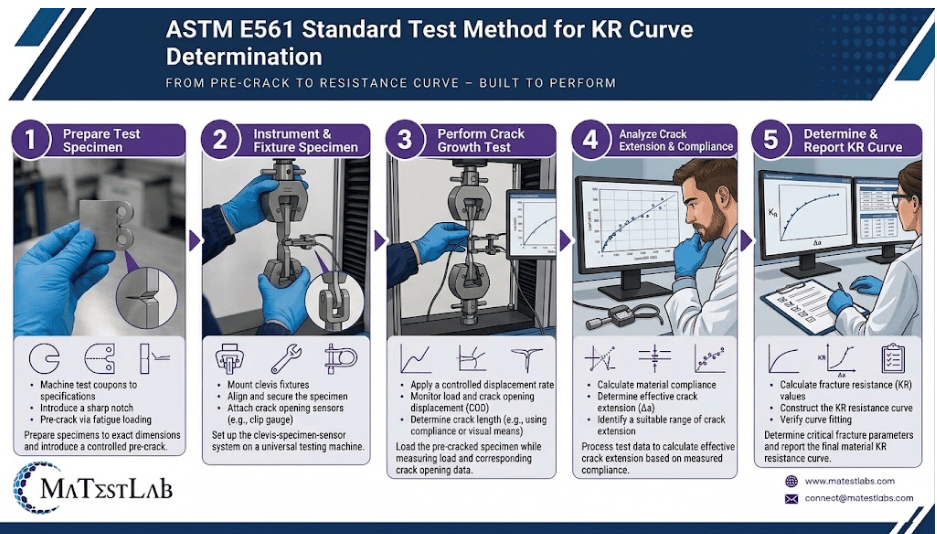
    ASTM E561 involves the preparation of an M(T) or C(T) specimen with a notched and fatigue precrack and the slow driving of the crack under a number of increasing values of stress intensity factor, while observing the crack-extension response. Testing proceeds through stable crack growth until the crack-driving condition of interest limits the acquisition of valid K-R data. The procedure outlined in ASTM E561 is as follows-

    Read more

    Specimen PreparationTechnicians prepare the selected M(T) or C(T) specimen with the required geometry, starter notch, and fatigue precrack before the stable crack-extension test.
    Dimensional MeasurementAnalysts measure the specimen dimensions and initial crack size required for stress-intensity calculations and evaluation of the resulting K-R curve.
    Fixture InstallationTechnicians install the specimen in the appropriate loading fixture and verify proper alignment so that the intended Mode I loading is applied.
    Crack MeasurementThe crack-extension measurement system measures the growth of the fatigue precrack, and force and displacement data are recorded during the test.
    Stable Crack LoadingThe testing machine slowly but steadily raises the crack-driving force under conditions of slow and stable crack propagation.
    Result ReportingThe system records force, displacement, crack extension, and calculated stress-intensity information. These data are used to build K-R curves and assess the fracture-resistance response. 

    ASTM E561 Testing Process and Data Collection

    ASTM E561 involves testing a precracked specimen in the testing machine under an increasing crack-driving force in Mode I. As the crack propagates in a stable manner, the values of force, displacement, and information about crack extension are recorded. The measured crack extension and corresponding stress intensity are used to draw up the K-R curve, which defines the fracture resistance of the material. 

     Precracked metallic specimen undergoing Mode I stable crack-extension testing for ASTM E561 K-R curve determination.
    ASTM E561 K-R curve determination using a precracked metallic fracture specimen.

    Common Challenges and Troubleshooting

    Common problems with ASTM E561 are fatigue precracking, misalignment of specimens, measurement of crack extension, specimen size, and premature unstable crack growth. Therefore, the geometry of specimens, the preparation of cracks, the alignment of loading, the measurement equipment, and the size of specimens should be checked before testing. The thickness of the specimen, temperature, strain rate, and loading configuration should also be taken into account by technicians, as these factors can influence the K-R curve that is obtained. 

    ASTM E561 Analysis Results and Interpretation

    ASTM E561 results give a continuous K-R curve that describes the fracture resistance as a function of the effective crack extension. Thus, the curve is interpreted by the engineers in the context of stable crack growth, applied stress intensity, specimen configuration, material thickness, and the conditions related to unstable crack propagation. 

    Read more

    • The laboratory records the applied loading, crack extension, and the corresponding fracture-resistance values for the construction of the K-R curve.
    • The analyst examines the correlation between the rise in stress intensity factor and the stable crack extension.
    • The laboratory takes into account the thickness of the specimen, its size, shape, temperature, and strain rate in the interpretation of the measured K-R response.
    • Engineers compare K-R curves with crack-driving curves to evaluate expected stable crack extension and conditions associated with instability.
    • Analysts use these results to help assess fractures, characterize materials, evaluate structures, and investigate crack growth. 

    Link to ASTM E561

    FAQ

    Why is ASTM E561 important?
    ASTM E561 is important because it offers a standard procedure for calculating fracture resistance when the crack is slowly expanded in a stable manner and constructing a continuous K-R curve.
    ASTM E561 is a standard used to describe the stable crack-growth resistance of metallic materials and determine the relationship between crack extension and increasing stress intensity.
    ASTM E561 is a measurement of crack extension and the associated stress-intensity-based fracture resistance for use in developing the K-R curve.

    Updated on September 24, 2026

    Rohit Dhembare
    About Author
    Rohit Dhembare is an Operations Associate at Matestlab Inc., holds a postgraduate degree in Organic Chemistry and is trained in Materials Science testing techniques.
    Know More
    Testimonials
    Real results
    Engineers trust us with what matters most
    Why Choose Matestlab?
    Matestlab is a unified testing services partner based in the USA. Matestlab offers raw material and product testing services through accredited, expert laboratories primarily based in the USA. Matestlab supports physical, thermal, chemical, electrical, mechanical, environmental, and characterization testing needs through its global network of 2200+ accredited testing laboratories. Matestlab's in-house materials science experts curate and design comprehensive testing programs matched to the sample material and specific testing need, with regulatory requirements and confidentiality in mind.

    If you are looking for a managed and trusted testing partner to achieve your research goals, feel free to schedule a meeting with us or send us a request at connect@matestlabs.com to learn more about our services. For a quick quote, call us at (302)244-7710. We are happy to serve you.
    Start Your Testing
    Project Today
    Define your requirements and get access to
    specialized laboratories ready to deliver results
    Partners with us
    Clients
    Vendors
    Process for testing
    • STEP 01

      You share your testing requirements

    • STEP 02

      You share your sample(s)

    • STEP 03

      We deliver your test reports

    Get your testing done

    Let us know your testing requirements and we will be right back with a solution.

      Let us root for each other. Collaborate to grow, expand, and accelerate our businesses.

      Partner with us