ASTM E328 Stress Relaxation for Materials and Structures

    What is ASTM E328?

    ASTM E328 is a standard test method for determining the time dependence of stress, known as stress relaxation, in materials and structures. The method measures the change in external force to keep the constraint approximately constant over time. ASTM E328 includes stress-relaxation tests for tension, compression, bending, and torsion. The test helps explain how materials and structures behave under long-term deformation when subjected to stress. Thus, ASTM E328 (Standard Test Methods for Stress Relaxation for Materials and Structures) data can be applied to the long-term stress retention of parts and assemblies that require constant force or constraint.

    Read more

    Get Certified ASTM E328 Testing for Reliable Stress Relaxation Evaluation

    ASTM E328 testing is a standard procedure for determining stress relaxation under essentially constant constraint, a constant test environment, and minimal vibration. The test begins by applying a (restraining) force to the specimen from the outside and then determines how much force is needed over time to keep the specimen constrained. Thus, engineers are able to assess the ability of materials to retain stress in long service lives. The results can be used to assess mechanically fastened joints, pressed or shrink-fit components, gaskets, springs, wrapped connections, and wire tendons for prestressed concrete.

    What is the Scope of the ASTM E328 Test Standard?

    ASTM E328 defines the time-dependent behavior of stress in materials and structures subjected to essentially constant constraint and a test environment with little vibration. Specific methods of testing for tension, compression, bending, and torsion stress-relaxation are provided in the standard. The scope of ASTM E328 includes:

    Read more

    • Material type: Materials and structures suitable for stress-relaxation evaluation.
    • Purpose: Determination of the time-dependent decrease in stress under approximately constant constraint.
    • Primary property: Stress relaxation and the corresponding change in external force.
    • Loading method: Tension, compression, bending, or torsion.
    • Test condition: Approximately constant constraint throughout the test.
    • Environment: A constant and controlled test environment.
    • Vibration condition: Negligible vibration during testing.
    • Testing duration: Long-duration testing to characterize time-dependent stress relaxation.
    • Data evaluation: Remaining stress, relaxed stress, applied force, and fraction of initial stress relaxed can be evaluated.
    • Plastics limitation: Plastics stress-relaxation testing falls under ASTM D2991 rather than ASTM E328.
    • Bending limitation: Ring-shaped specimens machined from bulk material fall outside the 

    What are the Uses of ASTM E328 Testing?

    ASTM E328 testing assesses the loss of stress or force when materials or structures are subjected to nearly constant restraint. Thus, the outcomes can be useful for engineers to comprehend how materials cope with stress for long service times. The ASTM E328 standard:

    • Measures relaxation of stresses at nearly constant constraint.
    • Assesses the stress-relaxation properties under tension, compression, bending, and twisting forces.
    • Identifies changes in stress or force during a test period.
    • Assesses the capacity of materials to hold stress when they are continually and slowly deforming.
    • Helps in designing mechanically fastened joints.
    • Assists in the analysis of permanent tightness of bolted or riveted joints.
    • Helps assess press- or shrink-fit parts.
    • Assists in determining the loss of gasket tightness.
    • Allows the evaluation of hoop stress in solderless wrapped connections.
    • Helps with the analysis of the force of springs.

    Which materials can be tested under ASTM E328?

    ASTM E328 is applicable to materials and structures from which suitable specimens for stress-relaxation tests in tension, compression, bending, or torsion can be made. When the geometry of wire, plate, sheet, strip, bar, and rod materials is appropriate to the applicable method, it can be used as a suitable specimen. The specimen preparation should minimize changes in the residual stress, since stress-relaxation characteristics may be influenced by changes in the residual stresses. Thus, the technician should control the machined, handled, aligned, and surface condition before testing.

    Why is ASTM E328 Important?

    ASTM E328 is important because stress relaxation can reduce the force or stress maintained by a material while its constraint remains approximately constant. Mechanically fastened connections, press- or shrink-fit fittings, gaskets, springs, wrapped connections, and prestressed structural components can all be affected by this behavior. The standard offers controlled procedures for measuring this time-dependent behavior. Thus, the results can be used by engineers to achieve practical design data and to explore the fundamental behavior of materials under prolonged constraint. But small changes in constraint can make a big difference in the stress-relaxation results. Measured response can also be affected by the temperature, residual stress, material composition, geometry of the specimen, vibration, and loading conditions.

    ASTM E328 Equipment and Sample Preparation Guide

    According to ASTM E328, equipment must be capable of applying the initial force and maintaining a constant constraint at approximately the same level throughout the stress-relaxation period. The type of equipment varies based on the type of testing the lab conducts, such as tension, compression, bending, or torsion.

    Read more

    Sample and Specimen DetailsMetal wire, plate, sheet, strip, bar, rod, or other suitable shapes ready for a chosen loading method.
    Specimen PreparationTechnicians prepare specimens with appropriate geometry and surface condition. The changes in residual stresses should be minimized during machining, and surfaces should be smooth without nicks or scratches.
    Specimen DimensionsTension specimens may use round configurations such as 0.375 inches × 7.000 inches, 0.375 inches × 6.000 inches, 0.252 inches × 4.000 inches, or 0.500 inches × 6.000 inches for diameter × gauge length. Compression specimens use cylindrical specimens with an L/D ratio of 8 to 10.
    InstrumentationThe laboratory uses a suitable testing machine, force-measurement equipment, strain or displacement measurement equipment, temperature measurement equipment, and applicable fixtures.

    Testing Procedures and Requirements for ASTM E328

    ASTM E328 allows the laboratory to measure the change in force or stress for a period of time under approximately constant constraint. For this reason, the laboratory must control specimen preparation, loading, temperature, and measurement conditions during the test. The procedure outlined in ASTM E328 is as follows-

    Read more

    Specimen PreparationTechnicians prepare and inspect the specimen of suitable dimensions, surface condition, alignment, and geometry for the selected method of stress relaxation.
    Environmental ConditioningTechnicians set up the desired test conditions and provide thermal equilibrium and dimensional stability for the specimen as needed.
    Initial LoadingAnalysts apply the necessary initial force or stress without impact or vibration and set the initial strain or constraint.
    Zero-Time EstablishmentThe engineers define zero time when the desired initial stress or test condition is attained.
    Constant Constraint and Stress MonitoringThe testing apparatus applies the necessary constraint and the external force or stress varies with time. Then, analysts calculate remaining stress, relaxed stress, or applied force during the test period(s) specified.
    Data CollectionThe laboratory records initial and final stress and strain data together with applicable specimen, temperature, atmosphere, and test information.
    Result ReportingThe engineer’s report includes specimen geometry, equipment, methodology of measurements, temperature, atmosphere, initial conditions, final conditions, and relevant plots of the data.

    ASTM E328 Testing Process and Data Collection

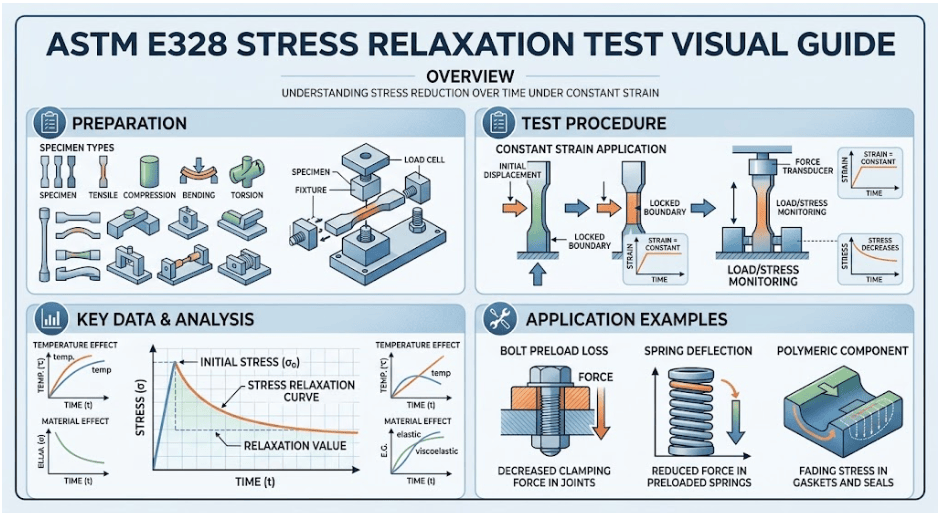
    ASTM E328 testing starts with selecting and preparing a specimen appropriate for the loading mode being tested. The specimen is then set up in the desired apparatus and a desired strain, displacement, or other constraint is applied. The laboratory makes the specimen thermally equilibrated if it is required. The initial force or stress is applied without a shock, and zero time is defined when the desired initial condition is met. The testing system then records the results of the measurements of changes in force or stress over time, while keeping the constraint approximately constant. The resulting data characterize the relaxation of the material or structure under the chosen conditions; stress-retention characteristics of materials can be compared when evaluated under similar temperature, loading, and environmental conditions.

    The image shows material specimens maintained under approximately constant strain during ASTM E328 stress-relaxation testing while stress decreases over time.
    ASTM E328 Stress-Relaxation Testing for Materials and Structures

    Common Challenges and Troubleshooting

    Accurate ASTM E328 results require careful control of constraint, specimen alignment, temperature, loading, and vibration. It can be challenging to maintain constant constraint, and slight differences in constraint can impact the observed stress-relaxation behavior. The presence of residual stress should also be considered, as machining may alter the stress-relaxation behavior of the material. Therefore, it is necessary for technicians to use proper machining practices and not cause unnecessary deformation when preparing specimens. Another significant issue is temperature, as stress-relaxation behavior is dependent on the test environment. So it is important for the laboratories to keep the mentioned temperature and reduce the vibrations during the test period.

    ASTM E328 Analysis Results and Interpretation

    ASTM E328 results provide information on the stress relaxation of materials or structures over time under conditions of approximately constant strain or constraint. Analysts determine the relaxation behavior of the material under the prescribed test conditions by analyzing the changes in stress or force over time. The data that are recorded allow engineers to compare the different materials and understand the differences in stress-retention behavior. Thus, these results may be used to aid material selection, component design, quality control, and long-term performance evaluation.

    Read more

    • The laboratory records stress, force, strain, and test time to establish the stress-relaxation response.
    • The analyst compares stress or force reduction to assess the amount of stress relaxation with time.
    • The laboratory provides results in MPa or ksi, depending on the applicable test, and in h or min, and records the test temperature in °C.
    • Engineers compare stress-relaxation behavior among materials tested under equivalent loading, temperature, and environmental conditions.
    • Analysts use the recorded results to support material evaluation, component design, quality control, and prediction of long-term stress retention.

    Link to ASTM E328

    FAQ

    Why is ASTM E328 important?
    ASTM E328 is important because it offers standard methods to determine time-dependent reduction in stress or force at nearly constant constraint.
    Stress-relaxation behavior of materials and components under tension, compression, bending, and torsion for long-term evaluation can be evaluated using ASTM E328.
    ASTM E328 quantifies the change in stress or force under approximately constant constraint with time. Stress may be reported in MPa or ksi and time reported in h or min, as appropriate.

    Updated on September 13, 2026

    Malhar Khole
    About Author
    Malhar Khole is a Material Testing Associate at Matestlab Inc. and holds a postgraduate degree in Material Science and Technology from IIT (BHU), Varanasi.
    Know More
    Testimonials
    Real results
    Engineers trust us with what matters most
    Start Your Testing
    Project Today
    Define your requirements and get access to
    specialized laboratories ready to deliver results
    Partners with us
    Clients
    Vendors
    Process for testing
    • STEP 01

      You share your testing requirements

    • STEP 02

      You share your sample(s)

    • STEP 03

      We deliver your test reports

    Get your testing done

    Let us know your testing requirements and we will be right back with a solution.

      Let us root for each other. Collaborate to grow, expand, and accelerate our businesses.

      Partner with us

        Discover more from Matestlab

        Subscribe now to keep reading and get access to the full archive.

        Continue reading