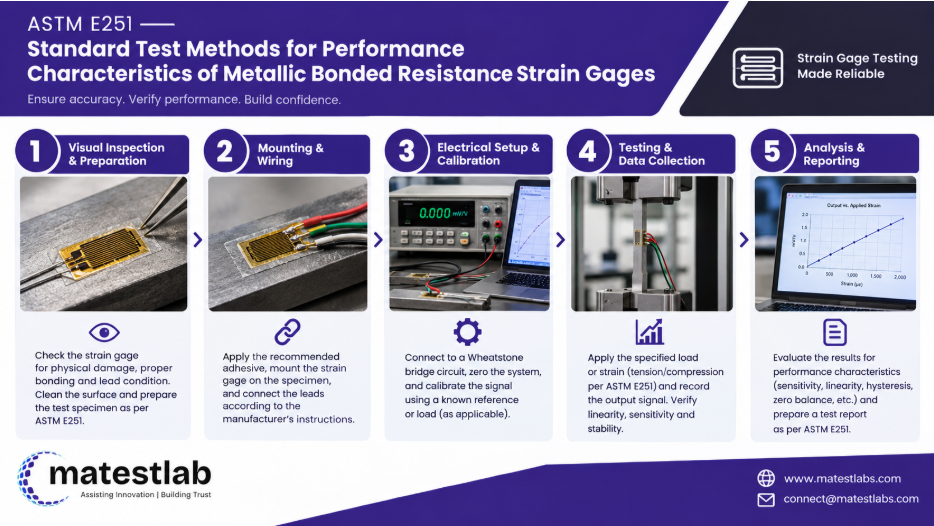
ASTM E251 Standard Test Methods for Performance Characteristics of Metallic Bonded Resistance Strain Gages
What is ASTM E251?
ASTM E251 is a set of standard test methods to measure the performance properties of metallic-bonded resistance strain gages. The standard gives consistent methods for testing critical strain gage attributes, which impact measurement accuracy. ASTM E251 (Standard Test Methods for Performance Characteristics of Metallic Bonded Resistance Strain Gages) addresses resistance, gage factor, temperature coefficient of gage factor, transverse sensitivity, and thermal output, all of which are measured at a reference temperature. These properties aid in the understanding of the response of strain gages to mechanical strain and temperature variations in the laboratory or manufacturing environment. The standard also suggests designs of test equipment that can be used to measure these performance characteristics.
Get Certified ASTM E251 Testing for Accurate Strain Gage Performance Evaluation
Metallic bonded resistance strain gages give sensitive measurements of the small dimensional changes of structures and materials. They are dependent upon the gage material, geometric design, bonding process, temperature, instrumentation and installation technique. ASTM E251 offers laboratories controlled test methods for determining the important performance characteristics to test the behavior of the strain gage. These measurements are used to describe the strain gage and to give information about the gage’s performance for a correct measurement of strain.
What is the Scope of the ASTM E251 Standard?
The ASTM E251 establishes common test methods for evaluating the performance characteristics of metallic bonded resistance strain gages. The standard includes: Resistance at a reference temperature, gage factor at a reference temperature, temperature coefficient of gage factor, transverse sensitivity, and thermal output. These qualities enable users to know the behaviour of the strain gages and to consider factors that could impact measurement accuracy. ASTM E251 only applies to metallic bonded resistance strain gages and not to transducers (load cells and extensometers) that contain bonded resistance strain gages as sensing elements.
Material type: Metallic bonded resistance strain gages.
Purpose: Evaluation of strain gage performance characteristics.
Properties evaluated: Resistance at a reference temperature, gage factor, temperature coefficient of gage factor, transverse sensitivity, and thermal output.
Testing method: Technicians attach strain gages to suitable test specimens and conduct the appropriate mechanical, electrical, and temperature tests.
Resistance measurement: The electrical resistance of the strain gage is measured at a specified reference temperature.
Gage factor: A relationship between the change in resistance and applied strain is determined by technicians.
Temperature coefficient: The gage factor is a property that is measured with respect to temperature.
Transverse sensitivity: Technicians test the strain gage response when strain is applied across the axis being measured.
Thermal output: Technicians determine the amount of strain gage response due to temperature changes.
Applications: Strain measurement, gage characterization, quality control, product development, and evaluation of performance.
What are the Uses of ASTM E251?
ASTM E251 describes the performance characteristics of metallically bonded resistance strain gages in detail. The results are used by manufacturers and laboratories to characterize strain gages and to understand the factors that affect them in their measurement.
The test methods:
Determine strain gage resistance at a reference temperature.
Determine the gage factor at a reference temperature.
Determine the changes in gage factor due to temperature change.
Determine the transverse sensitivity of strain gages.
Calculate thermal output of strain gages.
Give performance data for the characterization of strain gages.
Ensure quality control and manufacturing consistency.
Include instructions on how to consider some of the characteristics of strain gages that may influence the accuracy of the measurement.
Recommend the use and application of strain gages in structural and materials testing.
Which Materials and Components Can Be Tested Under ASTM E251?
Metallic bonded resistance strain gages attached to appropriate test specimens are applicable to ASTM E251. Technicians attach the gages to specimens that impart the necessary mechanical strain and temperature conditions to the test applied. The testing system may consist of the strain gage, bonding adhesive, lead wires, instrumentation, test specimen and environmental protection. The standard acknowledges the influence these components can have on the performance of a strain gage and the accuracy of the measurement.
Why is ASTM E251 Important?
ASTM E251 specifies consistent methods for testing certain characteristics of strain gage performance which are directly related to the measurement of strain. The resistance change induced by the applied strain is related to gauge factor, and other measurement effects such as temperature coefficient, transverse sensitivity and thermal output can be caused. Characterization of these properties in a laboratory, where they can be controlled, allows for performance data that can be used to interpret strain measurements. ASTM also points out that there are a number of strain gage performance parameters that can only be determined through destructive testing and that these data need to be analyzed statistically and measurement uncertainties need to be considered.
ASTM E251 Equipment and Sample Preparation Guide
ASTM E251 uses appropriate test specimens, metallic bonded resistance strain gages, electrical measurement equipment, mechanical loading equipment, and temperature-control equipment to determine the applicable performance characteristics.
The technicians choose representative metallic bonded resistance strain gages and appropriate testing specimens to provide the mechanical and temperature conditions necessary for testing.
Specimen Preparation
The technician prepares the sample surface, places the strain gage in the correct position and attaches the lead wires and instrumentation such that it is in accordance with the applicable test procedure.
Specimen Dimensions
The dimensions and geometry of the specimen vary by performance characteristics, and the technician chooses the appropriate specimen dimensions and geometry for the loading and strain conditions that the performance characteristic requires.
Instrumentation
The testing includes equipment capable of measuring resistance, strain, mechanical loading, temperature, data acquisition, and other relevant laboratory equipment.
Testing Procedures and Requirements for ASTM E251
ASTM E251 specifies test procedures for evaluating various performance characteristics of strain gages. Technicians control the mechanical and environmental conditions; they record the strain gage’s electrical response at each applicable evaluation.
Laboratory measurement of the transverse sensitivity is the ratio between the strain gage response and strain measured across the primary measurement axis.
Resistance Measurement
The temperature change produces heat, which is recorded by the analyst.
Gage Factor Testing
The laboratory documentation includes information on the tests performed, measurements taken, calculations performed, and the associated uncertainty.
Temperature Coefficient Testing
Analysts use the results to describe the behaviour of the strain gages and aid in the interpretation of strains.
Transverse Sensitivity Testing
Transverse sensitivity is measured by applying strain across the primary measurement axis and measuring the strain gage output.
Thermal Output Testing
Technicians change the strain gage temperature and check its output response to calculate thermal output.
Data Collection
Resistance, strain, temperature and electrical output data are recorded throughout the range of the test using automated or manual instrumentation.
ASTM E251 Testing Process and Data Collection
The analyst chooses representative strain gages and appropriate test specimens to meet the performance characteristic needed. The technicians prepare the surface of the specimen, bond the strain gage to the specimen and establish the necessary electrical connections. The operator then applies a mechanical strain to the strain gage or a temperature and observes the electrical measurement and records it. The resistance, applied strain, temperature and parameters etc. required during the test are measured by the technicians throughout the test period. From the collected data, the analyst will be able to calculate the gage factor, temperature coefficient of gage factor, transverse sensitivity, thermal output or reference resistance (as appropriate). The laboratory checks the results and documents the performance characteristics and relevant test conditions in the final report.
ASTM E251 Performance Testing of Metallic Bonded Resistance Strain Gages
Common Challenges and Troubleshooting
Technical difficulties may arise in an ASTM E251 test if the technician does not prepare the bonding surface properly, misaligns the strain gage, introduces electrical interference, or does not keep the temperature constant. Inadequate bonding may impact transfer of strain between specimen and strain gage, and incorrect alignment may impact transverse sensitivity measurements. Temperature changes may also affect thermal output measurements, as may the gage factor. To prepare and clean the bonding surface properly, to check electrical connections, to keep the test conditions stable, and to inspect the instrumentation before testing, technicians should be properly trained. Measurement equipment and controlled laboratory conditions are calibrated correctly to enhance the reliability of the results.
ASTM E251 Analysis Results and Interpretation
The report presents the characteristics of the tested metallic bonded resistance strain gauges in a summary.
ASTM E251 is used to test resistance strain gauges that are metallic bonded to determine their primary performance parameters, such as resistance at a reference temperature, gage factor, thermal output, temperature coefficient of gage factor, and transverse sensitivity.
What is a gage factor under ASTM E251?
The gage factor is a ratio that relates the increase in a strain gage’s electrical resistance to the strain applied to the gage.
Is ASTM E251 the same as calibrating an individual strain gauge?
No, ASTM cannot be calibrated; it can only be calibrated as a unit. The standard establishes the performance parameters and uncertainties of the strain gages for use in measuring that users can then take into account.
Rohit Dhembare is an Operations Associate at Matestlab Inc., holds a postgraduate degree in Organic Chemistry and is trained in Materials Science testing techniques. Know More
Testimonials
Real results
Engineers trust us with what matters most
“We had a great experience working with this company for our ASTM E84 testing. They were the first company to respond to our inquiry within just a few minutes of submitting it. From start to finish, the communication was excellent, and the entire process was swift, straightforward, and hassle-free.”
Ivars FancyWalls
United States
“Very good communication, testing associates were very patient with delays on our end. Reasonable turnaround time for results and nicely detailed report. Analysts were also quick to answer any follow-up questions. Happy with results.”
Skye Henderson
United States
“Matestlab connected us with an accredited lab within days, cutting weeks off our product validation timeline.”
Rebecca Kozodoy-Pins
United States
Why Choose Matestlab?
Matestlab is a unified testing services partner based in the USA. Matestlab offers raw material and product testing services through accredited, expert laboratories primarily based in the USA. Matestlab supports physical, thermal, chemical, electrical, mechanical, environmental, and characterization testing needs through its global network of 2200+ accredited testing laboratories. Matestlab's in-house materials science experts curate and design comprehensive testing programs matched to the sample material and specific testing need, with regulatory requirements and confidentiality in mind.
If you are looking for a managed and trusted testing partner to achieve your research goals, feel free to schedule a meeting with us or send us a request at connect@matestlabs.com to learn more about our services. For a quick quote, call us at (302)244-7710. We are happy to serve you.
Start Your Testing Project Today
Define your requirements and get access to specialized laboratories ready to deliver results