ASTM E208 Conducting Drop-Weight Test to Determine Nil-Ductility Transition Temperature of Ferritic Steels

    What is ASTM E208?

    ASTM E208 is a standard test method for conducting a drop-weight test to determine the nil-ductility transition temperature (NDT) of ferritic steels. Ferritic steels can become increasingly susceptible to brittle fracture as temperatures decrease, particularly when flaws or cracks are present. Evaluating this brittle behavior is important for structural components exposed to low-temperature service conditions. ASTM E208 (Standard Test Method for Conducting Drop-Weight Test to Determine Nil-Ductility Transition Temperature of Ferritic Steels) provides a standardized drop-weight test method for determining the NDT temperature of ferritic steels. The test method applies a controlled impact load to specially prepared specimens at selected temperatures to identify the highest temperature at which fracture occurs. The NDT temperature gives engineers a way to characterize the low-temperature fracture behavior of ferritic steels and supports material selection, component design, and safety assessment of important components. 

    Read more

    Get Certified ASTM E208 Testing for Reliable Steel Performance

    Ferritic steels are prone to low-temperature brittle fracture, especially in the presence of flaws or cracks. ASTM E208 specifies a standard test method for the NDT temperature determination by means of a drop-weight test on prepared steel specimens at a specified temperature. The test method helps manufacturers, engineers, and quality control personnel assess the low-temperature fracture behavior of ferritic steels and confirm material compliance with specified requirements. For more information about ASTM E208 testing, consult Matestlab Inc.

    What is the Scope of the ASTM E208 Test Standard?

    ASTM E208 covers the determination of the nil-ductility transition temperature (NDTT) of ferritic steels using a drop-weight test. The test evaluates the temperature at which a ferritic steel specimen changes from ductile behavior to brittle fracture under specified impact conditions. The primary purpose of ASTM E208 is to determine the nil-ductility transition temperature of ferritic steels. The results help evaluate the susceptibility of steel materials to brittle fracture and support material selection, quality control, and evaluation of steel performance.

    Read more

    The scope of ASTM E208 includes:

    • Material type: Ferritic steels
    • Purpose: Determination of nil-ductility transition temperature (NDTT)
    • Property measured: Nil-ductility transition temperature
    • Method: A drop-weight test is performed on prepared ferritic steel specimens under specified conditions to determine the temperature at which a specimen exhibits brittle fracture.
    • Result: Nil-ductility transition temperature (NDTT), reported as a temperature.
    • Test limitations: The method applies to ferritic steels meeting the dimensional and material requirements specified by the standard.
    • Test conditions: The standard controls specimen dimensions, notch preparation, impact conditions, and test temperature.
    • Applications: Evaluation of ferritic steels for brittle-fracture susceptibility, material qualification, quality control, research and development, and structural material assessment.

    What are the Uses of ASTM E208?

    This test method plays an important role in the oil and gas, automotive, aerospace, and construction industries by helping engineers evaluate material durability and safety and assess its resistance to sudden impact failure. Materials manufacturers, steel producers, engineering laboratories, and quality-control professionals use ASTM E208 to evaluate the low-temperature fracture behavior of ferritic steels. The ASTM E208 test method-

    • Determines the nil-ductility transition temperature. 
    • Evaluates susceptibility to brittle fracture at low temperatures. 
    • Supports material qualification and specification requirements. 
    • Compares the fracture behavior of different ferritic steels. 
    • Provides data for assessing materials used in critical structural applications. 
    • Supports fracture-toughness evaluations where drop-weight testing is specified.

    Which materials can be tested under ASTM E208?

    ASTM E208 applies to ferritic steels, including applicable low-alloy and HSLA steels, that are 5/8 in. (15.9 mm) or thicker. Engineers also test advanced materials, such as HSLA steels, to achieve weight reduction without compromising structural integrity. The standard includes α-iron steels, martensitic steels, pearlitic steels, and other non-austenitic steels. Engineers and manufacturers use this test to evaluate steels used in applications where low-temperature fracture behavior is critical, including structural components, pressure vessels, ship structures, machinery, and forged and cast steel components.

    Why is ASTM E208 important?

    ASTM E208 is important because the fracture strength of ferritic steels can change significantly with temperature. As temperature decreases, a steel may become more susceptible to brittle fracture when a flaw or crack is present. By determining the NDT temperature, ASTM E208 provides a standardized reference for evaluating this temperature-dependent fracture behavior. The results can help engineers and manufacturers make informed decisions regarding material selection, quality control, specification compliance, and safe application of ferritic steels.

    ASTM E208 Equipment and Sample Preparation Guide

    Proper specimen preparation and drop-weight machine setup are important for obtaining a valid test result. ASTM E208 uses a drop-weight machine with a vertically guided, free-falling weight and a rigidly supported anvil. The machine must allow the weight to be released from the required height and provide the specified impact energy for the steel being tested. The ASTM E208 test method involves the following equipment and sample preparation steps-

    Read more

    Specimen detailsTechnicians prepare standard rectangular ferritic-steel specimens that are 5/8 in. (15.9 mm) or thicker for determining the NDT temperature.
    Specimen PreparationTechnicians prepare the specimen according to the specified dimensions and requirements. 
    Crack-Starter WeldTechnicians apply a weld bead to the specimen surface to promote cleavage-crack initiation during impact.
    Temperature ConditioningTechnicians condition each prepared specimen at the selected test temperature before conducting the drop weight test.
    InstrumentationThe drop weight machine uses a vertically guided, free-falling weight to apply a controlled impact load to the specimen. The falling weight generally ranges from 50 to 300 lb (22.7 to 136 kg), with potential energy from 250 to 1200 ft·lbf (340 to 1630 J), depending on the steel’s yield strength.

    Testing Procedures and Requirements for ASTM E208 

    The ASTM E208 test involves conditioning a prepared specimen to a selected temperature and then subjecting it to a single impact from a free-falling weight. After the impact, technicians examine the specimen to determine whether it broke, did not break, or produced a no-test result. Technicians continue testing at selected temperatures until they determine the NDT temperature. Other related standards include ASTM E23 for notched bar impact testing of metallic materials and ASTM E1820 for measurement of fracture toughness. The ASTM E208 test method comprises the following test procedure-

    Read more

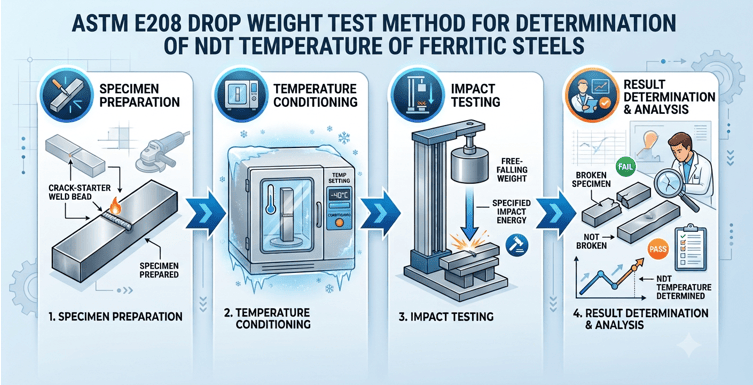
    Specimen PreparationTechnicians prepare the specified drop-weight specimens and apply the required crack-starter weld bead.
    Temperature ConditioningTechnicians condition each specimen to the selected test temperature before testing.
    Impact TestingTechnicians position the specimen on the anvil and release the guided weight from the specified height to apply the required impact energy.
    Result Determination and AnalysisTechnicians examine the specimen to determine whether it breaks and use results from different temperatures to determine the NDT temperature.

    ASTM E208 Testing Process and Data Collection

    The analyst first selects and prepares the required ferritic-steel specimens. Technicians apply the crack-starter weld bead and condition the specimens at predetermined temperatures. Each specimen is then positioned on the anvil, and the guided weight is released from the specified height to apply the required impact energy. After each impact, technicians examine the specimen to determine whether it breaks. The analyst records the test temperature and break/no-break response for each specimen and uses these observations to determine the NDT temperature.

    The image shows the drop-weight testing method used to determine NDT temperature as per ASTM E208.
    ASTM E208 Drop-Weight Test for Determining the NDT Temperature of Ferritic Steels

    Common Challenges and Troubleshooting

    ASTM E208 testing requires careful control of specimen preparation, temperature conditioning, equipment alignment, and impact energy. Improper preparation of the crack-starter weld bead can affect crack initiation and the test result. MaTestLab follows appropriate testing procedures and uses appropriate equipment to provide reliable temperature measurements.

    ASTM E208 Analysis Results and Interpretation

    The ASTM E208 report summarizes the nil-ductility transition temperature based on the break/no-break behavior of the tested specimens. The drop-weight test method determines the fracture behavior, impact strength, and toughness. The laboratory records the temperature at which each specimen is tested. 

    Read more

    • The test results establish the temperature limits for break and no-break performance. A duplicate test at the lowest no-break temperature confirms the no-break result. 
    • The maximum temperature at which a standard drop-weight specimen breaks is identified as the NDT temperature. The laboratory reports the NDT temperature in °C based on the highest temperature at which the standard drop-weight specimen breaks under the specified test conditions.
    • The laboratory compares the measured NDT temperature with the applicable material specification or customer requirement, where specified. 
    • A lower NDT temperature generally indicates that the steel resists brittle fracture at lower temperatures. In comparison, a higher NDT temperature indicates greater susceptibility to brittle fracture.
    • Engineers can assess the specimen’s response at different temperatures and determine its suitability for end-use applications.

    Link to ASTM E208

    FAQ

    What is the main purpose of ASTM E208?
    The main purpose of ASTM E208 is to determine the nil-ductility transition (NDT) temperature of ferritic steels by using a controlled drop-weight impact test.
    The NDT temperature is the maximum temperature at which a standard ASTM E208 drop-weight specimen breaks under the specified test conditions.
    The test provides information on the temperature-dependent brittle-fracture behavior of ferritic steels, supporting material qualification and fracture-related requirements for critical structural and pressure-containing applications.
    Dr Ruchika Yogesh
    About Author
    Dr Ruchika Yogesh
    Dr. Ruchika Yogesh is an entrepreneur, science and AI/ML enthusiast, medicinal chemistry subject matter expert (SME), scientific/medical copyeditor, and an independent researcher.
    Testimonials
    Real results
    Engineers trust us with what matters most
    Start Your Testing
    Project Today
    Define your requirements and get access to
    specialized laboratories ready to deliver results
    Partners with us
    Clients
    Vendors
    Process for testing
    • STEP 01

      You share your testing requirements

    • STEP 02

      You share your sample(s)

    • STEP 03

      We deliver your test reports

    Get your testing done

    Let us known your testing requirements and we will be right back with a solution.

      Let us root for each other. Collaborate to grow, expand, and accelerate our businesses.

      Partner with us

        Contact Us

        Discover more from MaTestLab

        Subscribe now to keep reading and get access to the full archive.

        Continue reading