ASTM E1641 Standard Test Method for Decomposition Kinetics by Thermogravimetry

    ASTM E1641 Introduction

    Thermogravimetry offers a quick means to assess a material’s temperature-decomposition profile. Additionally, it can estimate material lifetimes when coupled with Test Method E1877, given a correlation between thermal endurance test outcomes and real-world lifetime tests has been established.

    Read more

    ASTM E1641 Test Method

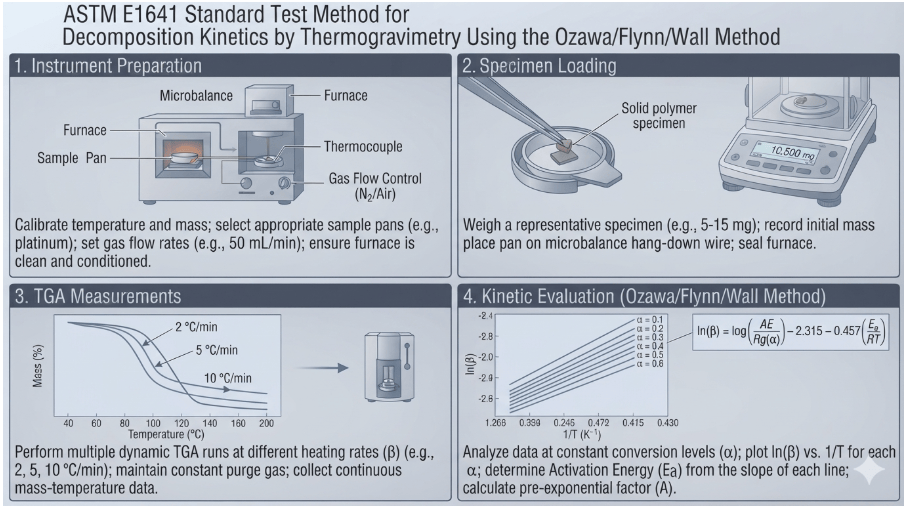
    Recording Mass as a Function of TemperatureASTM E1641 involves heating at least four test specimens extracted from the original sample at varying rates from 1 to 10 K/min through their decomposition range. Mass changes in the specimens are continuously recorded relative to temperature. The resulting mass loss curves identify the temperatures corresponding to constant conversion.
    Determination of Arrhenius Activation EnergyThe Arrhenius activation energy is calculated from a graph plotting the heating rate’s logarithm against the absolute temperature’s reciprocal at a constant conversion level. This activation energy gives the body thermal endurance.

    E1641 Equipment and Sample Preparation

    Specimen DetailIn ASTM E1641, powdered or granular specimens are preferred due to their high surface-to-volume ratio.
    Specimen SizeThis method involves heating a series of at least four test specimens extracted from the original sample at varying heating rates ranging from 1 to 10 K/min through their decomposition range.

    E1641 Test Results and Interpretation

    ASTM E1641-13 outlines procedures for testing Decomposition Kinetics using Thermogravimetry. It involves heating multiple test specimens from the original sample at different rates. The specimens undergo decomposition, with their mass recorded continuously as temperature changes. From this data, temperatures at constant conversion levels are determined. The Arrhenius activation energy is then calculated using a plotted graph. This energy is vital for assessing the material’s thermal endurance. The standard suggests using powdered or granular specimens for better accuracy.

    Read more

    ASTM E1641 is related to tests, including ASTM E473 for analysis-related terms, ASTM E1142 for thermophysical properties-related terms, and ASTM E1582 for calibration of scale for thermogravimetry.

    Use of E1641 in Various Industries

    It is an important test method in industries such as pharmaceuticals, polymers, and petrochemicals for assessing material thermal stability and decomposition kinetics, which helps in the design of high-temperature materials and ensures the stability of pharmaceutical compounds during storage and processing.

    Materials Commonly Tested with E1641

    It is used to test the materials such as polymers, resins, composites, and pharmaceuticals, by thermogravimetric analysis in determining weight loss patterns and thermal degradation characteristics, very crucial for product development and quality assurance.

    Common Challenges and Troubleshooting in E1641 Testing

    Challenges facing precise heating rate control include how deviations might impact results for decomposition kinetics during testing. Troubleshooting of problems includes re-calibrations of thermogravimetric analyzers, uniform sample preparation, and choosing proper inert atmospheres that inhibit oxidation.

    Safety and Best Practices in E1641 Testing

    Testing safety involves the handling of thermally unstable materials, adequate ventilation, calibrated instruments, inert gas environment for testing, and sample size limits to prevent runaway reactions and ensure results.

    Importance of E1641

    This standard is important in material science concerning decomposition kinetics, crucial to predict material behavior under thermal stress, optimize formulations for improved thermal stability, ensuring safety and performance standards comply with industries.

    FAQ

    Where can I get the astm e1641 tested?
    You can share your astm e1641 testing requirements with MaTestLab. MaTestLab has a vast network of material testing laboratories, spread across the USA and Canada. We support your all material testing needs ranging from specific astm e1641 test to various testing techniques.
    Please contact us for a detailed quote for your astm e1641 testing needs. Cost incurred to carry out different astm e1641 testing methodology depends on the type of raw material; number of samples, coupons, or specimens; test conditions, turn around time etc. Costs of some ASTM testing methods start from $100 and the final value depends upon the factors listed above. Please contact us for the best and latest prices.
    The required number of samples or specimens should comply with the procedure given in the astm e1641 standard. However, the MaTestLab operations team can assist you for your special requirements once you share your testing details with us.
    MaTestLab has a vast testing laboratory network, hence we bring you the best testing facilities in a cost-effective way. We offer considerable discounts (15-20%) to our returning customers based on test volume and frequency.
    The turnaround time for astm e1641 test methodology depends upon the test procedure mentioned in the standard test document. However, we at MaTestLab understand your research requirements and hence try to get your test completed within the least possible time.
    rowanjenkins
    About Author
    rowanjenkins
    Testimonials
    Real results
    Engineers trust us with what matters most
    Start Your Testing
    Project Today
    Define your requirements and get access to
    specialized laboratories ready to deliver results
    Partners with us
    Clients
    Vendors
    Process for testing
    • STEP 01

      You share your testing requirements

    • STEP 02

      You share your sample(s)

    • STEP 03

      We deliver your test reports

    Get your testing done

    Let us known your testing requirements and we will be right back with a solution.

      Let us root for each other. Collaborate to grow, expand, and accelerate our businesses.

      Partner with us

        Contact Us

        Discover more from MaTestLab

        Subscribe now to keep reading and get access to the full archive.

        Continue reading