ASTM E1527 Standard Practice for Environmental Site Assessments

    ASTM E1527 Introduction

    ASTM E1527 (Standard Practice for Environmental Site Assessments: Phase I Environmental Site Assessment Process) is the U.S. standard for conducting a Phase I Environmental Site Assessment (ESA) for commercial real estate. The practice is used to determine recognized environmental conditions that could impact a property’s environmental condition and future use. ASTM E1527 assesses environmental liabilities prior to the closing of a property acquisition, loan, development, or investment. Moreover, the practice meets all Comprehensive Environmental Response, Compensation, and Liability Act (CERCLA) landowner liability protection requirements for appropriate inquiries. ASTM E1527 is a historical research project that reviews government records, interviews, and inspects properties to determine the sources of hazardous substances and petroleum products. As a result, the assessment aids in making sound decisions and reducing uncertainty about the environmental conditions of a commercial property.

    Read more

    Get Certified ASTM E1527 Environmental Assessments for Confident Property Transactions

    Environmental liabilities may have a dramatic impact on property value, redevelopment plans, and transaction risks. That’s why organizations tend to prefer the ASTM E1527 evaluation prior to buying, refinancing, or renting commercial real estate. Comprehensive environmental due diligence can uncover potential issues in a timely manner and aid investment decision-making.

    Scope of ASTM E1527 Practice

    • Carries out commercial real estate evaluation of hazardous substance and petroleum product issues.
    •  Recognizes known environmental conditions related to the current and past use of a property.
    •  Merges, refinances, redevelops, and acquires commercial properties.
    •  Helps property owners who want CERCLA landowner liability protection.
    •  Conducts environmental investigations of industrial, retail, office, and mixed-use sites.
    •  Records environmental information in a standardized manner for research and reporting.

    Equipment and Sample Preparation

    Sample and Specimen DetailASTM E1527 evaluates commercial real estate properties rather than physical material specimens. The subject property, adjoining properties, historical records, and environmental databases form the basis for the assessment.
    Specimen PreparationThe environmental professional gathered property information, historical records, ownership data, environmental database records, and user-provided documentation before assessment activities.
    Camera and Documentation ToolsPhotographs, field notes, maps, and inspection records documented site observations during the assessment process.
    Environmental Database ResourcesFederal, tribal, state, and local environmental databases provided regulatory and contamination-related information.
    Historical Research ResourcesHistorical aerial photographs, fire insurance maps, topographic maps, and city directories supported land-use evaluations.

    Use of ASTM E1527 in Commercial Real Estate Due Diligence

    • Assesses risk prior to purchasing commercial real estate.
    •  Enables banks and financial institutions to make lending decisions.
    •  Helps to rehabilitate industrial and brownfield sites.
    •  Recognizes environmental issues prior to commercial lease transactions.
    •  Supplies the environmental data for corporate real estate portfolios.
    •  Represents property owners who are looking for liability protections under CERCLA.

    What Are Recognized Environmental Conditions in ASTM E1527?

    Recognized environmental conditions are the presence of, or likely presence of, hazardous substances or petroleum products from a release or possible release to the environment. Also, if the circumstances are such that there is a material likelihood of future releases, then those circumstances can be considered to be recognized environmental conditions. De minimis conditions are not considered, however. As a result, environmental professionals thoroughly consider all information before forming their conclusions.

    Read more

    Why Are Interviews and Historical Records Important?

    Site investigations may not show the site’s use, as evidenced by historical records. Interviews with owners, operators, and occupants also often yield data not found in public records. These resources will work together to provide environmental professionals with a better understanding of the property’s history and the potential for environmental concerns that require further investigation.

    Common Challenges and Troubleshooting 

    In practice, environmental professionals face numerous challenges during assessments, including incomplete historical records, limited access to the site, and limited participation in interviews. This can lead to situations that make it more difficult to be sure about the environmental conditions. Evaluations of older industrial properties can be challenging due to missing documentation. To address these challenges, professionals have to employ several historical sources, check other regulatory databases, and state data limitations in the report. In addition, the use of experienced judgment is always needed because ASTM E1527 acknowledges that there is always some uncertainty about recognized environmental conditions.

    Assessment Process and Data Collection

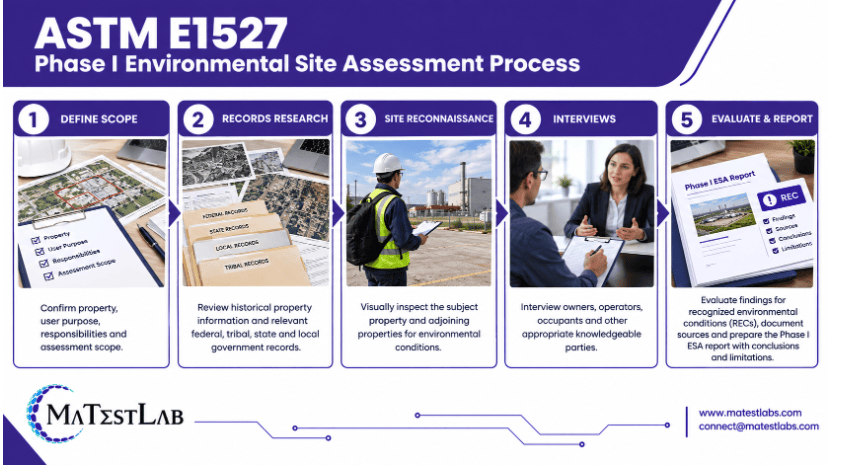
    The assessment process starts by gathering past building details and scrutiny of environmental records. The environmental professional then conducts interviews and performs a visual inspection of the subject property and surrounding properties. Once the information has been collected, the assessor makes professional judgments to analyze it. Lastly, the Phase I Environmental Site Assessment report is compiled and presented as an extensive document detailing all observations, records, and conclusions.

    Testing Procedure and Requirements

    The first step is the environmental professional’s review of historical and regulatory data about the property. Following this, interviews and a site inspection are conducted to ascertain any possible environmental issues. Lastly, the professional assesses all findings and issues a Phase I Environmental Site Assessment report documenting “recognized” environmental conditions.

    Read more

    Other referenced documents include CERCLA (42 U.S.C. § 9601), the EPA All Appropriate Inquiries Rule (40 C.F.R. Part 312), and the Controlled Substances Act (21 U.S.C. § 802).

    Historical Records ReviewThe environmental professional reviewed historical ownership records, aerial photographs, maps, directories, and land-use information to identify potential environmental concerns.
    Government Records ReviewFederal, tribal, state, and local environmental databases were reviewed to identify regulated sites, releases, permits, and enforcement actions.
    Interviews and Site InspectionThe assessor interviewed owners, operators, and occupants and visually inspected the subject property and adjoining properties.
    The image shows the De minimis environmental condition in the form of commercial chemical containers as described in ASTM E1527.
    ASTM E1527 De Minimis Environmental Condition

    Analysis Results and Interpretation

    The final report presents qualitative environmental results and expert conclusions. Results often include recognized environmental conditions, historically recognized environmental conditions, controlled recognized environmental conditions, data gaps, and other investigation recommendations. Users appraise the results for use in property transactions, risk management, and environmental due diligence.

    Read more

    FAQ

    Where can I get the astm e1527 tested?
    You can share your astm e1527 testing requirements with MaTestLab. MaTestLab has a vast network of material testing laboratories, spread across the USA and Canada. We support your all material testing needs ranging from specific astm e1527 test to various testing techniques.
    Please contact us for a detailed quote for your astm e1527 testing needs. Cost incurred to carry out different astm e1527 testing methodology depends on the type of raw material; number of samples, coupons, or specimens; test conditions, turn around time etc. Costs of some ASTM testing methods start from $100 and the final value depends upon the factors listed above. Please contact us for the best and latest prices.
    The required number of samples or specimens should comply with the procedure given in the astm e1527 standard. However, the MaTestLab operations team can assist you for your special requirements once you share your testing details with us.
    MaTestLab has a vast testing laboratory network, hence we bring you the best testing facilities in a cost-effective way. We offer considerable discounts (15-20%) to our returning customers based on test volume and frequency.
    The turnaround time for astm e1527 test methodology depends upon the test procedure mentioned in the standard test document. However, we at MaTestLab understand your research requirements and hence try to get your test completed within the least possible time.
    Gokula Srinivasan Selvam
    About Author
    Gokula Srinivasan Selvam
    Gokula Srinivasan Selvam is a Material Testing Associate at MaTestLab Inc. and holds a postgraduate degree in Ceramic Engineering from IIT (BHU), Varanasi.
    Testimonials
    Real results
    Engineers trust us with what matters most
    Start Your Testing
    Project Today
    Define your requirements and get access to
    specialized laboratories ready to deliver results
    Partners with us
    Clients
    Vendors
    Process for testing
    • STEP 01

      You share your testing requirements

    • STEP 02

      You share your sample(s)

    • STEP 03

      We deliver your test reports

    Get your testing done

    Let us known your testing requirements and we will be right back with a solution.

      Let us root for each other. Collaborate to grow, expand, and accelerate our businesses.

      Partner with us

        Contact Us

        Discover more from MaTestLab

        Subscribe now to keep reading and get access to the full archive.

        Continue reading