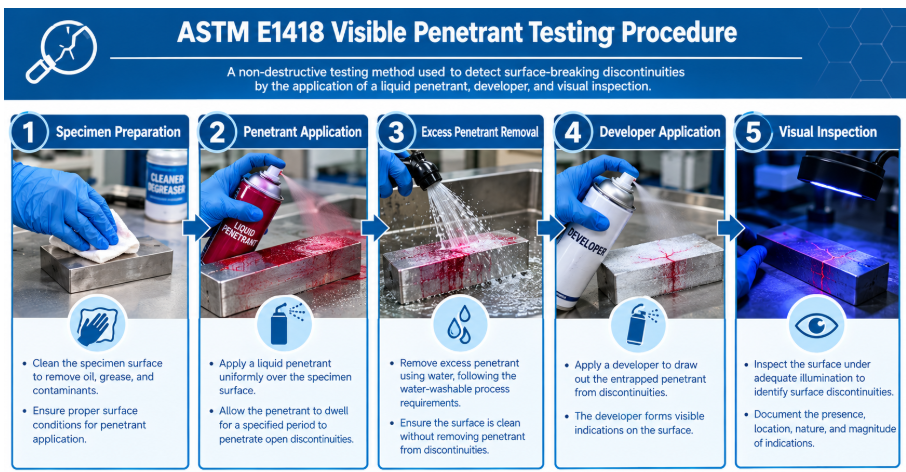
ASTM E1418 describes methods for the visible liquid penetrant examination using a water-washable process. The practice detects surface-open discontinuities such as cracks, seams, laps, cold shuts, laminations, isolated porosity, through leaks, or lack of fusion. The scope of ASTM E1418 includes:
- Material type: Nonporous metallic materials (ferrous and nonferrous) and nonmetallic materials (glazed or fully densified ceramics, certain nonporous plastics, and glass).
- Purpose: Detection of surface discontinuities for in-process, final, and maintenance examination.
- Property measured: Presence, location, nature, and magnitude of detected discontinuities.
- Method: Water-washable visible liquid penetrant testing involving penetrant application, dwell, excess removal, developer application, and visual inspection.
- Result: Visual indications of surface discontinuities under adequate illumination.
- Test Limitations: The practice does not indicate or suggest criteria for evaluating indications; separate codes or specifications define accept/reject criteria.
- Use conditions: Perform testing at ambient laboratory temperature on clean, dry surfaces. The method detects surface-breaking discontinuities only and does not evaluate internal defects or simulate service loading conditions.
- Applications: Aerospace, automotive, manufacturing, construction, and maintenance inspection.
What are the Uses of ASTM E1418 Testing?
The ASTM E1418 test identifies surface defects in nonporous materials. It is a standard used in many industries, including aerospace, automotive, construction, etc for quality control, structural integrity testing, and defect evaluation. This standard-
- Identifies surface discontinuities like cracks, seams, and porosity.
- Maintains product and structural safety.
- Supports manufacturing and maintenance quality-control tasks.
- Allows defects to be detected early on before failure occurs in the component.
- Delivers uniform inspection results across different industries.
- Minimizes risk in high-stress applications.
- Raises the awareness of consumers of the trustworthiness of tested goods.
Which materials can be tested under ASTM E1418?
ASTM E1418 tests nonporous materials such as metals, ceramics, and some polymers. It is widely applied to metallic materials such as aluminum, steel, and titanium; ceramics in aerospace and medical implants; and polymers in fuel tanks and structural components. The method is used on nonporous surfaces where penetrant does not become absorbed by the surface, but enters the surface-breaking discontinuity.
Why is ASTM E1418 Important?
ASTM E1418 specifies the water-washable liquid penetrant testing process. The practice sets out testing conditions to enable manufacturers and inspectors to identify key surface defects that would impact the structural integrity of the material. The standard provides uniformity in testing methods and interpretation of test results between laboratories. This standard is used in a variety of industries, including aerospace, automotive, and construction, where it is essential for safety, product quality, and component lifetimes. The method provides a uniform solution across the industry, reduces the risk of failure in high-stress environments, and increases customer confidence in tested products.