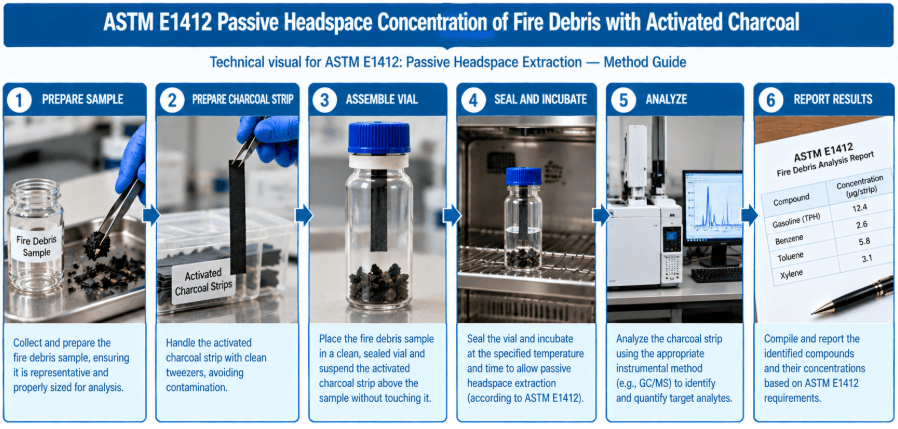
ASTM E1412 describes a standard practice for separating small amounts of ignitable liquid residues from fire debris samples by using the static headspace above the sample to remove the residue with an adsorbent material (activated charcoal). Technicians then flush the adsorbent with solvent, usually carbon disulfide, to elute the concentrated ignitable liquid residue, followed by analysis. Headspace concentration methods are good for extracting ignitable liquid residues where a high concentration is required, as the concentration in the sample is very low. This practice can be used throughout the concentration range. ASTM E1412 (Standard Practice for Separation of Ignitable Liquid Residues from Fire Debris Samples by Passive Headspace Concentration with Activated Charcoal) is essentially nondestructive and can isolate quantities less than 1/10 µL of ignitable liquid residue from a sample. Forensic laboratories use this practice to extract samples from fire debris for later GCMS analysis.
Get Certified ASTM E1412
Certification ensures accurate and forensically sound separation of ignitable liquid residues from fire debris by following standardized passive headspace concentration procedures. Using the right technique for adsorption, elution, and sample handling ensures evidence integrity throughout the process and is controlled by experienced forensic laboratory personnel. ASTM E1412-certified testing helps fire investigation agencies, forensic laboratories, and the legal process verify insurance claims and conduct fire cause and origin investigations. Laboratory services ensure that extractions are conducted based on the standard requirements and give confidence to the analytical results obtained. The use of certified testing is one of the ways fire investigators and forensic chemists are able to create a reliable, defensible chain of evidence in court proceedings.