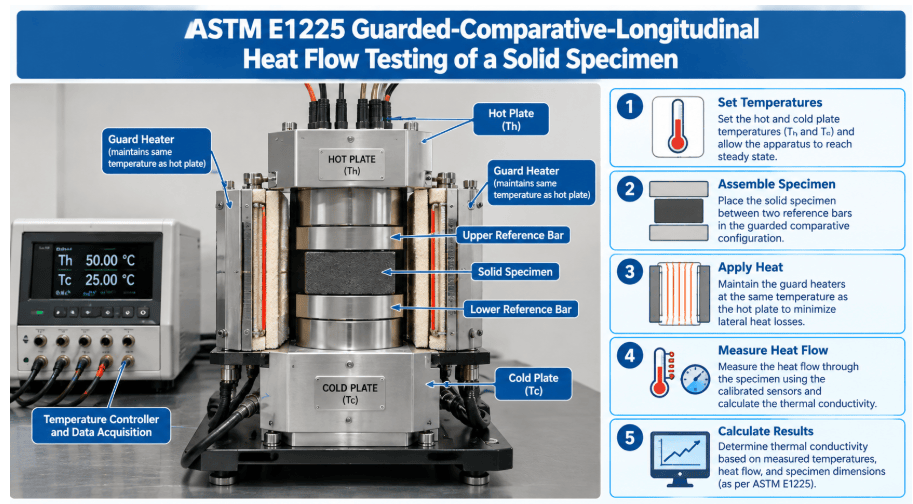
ASTM E1225 Thermal Conductivity of Solids Using the Guarded-Comparative-Longitudinal Heat Flow Technique
ASTM E1225 describes a steady-state test procedure to determine thermal conductivity of a uniform opaque solid in a guarded-comparative-longitudinal heat flow experiment. The method is used in industries to test ceramics, metals, polymers, and composites. The apparatus consists of a heat flow device, reference materials, and temperature sensors. The test report contains the values of thermal conductivity, temperature conditions, and specimen information, which are usually expressed in W/(mK). These findings are useful in material selection in thermal management within industrial systems.
Read More
GET STARTED
ASTM E1225 Introduction
ASTM E1225 (Standard Test Method for Thermal Conductivity of Solids Using the Guarded-Comparative-Longitudinal Heat Flow Technique) provides a standard approach for measuring the thermal conductivity of solid substances under steady-state heat-flow conditions. Thermal conductivity refers to the ability of a substance to conduct heat in a temperature gradient. Hence, this property is essential in the design of insulation systems, refractory linings, and electronic parts. The technique is applicable to homogeneous opaque solids that have a conductivity of 0.2 to 200 W/(mK) over the temperature range of 90K to 1300K. Besides, ASTM E1225 aids in quality control, research, and engineering design by providing quality thermal performance data on industrial materials.
Get Certified ASTM E1225 Testing for Accurate Thermal Performance Evaluation
Why should industries use ASTM E1225 testing? Proper thermal conductivity data guarantees the correct choice of material in heat-sensitive applications. Certified testing reduces architecture flaws and enhances system performance. In addition, stable lab practices can help ensure the reliability of results when material batches vary. One can consult professionals at MaTestLab for controlled and accurate testing.
Service Name
Remarks
ASTM E1225 Testing
Contact US
Testing Procedure and Requirements
ASTM E1225 involves a guarded longitudinal heat flow system to determine the steady-state heat transfer across a specimen. Technicians first insert the specimen of the test between known reference materials of known conductivity. Next, they apply a controlled temperature gradient across the assembly. They then determine the heat flow and temperature difference to determine thermal conductivity.
Specimen Configuration
Homogeneous opaque solid with consistent thickness and cross-section to limit variation within ±5%.
Temperature Range
Testing is performed between 90 K and 1300 K, depending on material behavior.
Heat Flow Measurement
Steady-state heat flow is established using reference materials and temperature sensors.
A Schematic Illustration of a Guarded Comparative Longitudinal Heat Flow Meter
Scope of ASTM E1225 Test Standard
Determines thermal conductivity of opaque homogeneous solids.
Covers have a conductivity of 0.2 to 200 W/mK.
Usable in temperatures between 90 K and 1300 K.
Measures composite thermal conductance of contacts.
ASTM E1225 Equipment and Sample Preparation
Guarded Heat Flow Apparatus
Maintains one-dimensional heat flow and minimizes lateral heat losses.
Thermocouples
Measure temperature gradient across specimen and reference materials.
Reference Materials
Provide known thermal conductivity for comparative calculations.
Use of ASTM E1225
Analyzes ceramics, polymers, metals, and composites.
Helps with the selection of refractory and insulation material.
Aids with thermal design of industrial equipment.
Helps certify material performance with temperature gradients.
Why Is the Guarded Comparative Method Used in ASTM E1225?
The guarded comparative technique provides a precise measurement of heat flow in a controlled situation. It minimizes lateral heat losses and ensures one-dimensional heat transfer. Hence, it enhances the accuracy of measurements in engineering materials.
How Does Material Homogeneity Affect ASTM E1225 Results?
The accuracy of thermal conductivity is directly related to material homogeneity. When the conductivity changes with thickness or cross-section more than ±5%, then the results are unreliable. Thus, ASTM E1225 uses standardized samples so that the behavior of heat flow remains consistent.
Common Challenges and Troubleshooting
Proper system design remains a significant challenge in ASTM E1225 testing. Lateral heat losses and inaccurate readings can result from improper guarding. Also, non-homogeneous media create errors in the values of conductivity. The resistance of the interfaces between layers can also give distorted results. In order to resolve these concerns, laboratories should check the performance of the apparatus and ensure that the specimen geometry is correct. Moreover, technicians are advised to maintain steady-state conditions and then make measurements.
ASTM E1225 Testing Technique Process, and Data Collection
The testing process begins with placing the specimen between reference materials in a guarded assembly. Next, technicians impose a controlled temperature difference on the system. Once the steady-state condition is reached, they measure the heat flow and temperature gradient. Lastly, they determine thermal conductivity through comparative analysis with the reference materials. Repeatability and reliability of data collection results occur because of consistency.
Analysis Results and Interpretation
ASTM E1225 also reports thermal conductivity in SI units W/(mK). The outcomes are temperature conditions, specimen size, and computed values of conductivity. Increased conductivity indicates efficiency, whereas low values indicate insulating behavior. These results help engineers identify appropriate materials for thermal management.
Factors to Consider For ASTM E1225
Speed: Testing needs steady-state conditions, and thus ample time should be given to stabilization without sacrificing accuracy.
Expert: Skilled technicians make sure that the right apparatus is properly set, calibrated, and the results interpreted to obtain reliable data.
Cost: Effective testing systems enable a tradeoff between accuracy and cost and can be used to facilitate regular quality control and research investigation.
You can share your astm e1225 testing requirements with MaTestLab. MaTestLab has a vast network of material testing laboratories, spread across the USA and Canada. We support your all material testing needs ranging from specific astm e1225 test to various testing techniques.
How much do I need to pay for the astm e1225 test?
Please contact us for a detailed quote for your astm e1225 testing needs. Cost incurred to carry out different astm e1225 testing methodology depends on the type of raw material; number of samples, coupons, or specimens; test conditions, turn around time etc. Costs of some ASTM testing methods start from $100 and the final value depends upon the factors listed above. Please contact us for the best and latest prices.
How many samples are required for astm e1225?
The required number of samples or specimens should comply with the procedure given in the astm e1225 standard. However, the MaTestLab operations team can assist you for your special requirements once you share your testing details with us.
How much discount can I get on the astm e1225 test?
MaTestLab has a vast testing laboratory network, hence we bring you the best testing facilities in a cost-effective way. We offer considerable discounts (15-20%) to our returning customers based on test volume and frequency.
How many days will it take to complete the astm e1225 test?
The turnaround time for astm e1225 test methodology depends upon the test procedure mentioned in the standard test document. However, we at MaTestLab understand your research requirements and hence try to get your test completed within the least possible time.
Where can I get the astm e1225 tested?
You can share your astm e1225 testing requirements with MaTestLab. MaTestLab has a vast network of material testing laboratories, spread across the USA and Canada. We support your all material testing needs ranging from specific astm e1225 test to various testing techniques.
MaTestLab Inc. offers accessible, quick, and affordable material testing, product testing, and failure analysis services. We support your on-demand testing and expert consultation needs with the help of our extensive network of material testing laboratories situated in the US and other parts of the world.
MATERIAL TESTING
We offer destructive and non-destructive tests over a range of mechanical, electrical, chemical, thermal, optical, corrosion, radiation, and biological testing methodologies defined by ASTM, ISO and other organizations.
PRODUCT TESTING
We help you evaluate and ensure your product quality and performance with standard and custom-made testing solutions. All the tests are done at well-equipped testing laboratories using standard testing methods for best output and satisfaction.
FAILURE ANALYSIS
Failure analysis ensures high levels of quality in every manufacturing process. We help you with getting the best failure or root cause analysis to determine the cause of the failure. The results help you identify means to prevent failure recurrences.