ASTM E1131 Compositional Analysis by Thermogravimetry

    What is ASTM E1131?

    ASTM E1131 is a standard test method for determining compositional analysis of materials by thermogravimetry. This technique subjects a sample to controlled temperature changes and measures weight loss or gain as it undergoes thermal decomposition. Compositional analysis is essential for identifying materials by their chemical components and thermal properties.  ASTM E1131 (Standard Test Method for Compositional Analysis by Thermogravimetry) determines the amount of highly volatile matter, medium volatile matter, combustible material, and ash content in compounds. The test method helps determine the composition and thermal behavior of complex materials, including polymers, minerals, pharmaceuticals, and various industrial products. Material composition and thermal stability are essential for quality control, process optimization, assessing purity, and ensuring materials are suitable for specific applications.

    Read more

    Get Certified ASTM E1131 Testing for Reliable Compositional Analysis 

    Thermogravimetric analysis helps laboratories determine material composition by measuring mass changes during controlled heating. ASTM E1131 provides a standardized approach for determining highly volatile matter, medium volatile matter, combustible material, and ash content using inert and reactive gas environments. For more information about ASTM E1131, consult Matestlab Inc.

    What is the Scope of the ASTM E1131 standard?

    ASTM E1131 covers the compositional analysis of materials by thermogravimetry, including the determination of highly volatile matter, medium volatile matter, combustible material, and ash. The test method evaluates material composition based on mass changes during controlled heating.

    Read more

    The primary purpose of ASTM E1131 is to determine the relative amounts of volatile, combustible, and nonvolatile components in a material. These measurements can support material characterization, quality control, material screening, and material comparison. The scope of ASTM E1131 includes:

    • Material type: Solid and liquid materials, including materials such as coal, lubricants, polymers, elastomers, and other materials suitable for thermogravimetric analysis.
    • Purpose: Compositional analysis using thermogravimetry.
    • Properties measured: Highly volatile matter, medium volatile matter, combustible material, and ash content.
    • Method: Controlled thermogravimetric heating under inert and reactive gas environments, with component concentrations determined from measured mass changes.
    • Results: Results are reported as the percentage by mass of highly volatile matter, medium volatile matter, combustible material, and ash.
    • Applications: Quality control, material screening, compositional analysis, material comparison, and product evaluation. 

    What are the Uses of ASTM E1131 Testing?

    ASTM E1131 testing helps laboratories determine material composition based on thermogravimetric mass-loss behavior. Thermogravimetric analysis is used in the pharmaceuticals, plastics, and composites industries to determine material composition, thermal stability, and moisture content, providing material reliability under thermal stress. It also ensures that a product is efficacious and nontoxic. The ASTM E1131 standard-

    • Supports quality control of materials and products.
    • Checks material screening and comparison.
    • Evaluates compositional analysis of mixtures and blends.
    • Determines volatile, combustible, and ash content.
    • Evaluates materials such as coal, coke, lubricants, polymers, elastomers, and calcium oxalate monohydrate.
    • Supports material and product problem-solving and performance evaluation.

    Which Materials Can Be Tested Under ASTM E1131?

    The standard evaluates the parameters of polymers, composites, elastomers, and pharmaceutical compounds. Measurements of weight loss linked to volatile constituents, plasticizers, and additives determine stability and product performance. Composite materials are used in the aerospace and automotive industries to determine filler content, degradation temperatures, and thermal stability. The analyst should consider the material composition and whether its components can be distinguished by their thermogravimetric behavior.

    Why is ASTM E1131 Important?

    ASTM E1131 is significant as it provides a controlled approach to determine material composition from mass changes during programmed heating. The standard is critical to the quality and reliability of materials used in consumer products and industrial components. Characteristic temperature ranges and mass-loss plateaus determine chemical components. 

    ASTM E1131 Equipment and Sample Preparation Guide

    ASTM E1131 test method uses a thermogravimetric apparatus to measure specimen mass changes under inert and reactive gas environments. Representative specimens are prepared and analyzed to determine their compositional components. The ASTM E1131 test method comprises the following equipment and sample preparation guide-

    Read more

    Sample and Specimen DetailsAnalysts select representative specimens of solid or liquid materials for thermogravimetric compositional analysis.
    Specimen PreparationTechnicians prepare and identify the specimen, record its initial mass, and apply any required pretreatment before analysis. 
    Specimen dimensionsTechnicians use a specimen mass of approximately 10 to 30 mg, selected according to the material and apparatus. 
    InstrumentationThe test uses a thermobalance/TGA apparatus, a controlled furnace, a temperature sensor, a temperature controller, a specimen holder, a recording system, and inert and reactive gas supplies such as nitrogen, air, or oxygen. 

    Testing Procedures and Requirements for ASTM E1131

    This test method determines material composition by measuring mass changes during controlled thermogravimetric heating under inert and reactive gas conditions. Technicians set the required temperature and gas conditions, record mass changes, and calculate the compositional fractions. The ASTM E1131 standard comprises the following test procedure-

    Read more

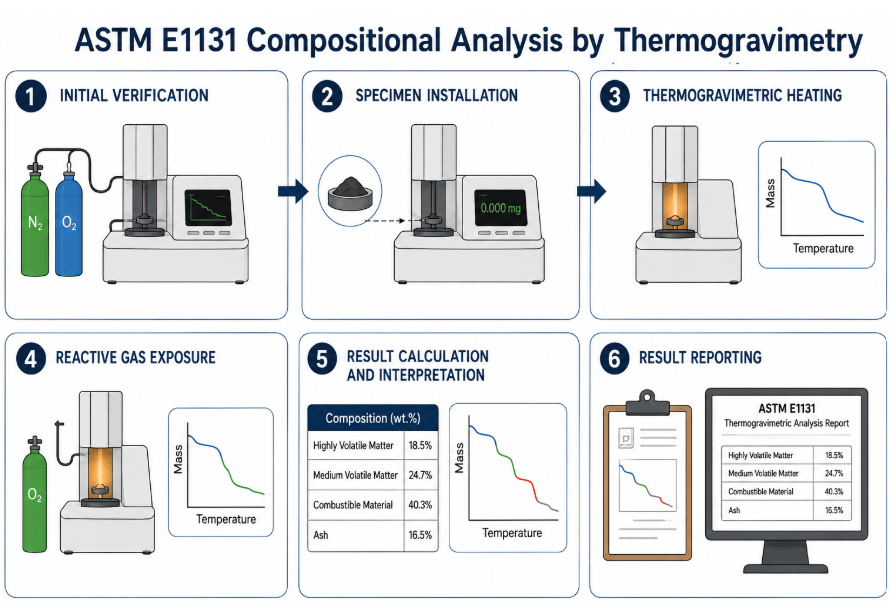
    Initial VerificationTechnicians calibrate the mass and temperature signals of the thermogravimetric apparatus and establish the required gas flow conditions before testing. 
    Specimen InstallationTechnicians place the prepared specimen in the specimen holder, zero the balance, and record the initial specimen mass before heating. 
    Thermogravimetric HeatingTechnicians heat the specimen through the specified temperature ranges under an inert atmosphere while continuously recording mass changes. 
    Reactive Gas ExposureTechnicians introduce the specified reactive gas after the appropriate mass-loss plateau is established to oxidize the combustible material and determine the remaining ash. 
    Result Calculation and InterpretationAnalysts determine the percentages of highly volatile matter, medium volatile matter, combustible material, and ash from the measured mass changes and corresponding thermogravimetric curve. 
    Result ReportingLaboratories report specimen information, pretreatment, temperature ranges, heating rates, gas conditions, calculated composition, and the thermogravimetric curve, as applicable. 

    ASTM E1131 Testing Process and Data Collection

    The analyst selects a representative specimen and determines the compositional components to be evaluated. Technicians record the initial specimen mass and prepare the thermogravimetric apparatus with the specified temperature and gas conditions. The specimen is subsequently heated under an inert atmosphere, with mass changes recorded continuously. After the appropriate mass-loss region, the atmosphere is changed to a reactive gas to determine the combustible material and remaining ash. Finally, analysts assess the thermogravimetric curve, determine the percentage of each component, and report the results.

    The image shows the procedure for compositional analysis by thermogravimetry as per ASTM E1131.
    ASTM E1131 Compositional Analysis by Thermogravimetry

    Common Challenges and Troubleshooting

    Problems with the testing are the variability in weight loss due to sample inhomogeneity or humidity. Troubleshooting involves calibration of the thermogravimetric analyzer, sample preparation, test environment control, and proper heating rate.

    ASTM E1131 Analysis Results and Interpretation

    The report gives a detailed account of the compositional analysis results obtained from the thermogravimetric mass changes. The measured mass losses and remaining residue are used to determine the amounts of highly volatile matter, medium volatile matter, combustible material, and ash.

    Read more

    • The laboratory reports the initial specimen mass and relevant test conditions, including temperature ranges, heating rates, and gas conditions.
    • The analyst determines the percentage of highly volatile matter and medium volatile matter from the corresponding mass-loss regions.
    • Engineers determine the percentage of combustible material from the mass loss occurring after exposure to the reactive atmosphere. The remaining mass is used to calculate the ash content.
    • The report presents the calculated composition values as percentages by mass (wt. %) and may include the thermogravimetric curve used for interpretation.
    • A higher value for a particular component indicates a greater proportion of that component under the specified test conditions. 

    Link to ASTM E1131

    FAQ

    What is ASTM E1131 used for?
    ASTM E1131 is used to determine material composition by measuring mass changes during controlled thermogravimetric heating.
    It determines highly volatile matter, medium volatile matter, combustible material, and ash content from thermogravimetric mass changes.
    The method applies from approximately room temperature to 1000 °C.
    The method uses a thermobalance/TGA system with controlled heating, temperature measurement, recording capability, and inert/reactive gas supplies.
    Malhar Khole
    About Author
    Malhar Khole
    Malhar Khole is a Material Testing Associate at MaTestLab Inc. and holds a postgraduate degree in Material Science and Technology from IIT (BHU), Varanasi.
    Testimonials
    Real results
    Engineers trust us with what matters most
    Start Your Testing
    Project Today
    Define your requirements and get access to
    specialized laboratories ready to deliver results
    Partners with us
    Clients
    Vendors
    Process for testing
    • STEP 01

      You share your testing requirements

    • STEP 02

      You share your sample(s)

    • STEP 03

      We deliver your test reports

    Get your testing done

    Let us known your testing requirements and we will be right back with a solution.

      Let us root for each other. Collaborate to grow, expand, and accelerate our businesses.

      Partner with us

        Contact Us

        Discover more from Matestlab Inc

        Subscribe now to keep reading and get access to the full archive.

        Continue reading