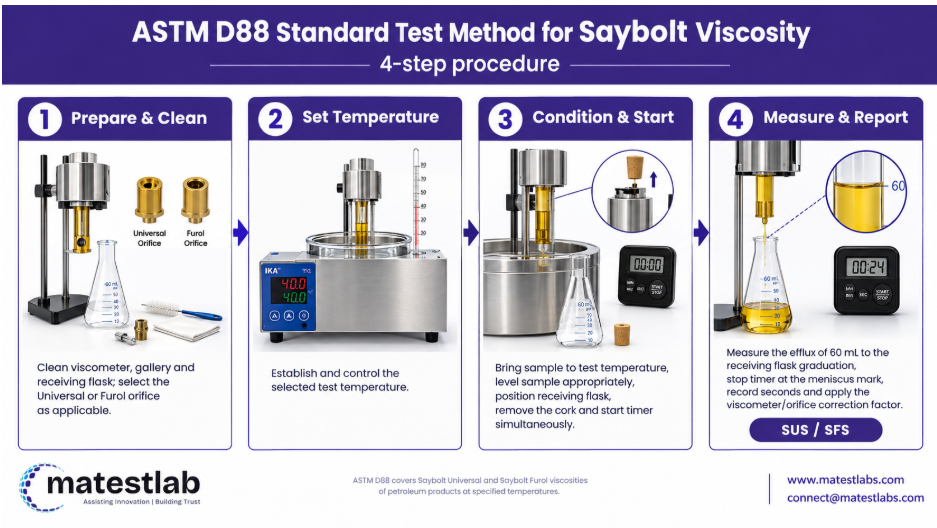
ASTM D88 Standard Method of Test for Saybolt Viscosity

    What is ASTM D88? 

    ASTM D88 is a standard test method for measuring the Saybolt viscosity of petroleum products at various temperatures. The method measures the time it takes a specific quantity of liquid to pass through a controlled-temperature, calibrated Saybolt viscometer. ASTM D88 describes the flow of petroleum products and other appropriate liquid materials in the laboratory. The method yields viscosity in either Saybolt Universal Seconds (SUS) or Saybolt Furol Seconds (SFS), depending on the viscometer used. ASTM D88 (Standard Method of Test for Saybolt Viscosity) helps manufacturers and laboratories determine consistency and compare the flow properties of petroleum-based products. 

    Read more

    Get Certified ASTM D88 Testing for Accurate Viscosity Measurement and Product Quality 

    Viscosity affects handling, pumping, lubrication, and the performance of petroleum products. ASTM D88 is the standard method for measuring viscosity under specific conditions. The sample is conditioned to the test temperature, and the liquid’s flow time is recorded using the required calibrated Saybolt viscometer. Manufacturers can use the resulting viscosity to track product consistency, assess product quality, and compare it to relevant specifications. 

    What is the scope of the ASTM D88 standard? 

    ASTM D88 describes methods for measuring the Saybolt viscosity of petroleum products at given temperatures. The method is based on the time taken to measure the flow of 60 mL of the liquid through a calibrated Saybolt Universal or Saybolt Furol viscometer under specified conditions. Saybolt Universal viscometer is used for materials of lower viscosity, and the Saybolt Furol viscometer is used for materials of higher viscosity. The method is suitable for use with materials where the flow property is appropriate for the measurement, using the apparatus specified. 

    Read more

    The scope of ASTM D88 includes: 

    • Material type: Petroleum products and other materials suitable for liquid use, such as flow characteristics. 
    • Purpose: This measures the flow of a liquid when heated to a specific temperature. 
    • Properties evaluated: Flow time and Saybolt viscosity. 
    • Testing method: The technicians heat and condition the sample to the required temperature and record the time taken by a given quantity to pass through the calibrated viscometer. 
    • Results: Results are presented in Saybolt Universal Seconds (SUS) or Saybolt Furol Seconds (SFS), depending on the viscometer used. 
    • Test equipment: Calibrated Saybolt Universal or Saybolt Furol viscometers, temperature control equipment, and timing devices. 
    • Test conditions: During the test, the sample temperature is controlled, and the apparatus is kept under specified conditions so as to be tested under the specified conditions. 
    • Applications: Quality control, product characterization, specification conformance, and viscosity comparison of petroleum products. 

    What are the Uses of ASTM D88? 

    ASTM D88 specifies a standard method for measuring the Saybolt viscosity of petroleum products and other fluids suitable for the method. The test is useful to manufacturers and laboratories for assessing flow properties and consistency of the product. 

    The test method: 

    • Measures the viscosity of petroleum products according to the Saybolt method. 
    • Measures the time needed for a given amount of liquid to pass through a calibrated viscometer. 
    • Measures viscosity in Saybolt Universal Seconds or Saybolt Furol Seconds. 
    • Assists with quality control and production monitoring. 
    • Helps manufacturers compare the viscosity of different petroleum products. 
    • Provides materials evaluation against applicable viscosity specifications. 
    • Assesses uniformity among the production batches 

    Which Materials Can Be Tested Under ASTM D88? 

    ASTM D88 primarily applies to petroleum products and other liquid materials that are suitable for viscosity measurement by the Saybolt method. Laboratories can test lubricating oils, fuel oils, petroleum fractions, and other petroleum-based liquids based on the type of viscometer used and the test temperature. The material’s suitability is dependent on the viscosity, flow, test temperature, and product specification. 

    Why is ASTM D88 Important? 

    ASTM D88 offers a standardized method for determining flow time and Saybolt viscosity of petroleum products. Because accurate viscosity measurement is critical, manufacturers can monitor product quality and ensure consistency from one batch to the next. The test also generates standardized data, which can be compared to petroleum products and assessed against relevant specifications. Apparatus D88 enables reliable viscosity characterization for quality control, product development, and lab testing by controlling apparatus conditions, measurement procedures, and temperature. 

    ASTM D88 Equipment and Sample Preparation Guide 

    This ASTM D88 method uses a calibrated Saybolt viscometer at a specified temperature to determine the time a given volume of petroleum product takes to flow through the instrument. The technician chooses the correct viscometer, and sample preparation is done based on the test conditions. 

    Read more

    Sample and Specimen Details The test sample consists of a representative petroleum product, such as lubricating oil, fuel oil, or other liquid petroleum products.
    Specimen Preparation Technicians carefully mix the sample, then filter out visible impurities/suspended materials that might affect the viscosity measurement. 
    Specimen Dimensions Analysts use the required sample volume to fill the reservoir in the Saybolt viscometer and maintain the liquid level at the specified volume during testing.
    Instrumentation The testing equipment consists of a calibrated Saybolt Universal or Saybolt Furol viscometer, a temperature-controlled bath, a thermometer or thermometer sensor, a receiving flask, and an accurate timing device. 

    Testing Procedures and Requirements for ASTM D88 

    The ASTM D88 method is the time taken for a liquid to flow through a calibrated Saybolt viscometer at a given temperature. The sample temperature is controlled by technicians, and through the relevant procedure, the accurate and repeatable viscosity is obtained.

    Read more

    Initial Evaluation Technicians check the sample and test equipment to ensure they are appropriate for Saybolt viscosity testing. 
    Sample Conditioning The sample is placed in the viscometer and heated to the desired test temperature in a controlled temperature bath. 
    Temperature Control The sample and viscometer are kept at the same temperature during the measurement to reduce the effect of viscosity change caused by temperature. 
    Viscometer Preparation Technicians clean and inspect the calibrated Saybolt viscometer and ensure that there is no contamination in the orifice and other components. 
    Flow Measurement The technicians then release the sample through the calibrated orifice and record the time of the measured flow of the desired amount of liquid into the receiving flask. 
    Timing The technicians use an accurate timing instrument to measure the flow time from the moment of discharge to the moment the required volume has been delivered to the receiving vessel. 
    Repeat Measurement Technicians repeat the measurement if necessary and check for acceptable consistency of measurement. 
    Viscosity Calculation Saybolt viscosity is measured through a flow time and applied to the ASTM D88 standard to calculate and report viscosity. 
    Result Evaluation and Reporting The final report includes the test temperature, type of viscometer used, test flow time, calculated Saybolt viscosity, and other test data. 

    ASTM D88 Testing Process and Data Collection 

    The analyst takes a representative liquid sample and determines the proper Saybolt viscometer and test temperature. The apparatus is cleaned and inspected before the sample is fed into the viscometer. They heat and cool the sample to the desired temperature and keep it at that temperature during the test. The operator then releases the sample through the calibrated orifice and records the time it takes for the sample volume in the receiving flask to reach the specified volume. When necessary, technicians repeat the measurement to ensure consistency. The flow time is measured, and the Saybolt viscosity is calculated for the appropriate units. The test conditions, flow time, viscosity value, and other observations are recorded in the laboratory test report. 

    The image shows laboratory equipment used to measure Saybolt viscosity under ASTM D88. 
    ASTM D88 Saybolt Viscosity Testing of Petroleum Products.

    Common Challenges and Troubleshooting 

    One of the most common issues with testing is that the technician does not maintain the required temperature, contaminated equipment is used, or an air bubble or other foreign material is introduced into the sample. Flow-time measurements can vary greatly with temperature changes, which can adversely affect viscosity. Before testing, the technicians should be sure to clean the viscometer thoroughly, check the calibration, keep the bath temperature stable, and condition the sample before testing. They should also employ reliable timing equipment and conduct the testing procedure as specified to enhance the reliability of measurements. 

    ASTM D88 Analysis Results and Interpretation 

    The report is a summary of the Saybolt viscosity results for the tested petroleum product or applicable liquid sample. 

    Read more

    • The sample identification, test temperature, viscometer type, and applicable ASTM D88 procedure are recorded in the laboratory. 
    • The measured flow time of the specified volume of liquid as it passes through the calibrated viscometer is recorded by the analyst. 
    • Laboratory-reported viscosity is in either Saybolt Universal Seconds (SUS) or Saybolt Furol Seconds (SFS), depending on the appropriate unit. 
    • The viscosity measured is compared with the applicable product specification or acceptance criteria. 
    • The laboratory records all subsequent measurements, observations, or deviations that could influence the reported value. 
    • The reported viscosity data is used by manufacturers for checking product consistency, quality control, and assessing compliance with specified requirements. 

    Link to ASTM D88 

    FAQ

    What does ASTM D88 measure?
    ASTM D88 is a procedure used to test petroleum products and other applicable liquids for Saybolt viscosity, which is the time needed for a given volume of a product to flow through a calibrated Saybolt viscometer at a set temperature.
    The viscosity is reported as Saybolt Universal Seconds (SUS) or Saybolt Furol Seconds (SFS) by ASTM D88, depending on the type of viscometer and test conditions.
    The Saybolt Universal viscometer is designed for lower-viscosity liquids, and the Saybolt Furol viscometer is designed for higher-viscosity materials.

    Updated on November 9, 2026

    Dr Ruchika Yogesh
    About Author
    Dr. Ruchika Yogesh is a serial entrepreneur, material science and AI/ML enthusiast, medicinal chemistry subject matter expert (SME), scientific/medical copyeditor, and a researcher.
    Know More
    Testimonials
    Real results
    Engineers trust us with what matters most
    Why Choose Matestlab?
    Matestlab is a unified testing services partner based in the USA. Matestlab offers raw material and product testing services through accredited, expert laboratories primarily based in the USA. Matestlab supports physical, thermal, chemical, electrical, mechanical, environmental, and characterization testing needs through its global network of 2200+ accredited testing laboratories. Matestlab's in-house materials science experts curate and design comprehensive testing programs matched to the sample material and specific testing need, with regulatory requirements and confidentiality in mind.

    If you are looking for a managed and trusted testing partner to achieve your research goals, feel free to schedule a meeting with us or send us a request at connect@matestlabs.com to learn more about our services. For a quick quote, call us at (302)244-7710. We are happy to serve you.
    Start Your Testing
    Project Today
    Define your requirements and get access to
    specialized laboratories ready to deliver results
    Partners with us
    Clients
    Vendors
    Process for testing
    • STEP 01

      You share your testing requirements

    • STEP 02

      You share your sample(s)

    • STEP 03

      We deliver your test reports

    Get your testing done

    Let us know your testing requirements and we will be right back with a solution.

      Let us root for each other. Collaborate to grow, expand, and accelerate our businesses.

      Partner with us