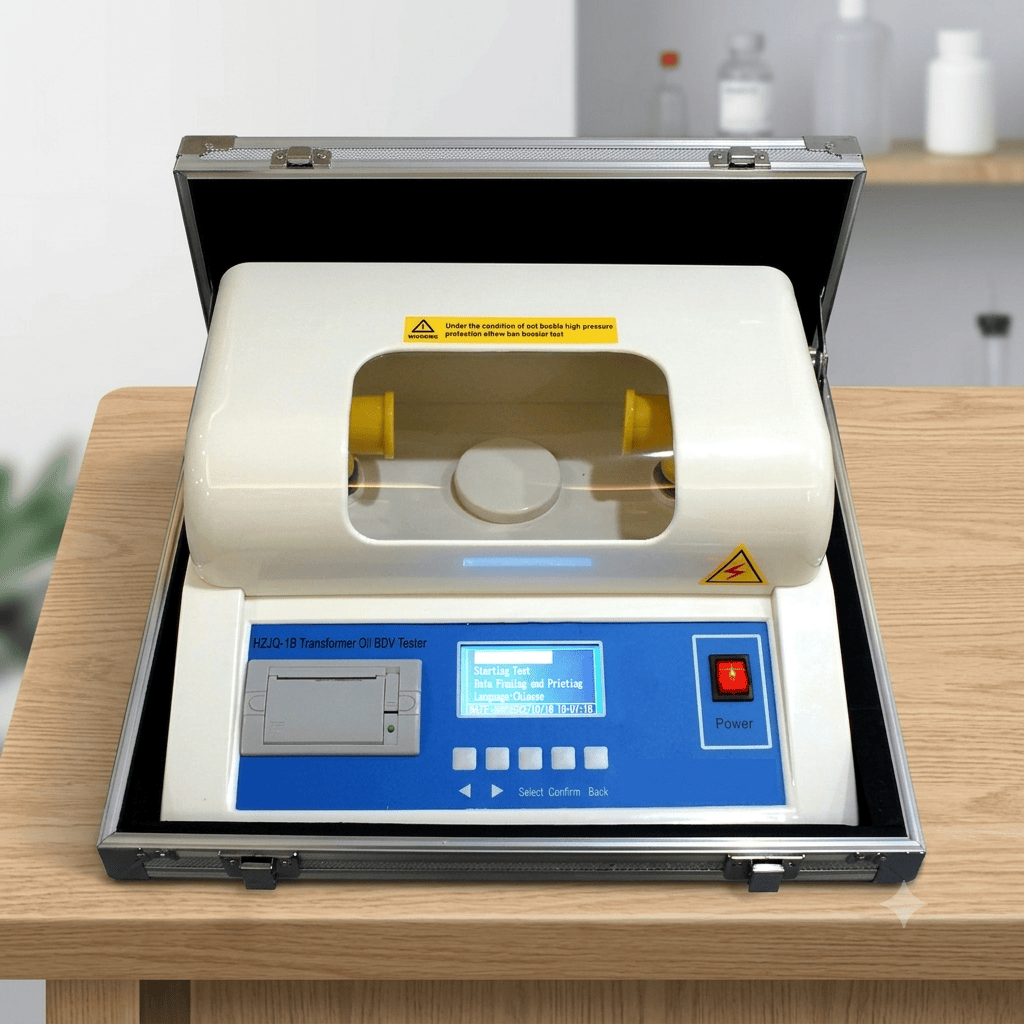
ASTM D877 Standard Test Method for Dielectric Breakdown Voltage of Insulating Liquids Using Disk Electrodes
The ASTM D877 outlines a standardized process to determine the dielectric breakdown voltage of insulating fluids using the disk electrode. This method plays a crucial role in evaluating the electrical insulation properties of fluids, including transformer oil, synthetic esters, and silicone-based fluids. By applying an increasing voltage between the two proximity electrodes immersed in the sample, the test identifies the point at which the electrical rupture occurs, an essential indicator of fluid position and contaminated appearance. It is facilitated by its simplicity, speed, and recurrence, making it widely applied to quality control, maintenance diagnosis, and specification compliance in power utilities, manufacturing, aerospace, and research laboratories.
Read More
GET STARTED
ASTM D877 Introduction
The ASTM D877 testing method assesses the partial breakdown of insulating fluids, which is important for the protection and performance of electrical equipment. The test involves applying two plates and increasing the voltage between the circular electrodes until the electrode is immersed in the fluid. This breakdown voltage reflects the ability of the insulating fluid to oppose electrical stress and its overall quality.
Get Certified ASTM D877 for Reliable Electrical Insulation Performance
The ASTM D877 certification standard has proven that labs, equipment vendors, and fluid suppliers have the right values in terms of determining the dielectric breakdown strength of insulating liquids. This certification is used to promote transformer OEM qualification, utility acceptance testing, maintenance diagnostics, and product quality control. Data on the purity of oil. Reliable dielectric-strength data assists engineers in the evaluation of the purity of oil, identification of deterioration patterns, and compatibility with high-voltage equipment.
Service Name
Remarks
ASTM D877 Testing
Contact US
ASTM D877 Testing Procedure and Requirements
Specimen Preparation
Filter and condition the insulating liquid to remove contaminants and moisture.
Voltage Application
Apply voltage at a controlled rate, typically 3 kV/s.
Breakdown Detection
Record the voltage at which electrical breakdown (arcing) occurs between the electrodes.
Scope of ASTM D877
ASTM D877 deals with the identification of dielectric breakdown voltage of new or in-service insulating liquids with certain electrode and gap parameters.
The procedure is developed to rapidly determine the dielectric strength and is frequently utilised in routine field testing, acceptance testing, quality assurance, and monitoring the fluid conditions.
The relatively big distance between the electrodes in comparison with ASTM D1816 results in D877 being less sensitive to minute amounts of moisture and particles, and can therefore be utilised in the initial screening as opposed to diagnostic precision.
ASTM D877 Equipment and Sample Preparation
Specimen Details
Insulating liquids (e.g., transformer oils)
Specimen Preparation
Filtered to remove particulates and moisture; conditioned at test temperature
Specimen Dimensions
Volume sufficient to fill the test cell and immerse the electrodes.
Use of ASTM D877
It will be used to detect degraded oil caused by oxidation, overheating, water intrusion, solid contamination, or ageing.
The technique helps to screen the oils before filling the transformers, service life, filtration effectiveness, and adherence to the equipment manufacturer’s specifications.
It is also applicable in studies, fluid development, and comparative analysis of dielectric liquids.
Common Challenges and Troubleshooting in ASTM D877
The difficulties are related to electrode contamination, inadequate spacing between electrodes, the entry of moisture during the sampling, the instability of voltage-rise, and the presence of microscopic particles that influence the breakdown outcomes. Imprecise measurements can be caused when the electrodes are torn or their alignment and cleaning are ineffective. The key issues of troubleshooting are to check the condition of electrodes, the stability of the rate of voltage-rise, sample cleanliness, and to eliminate outside interference or corona. Sample samples must be stored in humidity and kept intact to prevent deception of breakdown values due to absorption of water. Repeat testing should be done in cases where the results differ a lot.
ASTM D877 Testing Technique, Process, and Data Collection
It is a test in which the AC voltage is incrementally raised, keeping track of the dielectric behaviour of the oil. With increased electrical pressure, the liquid eventually ionizes and arcs at weak points. At failure, the breakdown voltage is recorded. Several repetitions of the test are carried out to obtain reproducible results, and average values are reported. The data recorded are the breakdown values of voltage, temperature, condition of electrode, record of sample history, and any other observable changes while testing. The resulting information can be used in trend analysis, detection of contamination, and high-voltage asset maintenance decision-making.
Analysis, Results, and Interpretation for ASTM D877
Good insulating quality, low contamination, and adequate dielectric integrity are represented by high breakdown voltage. Low values can signify moisture, oxidation products, PM, or thermal degradation. The interpretation will be based on the type of equipment, conditions of service, age of oil, and historical values of the baselines. There is always a necessity to replace the fluids, recondition, or filter them because of consistent results that are below acceptable limits. Time trends give us an analysis of equipment well-being and the possible risk of failures.
Problem & The Solution for ASTM D877
Problem: Low or inconsistent breakdown voltage caused by moisture contamination, particulate presence, improper sampling, or electrode irregularities. Solution: Enhance sampling methods, take care of clean and dry containers, calibrate electrodes, check the integrity of test cells, control temperature, and repeat the test.
Factors to Consider for ASTM D877
Speed: The test is a fast test, and thus, the quality of insulating oil can be quickly determined both in the field and in the laboratory.
Expert: There would be a need for skilled staff to work on high-voltage equipment safely and understand the behaviour of breakdowns correctly.
Cost: Equipment and safety systems add cost, but early detection of degraded oil prevents expensive transformer failures and outages.
Related
FAQ's
Where can I get the astm d877 tested?
You can share your astm d877 testing requirements with MaTestLab. MaTestLab has a vast network of material testing laboratories, spread across the USA and Canada. We support your all material testing needs ranging from specific astm d877 test to various testing techniques.
How much do I need to pay for the astm d877 test?
Please contact us for a detailed quote for your astm d877 testing needs. Cost incurred to carry out different astm d877 testing methodology depends on the type of raw material; number of samples, coupons, or specimens; test conditions, turn around time etc. Costs of some ASTM testing methods start from $100 and the final value depends upon the factors listed above. Please contact us for the best and latest prices.
How many samples are required for astm d877?
The required number of samples or specimens should comply with the procedure given in the astm d877 standard. However, the MaTestLab operations team can assist you for your special requirements once you share your testing details with us.
How much discount can I get on the astm d877 test?
MaTestLab has a vast testing laboratory network, hence we bring you the best testing facilities in a cost-effective way. We offer considerable discounts (15-20%) to our returning customers based on test volume and frequency.
How many days will it take to complete the astm d877 test?
The turnaround time for astm d877 test methodology depends upon the test procedure mentioned in the standard test document. However, we at MaTestLab understand your research requirements and hence try to get your test completed within the least possible time.
Where can I get the astm d877 tested?
You can share your astm d877 testing requirements with MaTestLab. MaTestLab has a vast network of material testing laboratories, spread across the USA and Canada. We support your all material testing needs ranging from specific astm d877 test to various testing techniques.
MaTestLab Inc. offers accessible, quick, and affordable material testing, product testing, and failure analysis services. We support your on-demand testing and expert consultation needs with the help of our extensive network of material testing laboratories situated in the US and other parts of the world.
MATERIAL TESTING
We offer destructive and non-destructive tests over a range of mechanical, electrical, chemical, thermal, optical, corrosion, radiation, and biological testing methodologies defined by ASTM, ISO and other organizations.
PRODUCT TESTING
We help you evaluate and ensure your product quality and performance with standard and custom-made testing solutions. All the tests are done at well-equipped testing laboratories using standard testing methods for best output and satisfaction.
FAILURE ANALYSIS
Failure analysis ensures high levels of quality in every manufacturing process. We help you with getting the best failure or root cause analysis to determine the cause of the failure. The results help you identify means to prevent failure recurrences.