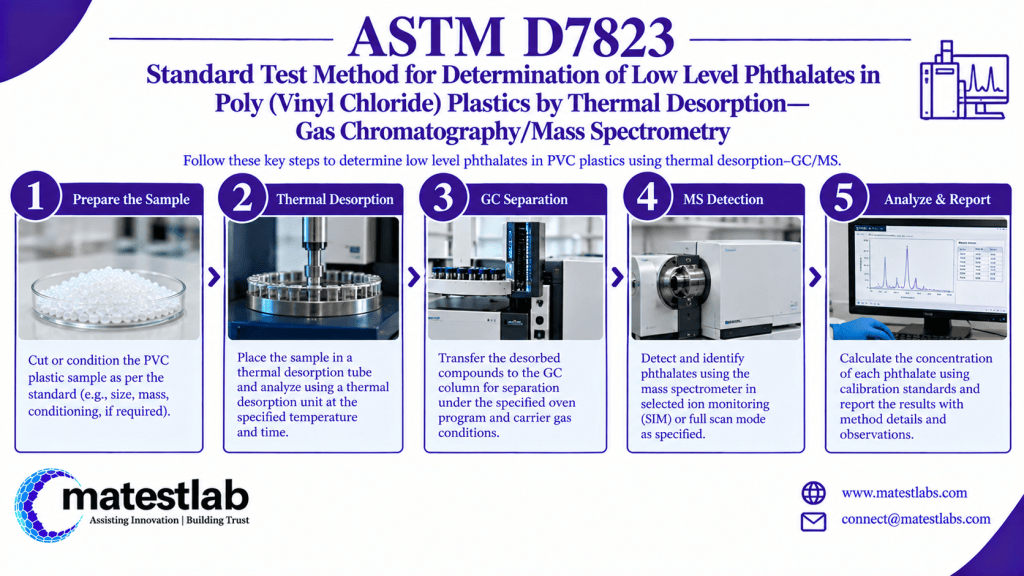
The analysis results show the concentration of each target phthalate detected in the PVC sample. Analysts should interpret each value alongside the compound name, measurement units, and sample identification details. The results can support product compliance assessments, but they do not determine compliance on their own. Analysts must compare the reported concentrations with the applicable regulatory limits or product specifications. The following points explain how to interpret the results.
- The technician records the target phthalates analyzed and their measured concentrations, typically expressed in parts per million (ppm).
- The analyst reviews the reported concentrations alongside the laboratory’s identification criteria and stated method limitations. The analyst also considers possible interfering compounds that may affect the analysis.
- The analyst checks the applicable analytical range and reporting limits before interpreting the results. If a sample falls outside the validated range or requires further investigation, the laboratory may perform additional analysis using an appropriate procedure.
- The analyst reviews the sample preparation, calibration, instrument performance, and quality-control information to assess the reliability of the reported concentrations. The technician documents any qualifications or limitations associated with the results.
- The analyst applies the results only to the sample and target compounds included in the test. The technician identifies the tested batch, component, or material because different parts of the same product may contain different phthalate concentrations.
- The analyst compares each reported concentration with the limits established by the applicable regulation, customer specification, or purchase agreement. ASTM D7823 provides the analytical procedure but does not establish universal acceptance limits.
- The analyst considers the method’s scope when interpreting and comparing results. The technician identifies the analytical method used because results from other methods may not be directly equivalent without an appropriate technical basis.
FAQs
Which version of ASTM D7823 is current?
ASTM lists D7823-20 as the active version, last updated March 11, 2020. Earlier versions, such as D7823-18, D7823-16, D7823-14, and D7823-13, are historical.
Which phthalates does this test method measure?
It demonstrates the procedure with BBP, DBP, DEHP, DNOP, DINP, and DIDP. The method can extend to other ortho-phthalates in polymeric substrates.
Does this test method replace solvent extraction methods?
No. ASTM notes that GC/MS, HPLC/UV, HPLC/MS, FTIR, and GC/FID also separate and identify phthalates in PVC. This method offers a thermal desorption option.
How much does phthalate testing cost?
The cost depends on the number of samples, the phthalates reported, and the reporting needs. Please contact Matestlab for a quote.
How long does testing take?
Turnaround depends on the number of samples and the laboratory schedule. Please contact Matestlab for a timeline.
Direct link to the ASTM D7823 PDF
Related