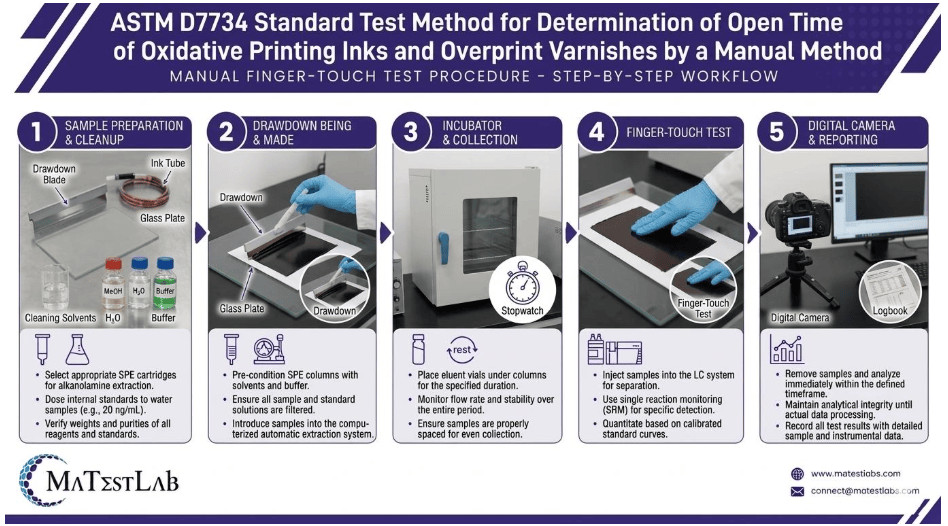
ASTM D7734 testing provides a manual method for measuring the oxidative-drying printing inks and overprint varnishes, based on the utilization of the finger transfer method. The method considers an ink or varnish film to remain open while it is wet and capable of transferring. The time required for the film to reach the endpoint is recorded in hours.
The scope of ASTM D7734 includes:
- Use: Oxidative drying printing inks and overprint varnishes.
- Test objective: To find out the period for which the applied film is open.
- Test principle: Manual evaluation of film transfer with the ‘finger transfer’ technique.
- Open condition: Current condition of the ink or varnish when the film is still wet and can be transferred.
- The endpoint of a film is when ink or varnish will no longer transfer to the fingertip under the given assessment conditions.
- Result: The time required to reach the endpoint is recorded in hours.
- Typical materials: Oil-based sheetfed offset inks, letterpress inks, and screen inks.
- Application relevance: The method is useful for evaluating drying behavior that may cause premature drying on printing press rollers and other parts.
- Film representation: The applied test film is thicker than the film printed on a substrate and is nominally representative of the film on printing press rollers.
- Measurement systems: This method allows the use of both SI and inch-pound units.
- Safety: All potential safety issues are not addressed in the standard. Laboratories should develop their own safety, health, and environmental protocols for conducting tests.
What are the Uses of ASTM D7734 Testing?
ASTM D7734 testing helps the laboratory determine the stay-open properties of oxidative-drying printing inks and overprint varnishes. This information is used in developing or comparing formulations to prevent the interference of premature drying within printing operations. The method provides a controlled way to observe how long the applied material remains wet and transferable under the standard test conditions. This standard-
- Determines the stay-open time of oxidative-drying printing inks.
- Evaluates the open time of overprint varnishes.
- Helps in the selection of formulations which can dry too quickly.
- Supports development and comparison of printing ink formulations.
- Provides information relevant to printing press roller performance.
- Supports quality-control evaluation of oxidative-drying materials.
- Helps laboratories compare drying behavior between different samples under comparable test conditions.
Which Materials Can Be Tested Under ASTM D7734?
ASTM D7734 method is used for the testing of oxidative-drying printing inks and overprint varnishes. This method specifically identifies oil-based sheetfed offset, letterpress, and screen inks as typical materials that dry through oxidation. Laboratory uses this method to determine the “wet time” of an applied film. This method is used to test various formulations, production samples, and comparative materials. The laboratory should confirm the drying process of the medium and its application before testing. In addition, results depend on the material specification and the purpose of the evaluation.
Why is ASTM D7734 Important?
Open time is an important property for oxidative-drying printing materials because the material must remain workable during the required printing process. If an ink or overprint varnish dries prematurely, it may affect printing operations, particularly on press rollers and other components. ASTM method identifies the stay-open time during the formulation of printing inks and overprint varnishes that primarily dry through oxidation. ASTM D7734 testing provides an agreed-upon manual method for assessing this property. Technicians use the material under controlled test conditions and set a specific endpoint that they determine with a consistent transfer evaluation, not just a general observation. The method is also useful for formulation comparison. When different samples are tested using comparable film application and environmental conditions, their measured open times can provide useful information about differences in drying behavior.