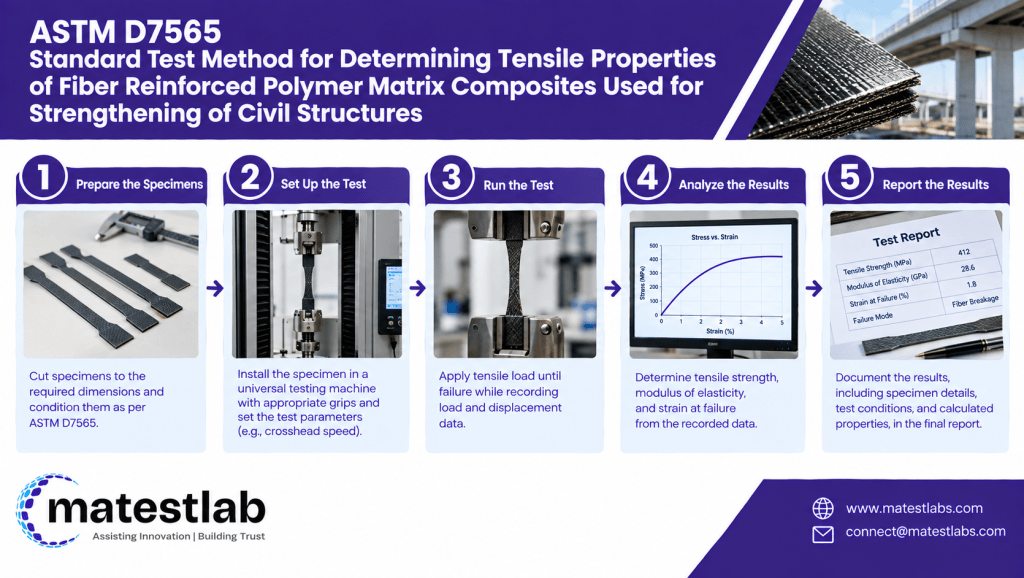
ASTM D7565/D7565M is a standard test method that outlines the procedures for sample preparation, mechanical pulling, and numerical properties determination for thin, flat skins of reinforcement intended for the reinforcement of failing public installations. This standard assesses the strength of material layers as a product of either ideal factory-controlled processes or as a laid-on-site product with environmental field variables. It converts raw failure loads to structural capacity baselines for major infrastructure calculations.
The scope of ASTM D7565 includes:
- Materials: Unidirectional and cross-ply laminates, both wet lay-up and shop-manufactured, made of flat (FRP) matrix composites.
- Goal: Assess the tensile force capacity and ultimate elongation of composites to be used to strengthen existing civil structures.
- Measured Properties: Ultimate tensile force per unit width, Chord Modulus of Elasticity, and ultimate tensile strain percent.
- Methods: Physical tension loading was performed using mechanical wedge grips and electronic strain monitoring in real time, according to ASTM D3039 references.
- Result: Force capacity calculated on a strict per-mm-of-width basis, without using unsuitably problematic thickness measurements.
- Test Limitation: Does not include use of integral components like primers, structural leveling putties, or independent bonding adhesives.
- Environmental Conditions: Standardized temperature- and humidity-controlled laboratory conditions that eliminate ambient moisture fluctuations before conducting material pull tests.
- Applications: Material sourcing specifications, factory quality assurance, civil structural engineering calculations, and infrastructure repair research.
What are the Uses of ASTM D7565 Testing?
The ASTM D7565 test provides essential structural performance data to ensure layout quality, validate raw material recipes, and simulate long-term tension handling in concrete or masonry support applications. This standard,
- Provides an important baseline tool to ensure the success of curing site-cured laminate.
- Enables organizations to produce consistent design mathematics for civil engineers.
- Compares various carbon, glass, or aramid fiber setups.
- Provides uniform analytical data for bridge and highway repair permits.
What material can be tested under ASTM D7565?
The testing protocol is designed for thin, flat structural polymer strips. It specifically compares wet lay-up composites with those fabricated directly on construction elements with pre-impregnated (pre-preg) composites produced in a shop under factory controls. It assesses the advanced polymer matrices to analyze existing structural concrete, timber, masonry, or metallic beams bound and secured using unidirectional configuration or cross-ply configuration.
Why is ASTM D7565 Important?
ASTM D7565 is important because it provides a standardized way to monitor the performance of composites, apart from the laminate thickness measurement, which is highly variable in the field when composites are installed manually. Conventional calculations of stresses based on cross-sectional area often result in inaccurate and hazardous stress information, due to the irregular thickness of the adhesive layer in the areas where the resin is applied manually. This standard addresses this problem by determining the force limits as a function of coupon width only. This standardization will provide civil engineers with the correct capacity of structures, allowing them to plan repairs safely for bridges, columns, and public structures.