ASTM D6646 Determination of the Accelerated Hydrogen Sulfide Breakthrough Capacity of Granular and Pelletized Activated Carbon

    What is ASTM D6646?

    ASTM D6646 is a standard test method for determining the accelerated hydrogen sulfide breakthrough capacity of granular and pelletized activated carbon under specified laboratory conditions. In the test, a standard gas mixture with hydrogen sulfide is passed through a bed of activated carbon until the concentration of hydrogen sulfide in the outlet gas reaches the specified value. The breakthrough capacity shows the quantity of hydrogen sulfide that the carbon will adsorb before it loses its effectiveness. It is widely used for activated carbon in air purification systems, natural gas treatment, upgrading of biogas, control of odor from wastewater, emission control systems for chemical processing plants, landfill gas treatment, and industrial emission control. The accelerated laboratory procedure allows laboratories to compare the hydrogen sulfide breakthrough capacities of different activated carbons under controlled test conditions.

    Read more

    Get Certified ASTM D6646 Testing for Reliable Activated Carbon Performance

    ASTM D6646 testing provides comparative information about the hydrogen sulfide breakthrough capacity of activated carbon under the laboratory conditions specified by the standard. Reliable testing provides assurance to manufacturers of product quality, a comparison of the adsorption performance, optimization of production processes, and compliance with customer requirements for odour control and gas purification.

    What is the Scope of ASTM D6646 Testing?

    ASTM D6646 evaluates the performance of activated carbon for removing hydrogen sulfide from gas streams. The test determines the breakthrough time and adsorption capacity of activated carbon under specified test conditions. It helps assess the effectiveness and suitability of activated carbon for hydrogen sulfide removal applications. 

    Read more

    • Determines the hydrogen sulfide adsorption capacity of activated carbon per unit volume at 99.5% removal efficiency under the specified laboratory conditions.
    • Evaluates granular and pelletized activated carbon for hydrogen sulfide removal from a humidified air stream.
    • Compares the hydrogen sulfide breakthrough performance of different granular and pelletized activated carbons.
    • Supports the development and quality assurance of products. 
    • Helps in the selection of activated carbon for the gas purification systems used in industry. 

    What are the uses of the ASTM D6646 test standard?

    The ASTM D6646 test standard helps evaluate the ability of activated carbon to remove hydrogen sulfide from gas streams. It also helps laboratories compare adsorption performance, determine breakthrough time, and assess the suitability of activated carbon for gas purification applications. 

    • Determines the hydrogen sulfide adsorption capacity of activated carbon under the specified accelerated laboratory conditions.
    • Compares the apparent effectiveness of adsorption of various grades of activated carbon 
    • Helps with quality control in the manufacture of activated carbon. 
    • Supports comparison of virgin and newly impregnated or in-service granular and pelletized activated carbons for hydrogen sulfide removal in odor-control applications.
    • Helps to make the right choices for gas purifiers with activated carbon. 
    • Supports the development and research of better adsorption materials. 

    Which Materials Can Be Tested Under ASTM D6646?

    ASTM D6646 applies to granular and pelletized activated carbon to be used for hydrogen sulfide removal. The method applies to granular and pelletized activated carbons that meet the particle-size and other requirements of ASTM D6646 regardless of the carbonaceous precursor used. It can also be used for virgin activated carbon, impregnated activated carbon, catalytic activated carbon, and specialty adsorbents used in the field of odor control, purification of biogas, natural gas processing, wastewater treatment, industrial air filtering, and emission control.

    Why is hydrogen sulfide breakthrough testing important?

    Hydrogen sulfide is extremely toxic and corrosive and causes objectionable odors in many industrial gas streams. ASTM D6646 is an accepted standard used to measure the length of time that activated carbon will effectively remove hydrogen sulfide before breakthrough. It helps engineers choose the right adsorbent, determine optimal replacement cycles, improve system reliability, and reduce maintenance costs.

    What Properties Does ASTM D6646 Measure?

    The test determines the hydrogen sulfide breakthrough performance and adsorption capacity of granular and pelletized activated carbon under specified accelerated laboratory conditions.

    Common Challenges and Troubleshooting

    Common problems include non-uniform bed packing, gas leaks, flow-rate variation, inaccurate hydrogen sulfide concentration, moisture variation, and instrument calibration errors. Good sample preparation, leak-free connections, calibrated gas analyzers, a controlled environment, and a uniform gas flow rate improve measurement repeatability and accuracy.

    Analysis Results and Interpretation

    • ASTM D6646 calculates hydrogen sulfide adsorption capacity per unit volume of activated carbon at 99.5% removal efficiency and expresses the result in grams of H₂S per cubic centimeter of carbon (g H₂S/cm³ carbon).
    • A longer breakthrough time under otherwise equivalent laboratory conditions generally indicates greater relative hydrogen sulfide breakthrough performance.
    • A higher adsorption capacity indicates better hydrogen sulfide removal performance and potentially longer service life.
    • A lower adsorption capacity or shorter breakthrough time indicates lower relative hydrogen sulfide breakthrough performance under the specified laboratory conditions.
    • Laboratories can use these results to compare activated carbon performance and evaluate its suitability for hydrogen sulfide removal applications.

    Link to ASTM D6646

    ASTM D6646 Equipment and Sample Preparation

    ASTM D6646 requires a controlled test system that can provide a certain level of hydrogen sulfide gas in terms of concentration, flow rate, temperature, and humidity. The test is conducted on an appropriate test column, gas monitoring equipment, and a uniformly prepared and packed activated carbon sample to get a uniform gas flow. Care should be taken in conditioning and packing the sample to ensure minimum voids and channeling that might impact the test result.

    Read more

    Specimen DetailsThe test uses granular or pelletized activated carbon derived from carbonaceous feedstocks such as coconut shell, coal, wood, lignite, or other carbon sources. The method applies to organic, newly impregnated, or in-service granular or pelletized activated carbon intended for hydrogen sulfide removal from an air stream.
    Specimen PreparationLaboratory personnel condition the activated carbon as needed, remove excess dust and fines, and pack the sample into the adsorption column. They ensure a uniform bed density and minimize channeling.
    Specimen DimensionsASTM D6646 is applicable to granular and pelletized activated carbons with a mean particle diameter of less than 2.5 mm. Testing activated carbons with larger mean particle diameters requires a larger adsorption column and additional conditions specified by the standard.
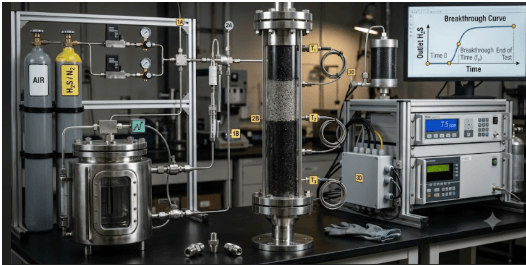
    InstrumentationThe test apparatus includes an adsorption column, a system for delivering the humidified H₂S-containing air stream, gas-flow control equipment, hydrogen sulfide monitoring equipment, and equipment for determining the carbon-bed and sample parameters required by the procedure.

    Testing Procedures and Requirements

    ASTM D6646 determines the accelerated hydrogen sulfide breakthrough capacity by passing a humidified air stream containing 1% by volume hydrogen sulfide through a granular or pelletized activated-carbon bed until 50 ppm H₂S breakthrough is observed. The test calculates the H₂S adsorption capacity of the carbon per unit volume at 99.5% removal efficiency. 

    Read more

    Sample PreparationTechnicians precondition the activated carbon sample, then pack it uniformly into the test column while minimizing voids and channels. For pelletized activated carbon, technicians use the equivalent spherical diameter to determine the appropriate adsorption-column diameter. ASTM recommends averaging 50 to 100 pellet-length measurements when determining the average pellet length.
    Test System SetupTechnicians set up the test column and establish the specified hydrogen sulfide concentration, gas flow rate, temperature, and humidity.
    Gas Exposure and MonitoringTechnicians pass the hydrogen sulfide-containing gas through the activated carbon bed and continuously monitor the hydrogen sulfide concentration at the outlet.
    Data Collection and AnalysisAnalysts record the breakthrough time and calculate the hydrogen sulfide adsorption capacity using the gas flow rate, concentration, and sample weight.

    ASTM D6646 Testing Technique, Process, and Data Collection

    A humidified air stream (1% H₂S, by volume) is passed through the activated-carbon bed until the outlet concentration reaches the specified 50 ppm (breakthrough point). The laboratory then measures the amount of hydrogen sulfide removed at 99.5% efficiency from a unit volume of carbon. Technicians condition the activated carbon sample and then pack it into a test column. The controlled hydrogen sulfide gas mixture flows continuously through the packed bed under certain operating conditions. Technicians continuously monitor the outlet gas concentration during the test until hydrogen sulfide breakthrough. Technicians record the breakthrough time, gas-flow conditions, sample information, and inlet hydrogen sulfide concentration, then use these measurements to determine the adsorption capacity of the activated carbon.

    The image shows a laboratory hydrogen sulfide breakthrough testing system used for ASTM D6646 testing.
    ASTM D6646 Hydrogen Sulfide Breakthrough Test Apparatus

    FAQ

    Where can I get the astm d6646 tested?
    You can share your astm d6646 testing requirements with MaTestLab. MaTestLab has a vast network of material testing laboratories, spread across the USA and Canada. We support your all material testing needs ranging from specific astm d6646 test to various testing techniques.
    Please contact us for a detailed quote for your astm d6646 testing needs. Cost incurred to carry out different astm d6646 testing methodology depends on the type of raw material; number of samples, coupons, or specimens; test conditions, turn around time etc. Costs of some ASTM testing methods start from $100 and the final value depends upon the factors listed above. Please contact us for the best and latest prices.
    The required number of samples or specimens should comply with the procedure given in the astm d6646 standard. However, the MaTestLab operations team can assist you for your special requirements once you share your testing details with us.
    MaTestLab has a vast testing laboratory network, hence we bring you the best testing facilities in a cost-effective way. We offer considerable discounts (15-20%) to our returning customers based on test volume and frequency.
    The turnaround time for astm d6646 test methodology depends upon the test procedure mentioned in the standard test document. However, we at MaTestLab understand your research requirements and hence try to get your test completed within the least possible time.
    Gokula Srinivasan Selvam
    About Author
    Gokula Srinivasan Selvam
    Gokula Srinivasan Selvam is a Material Testing Associate at MaTestLab Inc. and holds a postgraduate degree in Ceramic Engineering from IIT (BHU), Varanasi.
    Testimonials
    Real results
    Engineers trust us with what matters most
    Start Your Testing
    Project Today
    Define your requirements and get access to
    specialized laboratories ready to deliver results
    Partners with us
    Clients
    Vendors
    Process for testing
    • STEP 01

      You share your testing requirements

    • STEP 02

      You share your sample(s)

    • STEP 03

      We deliver your test reports

    Get your testing done

    Let us known your testing requirements and we will be right back with a solution.

      Let us root for each other. Collaborate to grow, expand, and accelerate our businesses.

      Partner with us

        Contact Us

        Discover more from MaTestLab

        Subscribe now to keep reading and get access to the full archive.

        Continue reading