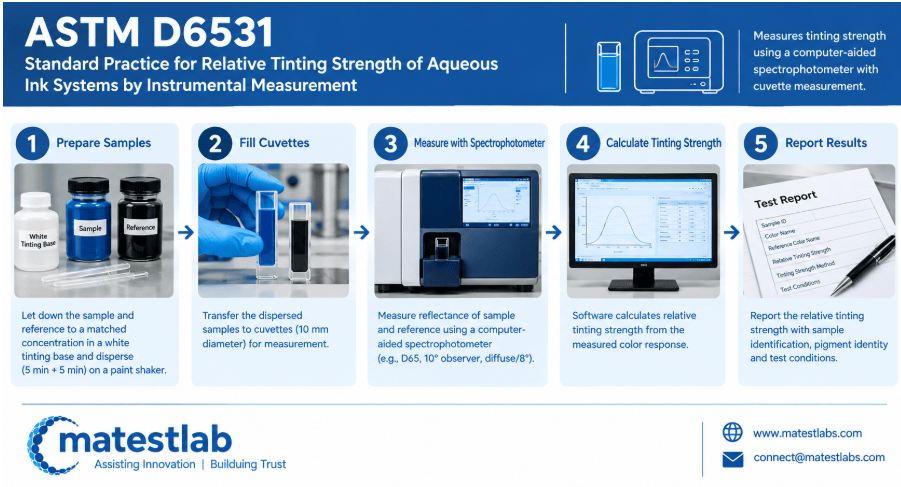
ASTM D6531 standard practice describes the procedure for determining the relative tinting strength of an aqueous ink system using a computer-aided spectrophotometer compared to a reference standard of an identical pigment identity.
The scope of ASTM D6531 includes-
- Material type: Water-based printing inks and bases intended primarily for flexographic and gravure printing applications.
- Purpose: Determination of relative tinting strength of a water-based ink system compared to a reference standard for the purposes of quality control and color matching.
- Properties evaluated: Relative tinting strength defined by the spectrophotometric analysis of a tinted sample compared to a reference standard.
- Testing method: A technician places a tinted sample in a cuvette for spectrophotometric measurement, and an analyst compares the resulting reading against a reference standard containing a pigment of the identical color index name and number.
- Results: Relative tinting strength expressed as a percentage derived from the spectrophotometric analysis compared to a reference standard using SI units of measurement as defined by the standard practice.
- Test limitations: The practice applies only to single, non-fluorescent pigmented colors and black ink systems for which a reference standard containing a pigment of the identical color index name and number exists. Thick wet drawdowns are inappropriate because aqueous systems can produce severe floating problems.
- Use conditions: Testing places tinted samples in a cuvette rather than applying wet drawdowns, since the aqueous system’s tendency to float and separate makes drawdown methods unreliable for this measurement.
- Applications: Quality control of production batches of ink bases and finished inks, and color matching between batches or against a target standard.
What are the Uses of ASTM D6531 Testing?
ASTM D6531 testing provides ink producers and printers with a comparable relative tinting strength value that visual assessment cannot always supply. The standard practice-
- Establishes the relative tinting strength value a production lot should meet compared to the reference standard.
- Supports quality control of ink bases and finished inks across production runs.
- Enables color matching between an ink batch and a target reference standard.
- Replaces visual judgment with an instrumental, repeatable spectrophotometric comparison.
- Flags batch-to-batch variation in pigment strength before ink reaches the press.
- Supports formulation troubleshooting when a batch’s color output drifts from expectation.
- Provides data usable alongside other water-based ink quality assessments.
Which materials can be tested under ASTM D6531?
ASTM D6531 applies to water-based printing inks and bases primarily for flexographic and gravure printing that contain nonfluorescent colorants and black inks for which a reference standard with identical pigment identity is available for comparison. An analyst should verify the pigment color index, the reference standard availability, and whether the system contains fluorescent colorants before testing, since these considerations fall outside the scope of the standard practice, and an analyst should ensure the material is a single-pigment system before testing commences.
Why is ASTM D6531 Important?
Tinting strength is an essential property of printing ink dispersions, since it determines how much color a given quantity of ink actually delivers once printed. Results on bulk tints do not guarantee equivalency of dry printed films, but they provide a useful, repeatable parameter for quality control of production batches of bases and finished inks. Tinting strength is an essential property of printing ink dispersions. Results on bulk tints do not guarantee equivalency of dry printed films, but they provide useful parameters for quality control of production batches of bases and finished inks. The results may also support color matching. ASTM D6531 uses cuvette-based spectrophotometric measurement because thick wet drawdowns are inappropriate for aqueous systems due to severe floating problems.