ASTM D6484/D6484M Standard Test Method for Open-Hole Compressive Strength of Polymer Matrix Composite Laminates

    What is ASTM D6484?

    ASTM D6484 is a standard test method that defines the open-hole compressive strength of multidirectional polymer matrix composite laminates made with high-modulus fibers. This test method involves machining a precise circular hole into the center of a rectangular laminate specimen, mounting the specimen in an anti-buckling support fixture, and compressing it to failure while a technician records the peak load. The open center is an approximation of the hole bored by a bolt, rivet, or pin through a polymer matrix composite structure, so the resulting strength value represents the strength of the composite laminate after the introduction of a hole for mechanical fasteners. Analysts use ASTM D6484 (Standard Test Method for Open-Hole Compressive Strength of Polymer Matrix Composite Laminates) to determine notched compressive strength for material qualification, structural design allowables, and quality control of polymer matrix composite laminates, most often those made with aerospace-grade materials, where the reduction in strength due to a hole is a design consideration. Engineers compare the notched strength against the laminate’s unnotched compressive strength to judge how much capacity the hole removes. 

    Read more

    Get Certified ASTM D6484 Testing for Reliable Composite Laminate Performance

    Composite laminate specimens rarely remain free of holes after being assembled into a larger structure; mechanical fasteners such as rivets, bolts, and pins necessitate a hole in the laminate at the point of joining. A hole can cause localized stress concentrations in a composite laminate, reducing the compressive strength that the composite can withstand far below its theoretical maximum. ASTM D6484 determines the open-hole compressive strength, a value that can be used to size a composite joint with mechanical fasteners or determine a reduction factor for other composite structures with holes.

    What is the Scope of the ASTM D6484 Test Standard?

    ASTM D6484 test method specifies how a technician measures the compressive strength of a multidirectional polymer matrix composite laminate that has been machined with an open hole in its center. The scope of ASTM D6484 includes:

    Read more

    • Material type: Multidirectional polymer matrix composite laminates made with high-modulus fibers. Continuous-fiber or discontinuous-fiber (tape or fabric, or both) forms are acceptable, so long as the laminate is balanced and symmetric with respect to the direction of testing.
    • Purpose: Determination of the compressive strength of a composite laminate that contains an open, unfilled circular hole. The objective is to quantify the reduction in strength caused by a hole necessary to accept a mechanical fastener.
    • Properties evaluated: Open-hole compressive strength, determined using the gross cross-sectional area of the specimen; strain is sometimes measured if the test setup incorporates an extensometer, although it is not required for the determination of compressive strength.
    • Testing method: A technician machines a circular hole in the center of a rectangular composite laminate specimen, mounts the specimen in a face-supported anti-buckling fixture, and compresses the specimen to failure while measuring or recording the peak load. An analyst then determines the open-hole compressive strength of the specimen based on the peak load and the specimen’s cross-sectional area.
    • Results: Open-hole compressive strength is reported in stress units, expressed independently in SI (MPa) and inch-pound (psi) values, since the standard treats the two systems as separate rather than converted equivalents.
    • Test limitations: The only valid failure mode is compressive failure at the hole; failure elsewhere invalidates the result. ASTM D6484 is a coupon-level test method; it does not apply to full-scale structural specimens or to a bolted joint test.
    • Use conditions: The specimen may be conditioned and tested under specified environmental conditions. When non-ambient conditions apply, the required temperature and relative humidity must be controlled and reported.
    • Applications: Aerospace material qualification, structural design allowable development, bolted and mechanically fastened joint design, quality control, and comparison of different laminate lay-ups or material systems.

    What are the Uses of ASTM D6484 Testing?

    ASTM D6484 provides a designer or manufacturer of composite materials with a comparable notched strength value that an unnotched compression test cannot supply on its own. The test method:

    • Establish the open-hole compressive strength value that design allowables and material specifications require for a composite laminate.
    • Quantify the reduction in strength that a composite laminate undergoes as a result of being machined with an open hole.
    • Develop designs for mechanically fastened composite joints and structures where a hole is necessary for the insertion of a mechanical fastener.
    • Compare different composite laminate lay-ups, fiber forms, and resin systems on the basis of their notched compressive strength.
    • Contribute to material qualification and structural design allowable development, particularly in the aerospace industry.
    • Verify that a manufactured composite laminate meets the notched-strength requirement that a specification establishes for it.
    • Support failure-mode investigation when a structure with fastener holes underperforms expectations.

    Which materials can be tested under ASTM D6484?

    ASTM D6484 testing applies to multidirectional polymer matrix composite laminates made with high-modulus fibers in either continuous or discontinuous (tape or fabric, or both) form, provided that the laminate is balanced and symmetric with respect to the direction of testing. ASTM D6484 applies to carbon-fiber-reinforced polymers, glass-fiber-reinforced polymers, and other high-modulus fiber-reinforced composite materials used in the manufacture of aerospace, automotive, and other structural composite components. Before testing, an engineer should specify the lay-up, thickness, and hole geometry that a test specimen should possess for the purposes of comparison.

    Why is ASTM D6484 Important?

    Composite laminate specimens experience a reduction in compressive strength that is particular to the lay-up, fiber form, and geometry of the specimen once a hole of any size is introduced. ASTM D6484 determines the open-hole compressive strength of the specimen as a controlled value that can be applied to the design of composite structures that make use of mechanical fasteners. Open-hole compression testing plays the most important role in the design process of structures with bolted joints, access panels, and other elements with mechanical fasteners that introduce holes in a composite structure that are sources of stress concentration. The value determined by ASTM D6484 testing is critical to the evaluation and design of composite structures in the aerospace field and composite engineering in general, where weight is a critical design factor.

    ASTM D6484 Equipment and Sample Preparation Guide 

    ASTM D6484 testing requires that a technician mounts a rectangular composite laminate specimen with a machined hole in the center of a face-supported anti-buckling compression fixture and proceeds to compress it to failure. The anti-buckling fixture is critical in this test method, since a specimen of this geometry would exhibit premature end-column buckling if the technician were to mount it with simple end grips. Proper anti-buckling fixture setup ensures that a technician obtains a valid open-hole compressive strength value for a composite laminate specimen.

    Read more

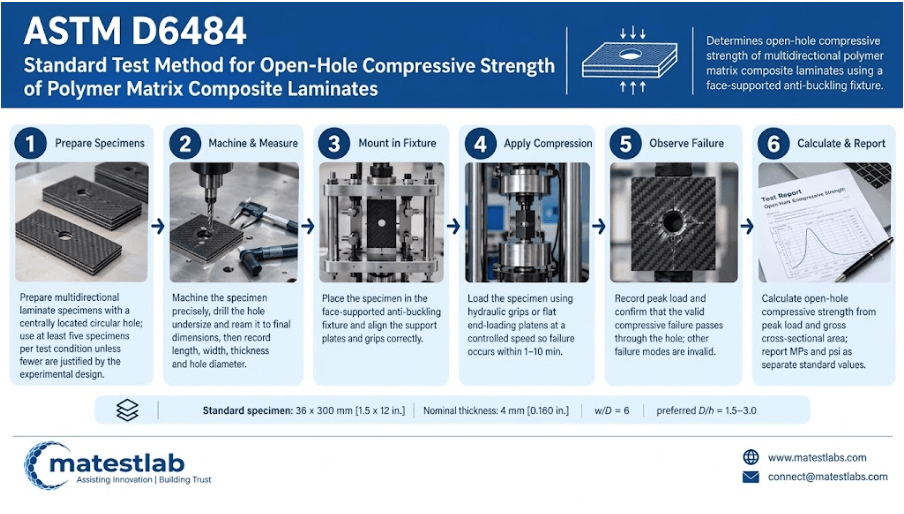
    Sample and Specimen DetailsA technician prepares rectangular multidirectional laminate specimens with a centrally located circular hole. The method calls for at least five specimens per test condition unless fewer specimens are justified by the experimental design. 
    Specimen PreparationA technician machines the laminate using appropriate precision methods, drills the hole undersize, and reams it to final dimensions while avoiding delamination or other damage around the hole. The technician then measures and records the specimen dimensions and hole geometry.
    Specimen DimensionsStandard specimens are 36 × 300 mm [1.5 × 12 in.]. The nominal laminate thickness is 4 mm [0.160 in.], with an acceptable range of 3–5 mm [0.125–0.200 in.]. The method specifies a width-to-hole-diameter ratio of 6 and a preferred hole-diameter-to-thickness ratio of 1.5–3.0. The ungripped specimen length-to-width ratio should be maintained at 2.7 unless the experiment specifically investigates that ratio.
    InstrumentationThe test uses a compression testing machine capable of the required load range, a face-supported anti-buckling fixture with matched grip and support-plate assemblies, precision measuring instruments for length, width, thickness, and hole diameter, and an extensometer of 25 mm (1.0 in.) gauge length meeting Practice E83 Class B-1 when strain data is required.

    Testing Procedures and Requirements for ASTM D6484 

    This test method compresses a notched composite laminate specimen to failure, measures the peak load, and calculates the open-hole compressive strength of the specimen on the basis of the peak load and the specimen’s gross cross-sectional area. A technician prepares and mounts the specimen in the fixture while an analyst calculates the open-hole compressive strength of the specimen and prepares the test report. The ASTM D6484 test method comprises the following test procedure:

    Read more

    Specimen MeasurementTechnicians measure the specimen’s length, width, thickness, and hole diameter using instruments accurate enough for the specimen’s geometry and record these values as the baseline for the strength calculation.
    Fixture InstallationTechnicians mount the specimen in the test fixture, ensuring that it is centered, and set the support plates and shims such that the gap between the support plates and the specimen faces is consistent with the requirements of the standard.
    LoadingThe compression testing machine applies load to the specimen at a prescribed rate to failure through shear loading in hydraulic grips or end platens, depending on the configuration of the fixture.
    Strain MonitoringWhen strain data is required, an extensometer records strain during loading; strength determination itself needs only the recorded peak load.
    Failure ObservationAnalysts confirm that failure occurred as compressive failure at the hole, since any other failure mode invalidates the result for open-hole compressive strength.
    Calculation and ReportingAnalysts calculate the open-hole compressive strength on the basis of the recorded peak load and the gross cross-sectional area of the specimen, recording the calculated value alongside the relevant information pertaining to the test specimen.

    ASTM D6484 Testing Process and Data Collection

    An analyst selects suitable test specimens that represent the lay-up and hole geometry under investigation and instructs a technician to machine a hole of the required diameter in the test specimen, measure, and record the length, width, thickness, and diameter of the hole. The technician mounts the specimen in the anti-buckling fixture and ensures that the specimen is aligned with the axis of the load cell. If the test requires it, an extensometer mounted on the specimen measures and records strain. The technician confirms the specimen failed at the hole rather than elsewhere in the gage section. An analyst then calculates the open-hole compressive strength from the recorded peak load and gross cross-sectional area of the specimen and records the result alongside specimen identification, lay-up details, and test conditions.

    The image shows a notched composite laminate specimen mounted in an anti-buckling fixture during ASTM D6484 open-hole compression testing.
    ASTM D6484 Open-Hole Compression Testing of Polymer Matrix Composite Laminates


    Common Challenges and Troubleshooting

    A technician should inspect a machined hole for delamination or fiber damage if the measured strength value falls below the expected value, since such defects that occur during machining reduce the compressive strength of a specimen. Improper alignment of the specimen or of the fixture itself can lead to bending of the specimen during testing, which defeats the purpose of using an anti-buckling fixture. Adjusting shim thickness can address issues of improper contact between the specimen and the support plates of the anti-buckling fixture. If premature end-column buckling occurs, the technician should recheck the contact between the specimen and the support plates. Failure at a location other than the hole renders the test results invalid since the strength value that the test calculates only accounts for failure at the hole in the specimen. An analyst should double-check that the thickness and diameter of the hole of the specimen fall within the tolerances of the test method since both values affect the mode of failure of the specimen.

    ASTM D6484 Analysis Results and Interpretation

    The report contains information about the open-hole compressive strength of the tested composite laminate along with the pertinent data about the specimen geometry and the mode of failure observed during testing.

    Read more

    • The technician records the identification of the test specimen, the lay-up of the composite laminate, the thickness of the specimen in millimeters (in.), the diameter of the hole in millimeters (in.), and the width of the specimen in millimeters (in.).
    • The analyst reports the peak load in newtons (lbf) and calculates the open-hole compressive strength in megapascals (psi) on the basis of the gross cross-sectional area of the tested specimen. The standard requires reporting values in both SI and inch-pound units as independent measurements.
    • The technician records the mode of failure observed during testing and confirms that the observed failure is consistent with compressive failure at the hole.
    • The report lists the temperature at which the test was conducted, as applicable, since testing in ambient or controlled environmental conditions can affect the compressive strength of the specimen.
    • The analyst compares the open-hole compressive strength against the laminate’s unnotched compressive strength where available to express the strength loss the hole introduces.

    Link to ASTM D6484

    FAQ

    How does ASTM D6484 measure open-hole compressive strength?
    ASTM D6484 standard test method determines the open-hole compressive strength of a composite laminate specimen by mounting the specimen in an anti-buckling compression fixture and applying a compressive load until the specimen fails, with the open-hole compressive strength calculated from the peak load and the gross cross-sectional area of the specimen.
    ASTM D6484 applies to multidirectional polymer matrix composite laminates made with high-modulus fibers in either continuous or discontinuous (tape or fabric, or both) form, provided that the laminate is balanced and symmetric with respect to the direction of testing.
    ASTM D6484 relies on a face-supported anti-buckling fixture because the long, notched specimen would buckle under compressive load without it, which would produce an invalid failure mode.
    ASTM D6484 treats SI and inch-pound units as independent standard values. Analysts report open-hole compressive strength in MPa (psi) and specimen dimensions in mm (in.).

    Updated on September 21, 2026

    Rohit Dhembare
    About Author
    Rohit Dhembare is an Operations Associate at Matestlab Inc., holds a postgraduate degree in Organic Chemistry and is trained in Materials Science testing techniques.
    Know More
    Testimonials
    Real results
    Engineers trust us with what matters most
    Why Choose Matestlab?
    Matestlab is a unified testing services partner based in the USA. Matestlab offers raw material and product testing services through accredited, expert laboratories primarily based in the USA. Matestlab supports physical, thermal, chemical, electrical, mechanical, environmental, and characterization testing needs through its global network of 2200+ accredited testing laboratories. Matestlab's in-house materials science experts curate and design comprehensive testing programs matched to the sample material and specific testing need, with regulatory requirements and confidentiality in mind.

    If you are looking for a managed and trusted testing partner to achieve your research goals, feel free to schedule a meeting with us or send us a request at connect@matestlabs.com to learn more about our services. For a quick quote, call us at (302)244-7710. We are happy to serve you.
    Start Your Testing
    Project Today
    Define your requirements and get access to
    specialized laboratories ready to deliver results
    Partners with us
    Clients
    Vendors
    Process for testing
    • STEP 01

      You share your testing requirements

    • STEP 02

      You share your sample(s)

    • STEP 03

      We deliver your test reports

    Get your testing done

    Let us know your testing requirements and we will be right back with a solution.

      Let us root for each other. Collaborate to grow, expand, and accelerate our businesses.

      Partner with us