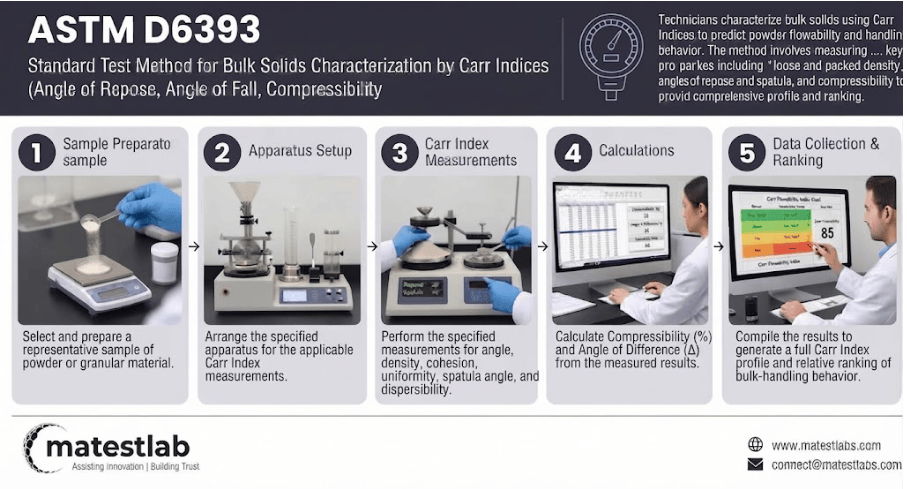
ASTM D6393/D6393M Standard Test Method for Bulk Solids Characterization by Carr Indices
ASTM D6393 is a standard test method to characterize bulk solids by using Carr Indices. This test method measures the flowability and compressibility properties of bulk materials that are important for storage, transportation, and processing operations. The technique includes measuring bulk density, tapped density, compressibility index, and Hausner ratio to assess powder flow characteristics. It is extensively applied in powder metallurgy, pharmacy, food technology, and chemical production for efficient hopper design and material handling. Carr Indices provide a fast and economical evaluation of powder properties in industrial systems.
Read More
GET STARTED
ASTM D6393 Introduction
ASTM D6393 is an important standard for the assessment of powders and granular materials’ packing behavior and flow properties. The standard specifies a method of procedure for measuring Carr Index parameters of compressibility index and Hausner ratio, which are key flowability indicators. These indices enable engineers to make predictions about whether a powder will rathole, bridge, or flow uniformly in feeders, silos, and bins. The procedure also determines the degree of densification by tapping or vibration, thereby replicating the handling and transportation impact on bulk materials. Following ASTM D6393 testing reduces risks of flow stoppages, equipment downtime, and variable feed rates in continuous processes. The standard is widely practised in industries where the uniformity of product, control of dosage, and consistent processing are critical to safety and performance.
ASTM D6393 Test Method
Bulk Density Measurement
A known mass of powder is poured into a graduated cylinder without tapping; volume is recorded to calculate bulk density.
Tapped Density Measurement
The same sample is tapped mechanically 1250 times or until no further volume change is observed; tapped density is calculated.
Compressibility Index and Hausner Ratio
Compressibility index is calculated as [(tapped density – bulk density)/tapped density] x 100; the Hausner ratio is tapped density divided by bulk density.
ASTM D6393 Equipment and Sample Preparation
Graduated Cylinder (100 ml)
Ensure dry and clean; fill with 50-100 g sample poured without compaction to measure bulk volume.
Tapping Apparatus
Calibrated to deliver uniform tapping height (14 ± 2 mm) for accurate tapped density determination.
Sample Powder Specimen
Minimum 50 g sieved to remove agglomerates; particle size recorded to correlate with flow results.
ASTM D6393 Results and Interpretation
The Hausner ratio and compressibility index from these tests give direct measurements of powder flowability. Compressibility indexes lower than 15% represent excellent flow, whereas those higher than 25% represent poor flow behavior. Hausner ratios approaching 1.00 represent free-flowing powders, while values higher than 1.25 indicate cohesiveness and possible obstruction to flow. All these results assist engineers in choosing hopper angles, designing feeders, and selecting flow aids or granulation methods for productive processing.
Service Name
Remarks
ASTM D6393 Testing
Contact US
ASTM D6393Related Articles
The ASTM D6773 describes the bulk solids characterization using the Jenike Shear Cell to determine flow function and cohesive strength. The outline of procedures to measure the apparent density of free-flow powder using the ASTM D6940 Scott Volumeater. The ASTM E11 Carr Indices provides specifications for important tests to prepare representative powder samples before the test.
Materials Commonly Tested with ASTM D6393
The materials assessed using ASTM D6393 include pharmaceutical powder such as lactose, microcrystalline cellulose, and excipients, as well as additive manufacturing, metal powder for dough, starch powder in food processing, and fine chemical medium used in catalytic or polymer production. Their flowability profile dose is essential for uniformity, tablet pressure, mixing efficiency, and bulk transport.
Applications of ASTM D6393 in Industry
In the pharmaceutical industry, ASTM D6393 is applied to the Powder Mixing characterization to ensure continuous tablet weight and material uniformity. In food processing, it helps in hopper and feeder design for flour, milk powder, and starch. The powder uses Carr Indis to assess the flow capacity of alloy powder in metallurgy mold filling. Chemical manufacturers implemented it to evaluate powder additives and catalysts to maintain flow in pneumatic conversion systems and storage silo.
Safety and Best Practices in ASTM D6393
Standard sampling emphasizes reducing contact with aerial dust during transfer and tapping, as fine powder can prevent breathing hazards. The personnel should use protective gloves and dust masks as suitable. To ensure tapping stability, the device must be calibrated regularly, and the sample must be handled carefully to prevent pre-determined errors that can distort the results. Clean, dry equipment is necessary to avoid cross-contamination or moisture-induced caking during testing.
Importance of ASTM D6393
D6393 test method is essential for measuring powder flowability and handling characteristics, allowing industries to create safer and more efficient storage, transport, and processing systems. It eliminates expensive downtime resulting from hopper blockage, guarantees pharmaceutical dosage accuracy, and assists in quality consistency in food and chemical manufacturing. By adopting this standard, manufacturers have assurance in bulk solid performance, promoting operational reliability and product safety.
Related
FAQ's
Where can I get the astm d6393 tested?
You can share your astm d6393 testing requirements with MaTestLab. MaTestLab has a vast network of material testing laboratories, spread across the USA and Canada. We support your all material testing needs ranging from specific astm d6393 test to various testing techniques.
How much do I need to pay for the astm d6393 test?
Please contact us for a detailed quote for your astm d6393 testing needs. Cost incurred to carry out different astm d6393 testing methodology depends on the type of raw material; number of samples, coupons, or specimens; test conditions, turn around time etc. Costs of some ASTM testing methods start from $100 and the final value depends upon the factors listed above. Please contact us for the best and latest prices.
How many samples are required for astm d6393?
The required number of samples or specimens should comply with the procedure given in the astm d6393 standard. However, the MaTestLab operations team can assist you for your special requirements once you share your testing details with us.
How much discount can I get on the astm d6393 test?
MaTestLab has a vast testing laboratory network, hence we bring you the best testing facilities in a cost-effective way. We offer considerable discounts (15-20%) to our returning customers based on test volume and frequency.
How many days will it take to complete the astm d6393 test?
The turnaround time for astm d6393 test methodology depends upon the test procedure mentioned in the standard test document. However, we at MaTestLab understand your research requirements and hence try to get your test completed within the least possible time.
Where can I get the astm d6393 tested?
You can share your astm d6393 testing requirements with MaTestLab. MaTestLab has a vast network of material testing laboratories, spread across the USA and Canada. We support your all material testing needs ranging from specific astm d6393 test to various testing techniques.
MaTestLab Inc. offers accessible, quick, and affordable material testing, product testing, and failure analysis services. We support your on-demand testing and expert consultation needs with the help of our extensive network of material testing laboratories situated in the US and other parts of the world.
MATERIAL TESTING
We offer destructive and non-destructive tests over a range of mechanical, electrical, chemical, thermal, optical, corrosion, radiation, and biological testing methodologies defined by ASTM, ISO and other organizations.
PRODUCT TESTING
We help you evaluate and ensure your product quality and performance with standard and custom-made testing solutions. All the tests are done at well-equipped testing laboratories using standard testing methods for best output and satisfaction.
FAILURE ANALYSIS
Failure analysis ensures high levels of quality in every manufacturing process. We help you with getting the best failure or root cause analysis to determine the cause of the failure. The results help you identify means to prevent failure recurrences.