
ASTM D6370 is the standard test method for determining rubber composition using thermogravimetric analysis. Technicians heat a small specimen in a controlled atmosphere, while a balance records mass changes continuously. As temperature increases, each component decomposes or oxidizes in its characteristic range, so the resulting mass-loss curve separates one component from another. Analysts measure levels of organics, carbon black, and ash in a rubber compound using ASTM D6370 (Standard Test Method for Rubber—Compositional Analysis by Thermogravimetry (TGA)). Engineers therefore use the results for quality control, material screening, and troubleshooting.
ASTM D6370 Rubber-Compositional Analysis by Thermogravimetry (TGA)
What is ASTM D6370?
What is the Scope of ASTM D6370 Test Standard?
The scope of ASTM D6370 covers the thermogravimetric determination of organic material, carbon black, and ash in rubber compounds. The test evaluates mass changes during controlled heating and oxidation to determine the relative amounts of these components. However, the method is not suitable for compounds containing fillers that decompose within the same temperature range as the polymer or carbon black, such as calcium carbonate. The heating parameters are also adjusted for other rubber compounds when appropriate. Laboratories and manufacturers use ASTM D6370 for material characterization, quality control, formulation evaluation, and comparison of rubber compounds.
The Scope of ASTM D6370 includes :
- Material type: Vulcanized rubber and thermoplastic elastomer compounds containing organic material, carbon black, and ash.
- Purpose: Quantification of organic components, carbon black, and inorganic ash in rubber compounds.
- Properties evaluated: Organic content, carbon black content, and ash content based on mass changes during controlled heating.
- Testing Method: Thermogravimetric analysis determines the mass of organic material, carbon black, and ash by heating the rubber compound under controlled atmospheric conditions.
- Result: The amounts of organic material, carbon black, and ash are reported as percentages of the original specimen mass.
- Test Limitations: The method is not suitable for compounds containing fillers that decompose within the same temperature range as the polymer or carbon black, such as calcium carbonate.
- Use conditions: Controlled heating rates and atmospheric conditions are maintained during the analysis to obtain consistent thermogravimetric measurements.
- Applications: Applications include rubber compound formulation, quality control, material characterization, product development, and comparison of rubber materials.
What are the Uses of ASTM D6370 Testing?
The applications of ASTM D6370 are that it is applicable to quality control, material screening, and compound troubleshooting. Laboratories compare the composition of a specimen to a known reference formulation. Meanwhile, manufacturers use the results to confirm supplier consistency and investigate field failures. This standard –
- Confirms formulation consistency across production batches.
- Supports material screening during compound development.
- Assists in troubleshooting unexpected performance or failures.
- Compares an unknown compound against a known reference material.
Which Materials Can Be Tested Under ASTM D6370?
ASTM D6370 covers natural rubber, synthetic rubber blends, and other common elastomers. Laboratories typically test NBR, EPDM, and SBR compounds that go into hoses, gaskets, and belts. This technique is used in vulcanized rubber as well as in thermoplastic elastomer compounds. This testing is therefore relied upon by automotive, aerospace, and building manufacturers to confirm compound quality.
Why is ASTM D6370 Important?
ASTM D6370 is important because it quickly and accurately tests rubber composition. The strength, heat resistance and durability of the final parts are directly affected by the polymer content, the filler content and the carbon black content. Out-of-proportions can lead to failure in critical applications. Therefore, the manufacturer can benefit from accurate compositional data for fine tuning formulations, industry norms and increased product reliability.
ASTM D6370 Equipment and Sample Preparation Guide
This test method requires a calibrated thermogravimetric analyzer and a small, carefully prepared rubber specimen. The table below outlines the equipment and sample requirements.
| Sample and Specimen Details | Technicians test polished sections of metallic or nonmetallic polycrystalline material for grain analysis. |
| Specimen Preparation | Technicians cut the specimen cleanly and place it in a platinum pan, free from surface contamination or moisture. |
| Specimen Dimensions | A specimen weighs approximately 10 to 12 mg, a size chosen for reliable mass-loss measurement. |
| Instrumentation | The test uses a calibrated thermogravimetric analyzer with nitrogen and air or oxygen purge gas. |
Testing Procedures and Requirements for ASTM D6370
Technicians follow a staged heating sequence to separate each component by decomposition temperature. Initially, the instrument purges with nitrogen and records the specimen’s baseline mass. The ASTM D6370 test methods comprise the following test procedure-
| Initial Heating (Nitrogen) | The specimen heats from about 50 °C to 550 °C in nitrogen, releasing organics as mass loss. |
| Atmosphere Switch | The purge gas changes to air or oxygen once the specimen cools and stabilizes near 300 °C. |
| Carbon Black Oxidation | Continued heating to about 800 °C burns off carbon black, recorded as a further mass loss. |
| Ash Determination | The mass remaining after heating represents the ash, or inorganic filler, content. |
Testing Process and Data Collection Guide
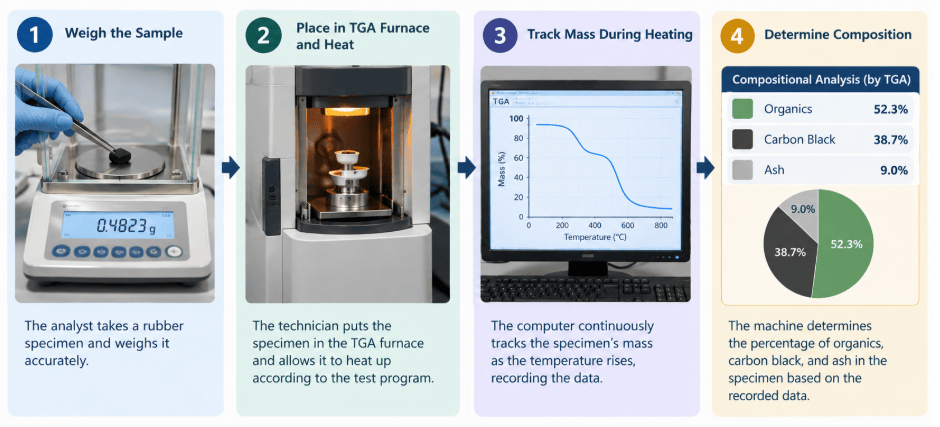
The process begins with analysts taking a sample specimen and weighing it. Next, technicians place the specimen in the TGA furnace and heat it. The third step involves the computer tracking the specimen’s mass as it continues to heat up. The last procedure is that the machine determines the percentage of organics, carbon black, and ash in the specimen based on the recorded data.
Common Challenges and Troubleshooting
The common challenges and troubleshooting while obtaining a specimen for TGA testing include obtaining a uniform and representative sample. Non-uniform heating rates and contamination lead to decomposition temperature shifts and erroneous results. The decomposition of fillers overlapping with those of the polymer or carbon black should also be taken into consideration during the analysis. Therefore, the problems are solved by checking the analyzer’s calibration regularly, adjusting the purge gas flow, and preparing the specimens in such a way that minimizes contamination.
ASTM D6370 Analysis Results and Interpretation
ASTM D6370 analysis results and interpretation show that analysts convert the recorded mass-loss steps into a compositional breakdown for each specimen. The report expresses organics, carbon black, and ash as a percentage of the original specimen mass. These findings help laboratories interpret results consistently under this test method.
- The laboratory reports the organic content, including oil and polymer components, from the measured mass loss that occurs during heating under an inert nitrogen atmosphere.
- Analysts determine the carbon black content from the additional mass loss recorded when the test atmosphere changes from nitrogen to an oxidative atmosphere such as air or oxygen.
- Laboratory technicians calculate the ash content from the inorganic residue that remains after the organic material and carbon black have been removed during the controlled heating cycle.
- Engineers compare the measured composition with known reference materials, expected formulation values, or applicable specification limits to identify differences in the rubber compound.
- Analysts report the calculated organics, carbon black, and ash as 0.1 percentage of the original specimen mass and review the overall compositional profile for consistency with the expected material formulation.
Get Certified ASTM D6370 Testing for Reliable Rubber Composition Analysis
Certified testing of ASTM D6370 assures manufacturers that a rubber compound is indeed true to its intended formulation before it enters production. Polymer, carbon black, and filler content are verified by certified testing to specification limits. Independent laboratory analysis thus removes doubt in material qualification and incoming inspection. Matestlab provides manufacturers with calibrated TGA instruments and experienced analysts to deliver accurate and repeatable composition data.
FAQ
What is ASTM D6370 used for?
ASTM D6370 is used to determine the amounts of organics, carbon black, and ash in a rubber compound through thermogravimetry. Laboratories rely on it for quality control, material screening, and troubleshooting.
What specimen size does this test method require?
The specimen size test method requires a small rubber specimen weighing approximately 10 to 12 mg. This size gives a reliable mass-loss signal without overloading the instrument.
Which materials can be tested with this method?
The materials that can be tested with this method are natural rubber, synthetic blends, and common elastomers such as NBR, EPDM, and SBR. Any vulcanized rubber or thermoplastic elastomer compound qualifies for the technique.
How does this test method separate organics from carbon black and ash?
This test method separates organics from carbon black and ash through staged heating in different atmospheres. Nitrogen removes organics first, then air or oxygen burns off carbon black, leaving ash as the residue.
Updated on September 14, 2026

Testimonials
Real results
Engineers trust us with what matters most
“We had a great experience working with this company for our ASTM E84 testing. They were the first company to respond to our inquiry within just a few minutes of submitting it. From start to finish, the communication was excellent, and the entire process was swift, straightforward, and hassle-free.”

“Very good communication, testing associates were very patient with delays on our end. Reasonable turnaround time for results and nicely detailed report. Analysts were also quick to answer any follow-up questions. Happy with results.”
“Matestlab connected us with an accredited lab within days, cutting weeks off our product validation timeline.”
Why Choose Matestlab?
Matestlab is a unified testing services partner based in the USA. Matestlab offers raw material and product testing services through accredited, expert laboratories primarily based in the USA. Matestlab supports physical, thermal, chemical, electrical, mechanical, environmental, and characterization testing needs through its global network of 2200+ accredited testing laboratories. Matestlab's in-house materials science experts curate and design comprehensive testing programs matched to the sample material and specific testing need, with regulatory requirements and confidentiality in mind.
If you are looking for a managed and trusted testing partner to achieve your research goals, feel free to schedule a meeting with us or send us a request at connect@matestlabs.com to learn more about our services. For a quick quote, call us at (302)244-7710. We are happy to serve you.
If you are looking for a managed and trusted testing partner to achieve your research goals, feel free to schedule a meeting with us or send us a request at connect@matestlabs.com to learn more about our services. For a quick quote, call us at (302)244-7710. We are happy to serve you.
Start Your Testing
Project Today
Project Today
Define your requirements and get access to
specialized laboratories ready to deliver results
specialized laboratories ready to deliver results
Start Testing
Partners with us
Clients
Vendors