ASTM D6203 Standard Test Method for Thermal Stability of Way Lubricants
What is ASTM D6203?
ASTM D6203 is a standard test method for determining the thermal stability of hydrocarbon-based way lubricants. The method exposes a lubricant to copper and steel test rods at 100°C for 24 h in a gravity convection electric oven. After heating, technicians visually evaluate discoloration on the copper and steel rods and inspect the test beaker for deposits. These observations indicate physical and chemical changes that may affect the lubricant’s lubricating performance. ASTM D6203 (Standard Test Method for Thermal Stability of Way Lubricants) is designed to qualify way lubricants, not for routine quality control or condition monitoring. The method does not directly correlate with actual field service because of the test.
Get Certified ASTM D6203 Testing for Reliable Thermal Stability Evaluation
ASTM D6203 testing evaluates how a hydrocarbon-based way lubricant responds to prolonged exposure to elevated temperature in contact with copper and steel. The lubricant is heated for 24 h at 100°C with standardized metal rods, and then the rods are checked for discoloration and deposits in the test container. Accurate results require controlled temperature, proper preparation of the metal specimens, clean test equipment, and consistent visual evaluation.
What is the scope of ASTM D6203?
ASTM D6203 covers the evaluation of the thermal stability of hydrocarbon-based way lubricants, although oxidation may occur during the test. The method analyzes physical and chemical property changes that can impair lubricant performance. The test exposes the lubricant to copper and steel rods at 100°C and evaluates the resulting rod colors and deposits.
Material type: Hydrocarbon-based way lubricants suitable for the thermal stability evaluation.
Test Objective: To test lubricant condition following controlled exposure to high temperature and metal surfaces.
Property measured: Thermal stability based on copper and steel rod discoloration and deposits.
Method: Heat the lubricant with copper and steel rods for 24 h at 100°C in a gravity convection electric oven.
Result: Provides visual ratings for copper and steel rod discoloration and an evaluation of deposits in the test beaker.
Test Limitations: This method is not designed to establish a field service performance correlation and does not apply to routine quality control or lubricant condition monitoring.
Environmental conditions: The test temperature is kept at 100 ± 2°C, and equipment conditions are controlled to ensure repeatable visual assessment.
Applications: Lubricant qualification, product development, comparative evaluation, and thermal stability assessment of various lubricants.
What are the uses of ASTM D6203 testing?
ASTM D6203 testing helps lubricant manufacturers and engineers evaluate physical and chemical changes that can occur when lubricants experience elevated temperatures. The test shows a visual representation of lubricant interactions with copper and steel surfaces. This standard-
Tests the thermal stability of hydrocarbon-based way lubricants.
Identifies discoloration of copper and steel test rods.
Detects deposits produced during thermal exposure.
Supports qualification of way lubricant formulations.
Helps compare the thermal behavior of different lubricant formulations.
Supports lubricant development and formulation studies.
Helps identify changes that could adversely affect lubricating performance.
Which Materials Can Be Tested Under ASTM D6203?
ASTM D6203 applies to hydrocarbon-based lubricants. The test measures the lubricant’s performance when exposed to standard copper and steel rods under controlled heat. Technicians use UNS C11000 electrolytic tough-pitch copper and AISI W1 1% carbon steel test specimens.
Why is ASTM D6203 important?
ASTM D6203 is a standard method to measure the thermal stability of a lubricant based on the changes observed in the lubricant properties and the metal test sample. Elevated temperature can cause physical and chemical changes that may affect lubricant performance.
ASTM D6203 Equipment and Sample Preparation Guide
ASTM D6203 requires a gravity convection electric oven capable of maintaining 100 ± 2°C, a calibrated temperature indicator, 100-mL borosilicate glass Griffin beakers, and standardized copper and steel rods. Technicians also use 320-grit silicon-carbide abrasive and crocus cloth to prepare the metal specimens.
Analysts test a hydrocarbon-based way lubricant with UNS C11000 copper and AISI W1 1% carbon steel rods.
Sample Preparation
Technicians prepare the metal rods using the specified abrasive materials and ensure clean surfaces before exposure to the lubricant.
Specimen Dimension
Copper and steel rods: 6.4 mm diameter × 7.6 cm length. The lubricant is contained in a 100-mL borosilicate glass Griffin beaker.
Instrumentation
Gravity convection electric oven, calibrated temperature indicator, 100-mL Griffin beaker, copper test rod, steel test rod, 320-grit silicon-carbide abrasive, crocus cloth, and Fives Cincinnati Milacron Color Chart.
Testing Procedures and Requirements for ASTM D6203
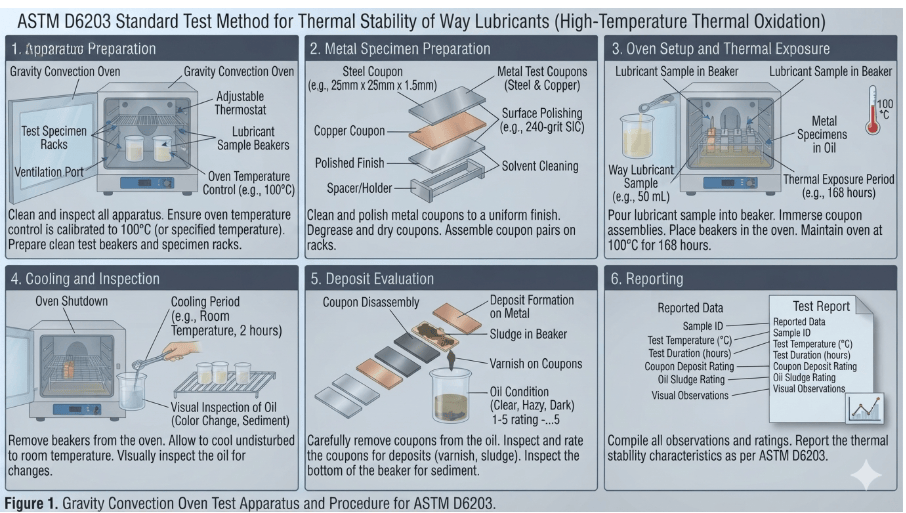
ASTM D6203 places a beaker containing the test lubricant and copper and steel rods in a gravity convection electric oven. Skilled experts maintain the test temperature at 100 ± 2°C for 24 h. After exposure, analysts visually evaluate rod discoloration and deposits. Other reference documents include D2070 and D4057. The complete procedure for ASTM D6203 is given below:
Skilled personnel verify the gravity convection oven, calibrated temperature indicator, beaker, and other test equipment before testing.
Metal Specimen Preparation
Technicians prepare the copper and steel rods using the specified 320-grit silicon-carbide abrasive and crocus cloth. Analysts place the required way lubricant in the 100-mL borosilicate glass Griffin beaker and position the copper and steel rods in the lubricant.
Oven Setup and Thermal Exposure
Skilled personnel place the prepared test assembly in the gravity convection electric oven and set it to 100°C. Technicians maintain the test at 100 ± 2°C for 24 h.
Cooling and Inspection
Analysts remove the test assembly after the exposure period and inspect the copper and steel rods for discoloration.
Deposit Evaluation
Skilled experts visually inspect the beaker and lubricant for deposits produced during thermal exposure. Analysts compare the rod colors with the specified Fives Cincinnati Milacron Color Chart and record the applicable ratings.
Reporting
Technicians record the lubricant identification, test temperature, exposure time, copper and steel rod ratings, deposit observation, and other relevant test information.
ASTM D6203 Testing Process and Data Collection
Technicians prepare the copper and steel rods and place them with the way lubricant in a 100-mL Griffin beaker. Analysts place the assembly in a gravity convection electric oven maintained at 100 ± 2°C for 24 h. After heating, skilled personnel evaluate discoloration on both metal rods and inspect the beaker for deposits. Analysts use the specified color chart for rod-color evaluation and document the resulting ratings and deposit observations.
ASTM D6203 Testing Procedure Using Gravity Convection Electric Oven
Common Challenges and Troubleshooting
The following should be maintained to ensure reproducible and accurate results: consistent metal surface preparation, controlled temperature, clean test equipment, consistent visual evaluation. The copper and steel rods should be prepared in equal amounts so that there will be no contamination before testing. The oven shall be checked by the analyst to ensure a uniform temperature of 100 ± 2 °C for a 24-hour period. The following color chart should also be used consistently by skilled experts to assess the discoloration of rods, and the beaker should be checked thoroughly for deposits.
ASTM D6203 Analysis Results and Interpretation
The report summarizes the thermal stability behavior of the tested way lubricant after controlled exposure to copper and steel rods at elevated temperature. Manufacturers use this method to evaluate discoloration and deposit formation and compare the lubricant’s thermal behavior with applicable qualification requirements.
The laboratory reports the copper rod rating, steel rod rating, and deposit observation, with the test temperature reported in °C and exposure time in h.
Technicians record the visual discoloration ratings of the copper and steel rods after the 24-h exposure at 100°C, together with the lubricant identification and test conditions.
Analysts document the test configuration, metal specimen types and dimensions, color-chart evaluation, and presence or absence of deposits in the test beaker.
Engineers compare the observed rod discoloration and deposit formation with applicable lubricant qualification requirements to evaluate the tested lubricant’s thermal stability.
Rohit Dhembare is an Operations Associate at Matestlab Inc., holds a postgraduate degree in Organic Chemistry and is trained in Materials Science testing techniques. Know More
Testimonials
Real results
Engineers trust us with what matters most
“We had a great experience working with this company for our ASTM E84 testing. They were the first company to respond to our inquiry within just a few minutes of submitting it. From start to finish, the communication was excellent, and the entire process was swift, straightforward, and hassle-free.”
Ivars FancyWalls
United States
“Very good communication, testing associates were very patient with delays on our end. Reasonable turnaround time for results and nicely detailed report. Analysts were also quick to answer any follow-up questions. Happy with results.”
Skye Henderson
United States
“Matestlab connected us with an accredited lab within days, cutting weeks off our product validation timeline.”
Rebecca Kozodoy-Pins
United States
Start Your Testing Project Today
Define your requirements and get access to specialized laboratories ready to deliver results