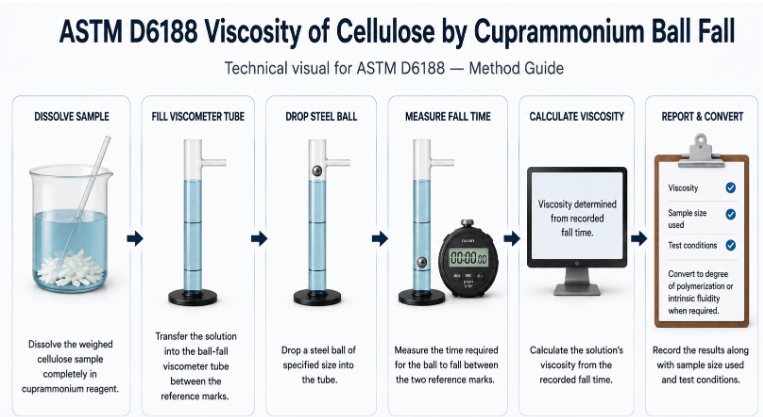
ASTM D6188 is the standard test method for estimating the molecular weight of cellulose by determining the viscosity of the cuprammonium solution using the ball-fall technique. The method implies preparing a solution of cellulose dissolved in cuprammonium reagent and measuring the viscosity of the resulting solution by timing the fall of a steel ball. The ASTM D6188 standard-
- Applies to cellulosic materials such as wood pulp, cotton, and cotton linters.
- Estimates cellulose molecular weight from a solution of cuprammonium in which the viscosity has been determined.
- Defines seven sample sizes, which decrease as the expected cellulose molecular weight increases.
- Suits rapid, routine testing of large numbers of samples without sacrificing accuracy or precision.
- Requires the cellulose sample to dissolve completely, without gel formation, for the result to be considered valid.
- Treats SI units as standard, with other values given in parentheses for reference only.
What are the Uses of ASTM D6188 Testing?
ASTM D6188 testing enables chemists to estimate the molecular weight of cellulose using a rapid method for screening and precise analysis, and manufacturers use the results to assess pulp uniformity and make production decisions. This standard-
- Determines the viscometric molecular weight of purified cotton or wood-derived pulps.
- Supports rapid control testing in the manufacture of pulp.
- Assists manufacturers to rapidly screen a large number of samples during production.
- Provides a viscosity value that can be used to calculate degree of polymerization or intrinsic viscosity.
- Assists researchers studying how processing conditions affect cellulose molecular weight.
Which Materials Can Be Tested Under ASTM D6188?
ASTM D6188 applies to cellulosic materials such as wood pulp, cotton, and cotton linters, totally dissolved in a cuprammonium reagent. The method applies to a wide range of cellulose materials with varying molecular weights and uses different sample sizes, as indicated by the test. Lower sample weights are used when higher molecular weights are expected. Cotton and other high molecular weight materials are challenging to dissolve in cuprammonium reagent, ensuring complete dissolution and no gel formation.
Why is ASTM D6188 Important?
ASTM D6188 gives a pulp and fiber manufacturer a rapid analytical method for monitoring the cellulose molecular weight distribution, an essential component in assessing the strength of pulp and its processability into other finished products such as rayon or other cellulose derivatives. This is mainly because the method is applicable to cellulose materials with a wide range of molecular weights, as described by the seven sample sizes. Thus, apart from being a routine control test for the manufacturing process, ASTM D6188 is a useful analytical tool for the precise analysis of purified pulp in research. The standard makes the observation that solutions of cellulose in cuprammonium reagent are non-Newtonian fluids, meaning that their viscosity is not constant at a given shear rate; however, the effect is minimal, and the method is applicable within the specified limits of testing.