
ASTM D6144 is a standard test for determining the purity of AMS (α-methylstyrene) by capillary gas chromatography. The test method uses external standard calibration to separate and quantify known impurities in the AMS sample; the gas chromatograph then determines purity based on the calculated impurity levels. Chemists use ASTM D6144 (Standard Test Method for Analysis of AMS (α-Methylstyrene) by Capillary Gas Chromatography) to set AMS purity specifications and ensure internal quality control throughout any manufacturing process that uses AMS, including polymer material testing programs that rely on monomer purity data. Analysts compare a sample’s impurity levels to the AMS specification to determine purity.
ASTM D6144 Standard Test Method for Analysis of AMS (α-Methylstyrene) by Capillary Gas Chromatography
What is ASTM D6144?
What is the Scope of the ASTM D6144 Test Standard?
ASTM D6144 covers AMS (α-methylstyrene) purity by capillary gas chromatography using external standard calibration. The method applies to common manufacturing impurities in AMS, including stabilizers added to the material, and analyzes these impurities over a range of 5 to 800 mg/kg. The ASTM D6144 standard:
- Determines AMS purity by using capillary gas chromatography and external standard calibration.
- Quantifies common AMS impurities, including cumene, 3-methyl-2-cyclopentene-1-one, n-propylbenzene, tert-butylbenzene, sec-butylbenzene, cis-2-phenyl-2-butene, acetophenone, 1-phenyl-1-butene, 2-phenyl-2-propanol, trans-2-phenyl-2-butene, m-cymene, p-cymene, and phenol.
- Determines para-tertiary-butylcatechol (TBC or PTBC), which manufacturers typically add as a stabilizer to AMS.
- Covers impurity concentrations from 5 to 800 mg/kg.
- Provides an average limit of detection of 1.2 mg/kg and an average limit of quantitation of 4 mg/kg of the specified impurities in AMS.
- Requires rounding of test results according to the rounding-off rules in the Practice E29 standard.
- Reports results using SI units as the standard unit system.
What are the Uses of ASTM D6144 Testing?
ASTM D6144 testing helps chemists confirm that AMS meets its purity specification before it enters resin production. Manufacturers then use the results to accept or reject AMS shipments and to monitor process quality over time. This standard-
- Confirms AMS purity against a manufacturer’s or buyer’s specification.
- Supports incoming-material acceptance checks before AMS enters production.
- Monitors batch-to-batch consistency as an internal quality-control measure.
- Determines stabilizer levels, including para-tertiary-butylcatechol (TBC/PTBC).
- Supports specification-setting for AMS and materials referenced by the method.
- Assists research and development work involving AMS.
Which materials can be tested under ASTM D6144?
ASTM D6144 standard applies to AMS (α-methylstyrene) containing normal impurities that fall within the method’s applicable analytical range. The method can support AMS produced or used in manufacturing processes and can also support development and research work involving AMS. Extremely high-boiling or unusual impurities may not be detected, which can make the calculated purity inaccurate. Before testing, a chemist calibrates the gas chromatograph using the external standard technique for the impurities covered by the method.
Why is ASTM D6144 Important?
ASTM D6144 gives AMS producers and users a standardized way to confirm monomer purity before it enters resin production, where trace impurities can interfere with polymerization or affect the finished product’s properties. Because ASTM D6144 has low detection limits (averaging 1.2 mg/kg) and quantification limits (averaging 4 mg/kg), the standard lets producers ensure their product purity meets specifications. The accuracy of the results is predicated on the fact that the trace amount of impurities being analyzed falls within the range of 5 mg/kg to 800 mg/kg. If the sample contains other unusually high-boiling impurities, the method will not detect them, and the purity level will be incorrectly estimated.
ASTM D6144 Equipment and Sample Preparation Guide
ASTM D6144 specifies using a capillary gas chromatograph calibrated by the external standard technique against reference standards for AMS’s known impurities.
| Sample and Specimen Details | Chemists test a representative sample of AMS intended for polystyrene, ABS, or other styrenic resin manufacturing, or for development and research work. |
| Specimen Preparation | Chemists condition the AMS sample so it introduces cleanly into the gas chromatograph without damaging the capillary column. |
| Specimen Dimensions | Chemists size the injection volume to the capillary column and detector so impurity concentrations remain measurable across the method’s 5 mg/kg to 800 mg/kg range. |
| Instrumentation | System uses a capillary gas chromatograph, external calibration standards for known impurities such as cumene, n-propylbenzene, tert-butylbenzene, sec-butylbenzene, 3-methyl-2-cyclopentene-1-one, and para-tertiary-butylcatechol (TBC or PTBC), and data-processing software. |
Testing Procedures and Requirements for ASTM D6144
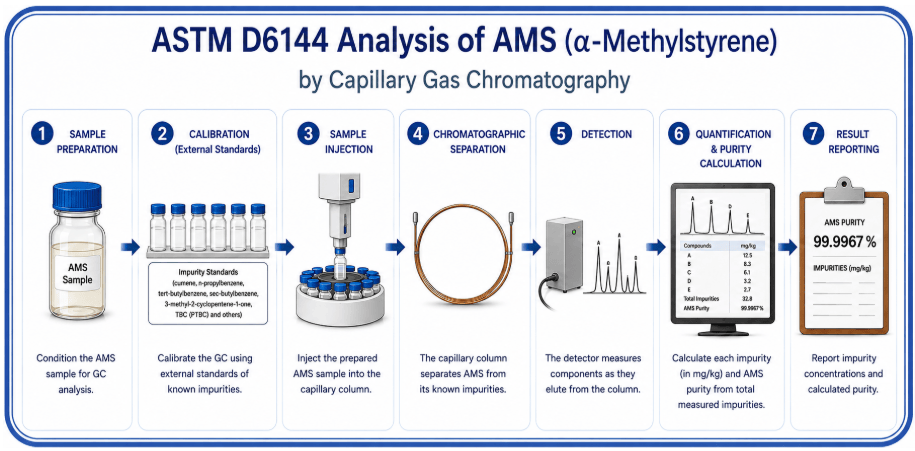
ASTM D6144 test standard separates and quantifies known impurities in an AMS sample using capillary gas chromatography with external standard calibration. The ASTM D6144 test method comprises the following procedure-
| Instrument Calibration | Chemists calibrate the gas chromatograph using external standards containing known concentrations of the target impurities. |
| Sample Introduction | Chemists inject the conditioned AMS sample into the capillary column under the method’s specified conditions. |
| Chromatographic Separation | The capillary column separates AMS from its known impurities as the sample moves through the system. |
| Detection | The detector measures the separated components as they elute from the column. |
| Quantification | Chemists calculate each impurity’s concentration, in mg/kg, from its peak response relative to the external calibration standards. |
| Purity Calculation | Chemists calculate the AMS purity from the total measured impurities. |
| Result Reporting | The analyst records the concentration of each detected impurity, along with the calculated purity and instrument conditions used. |
ASTM D6144 Testing Process and Data Collection
A chemist chooses an appropriate representative AMS sample and prepares a gas chromatograph against external standards of the method’s known impurities. Chemists then prepare the sample and inject it into a capillary column that elutes the AMS with its measured impurities out of the detector. Chemists calculate the concentration in mg/kg for each impurity using detector response, round the values according to Practice E29, and calculate the sample purity based on the determined impurities.
Common Challenges and Troubleshooting
Accurate ASTM D6144 results depend on a properly calibrated gas chromatograph, a clean capillary column, and consistent sample introduction. Column contamination or drift in detector response can shift retention times and skew impurity quantification. Extremely high-boiling or unusual impurities outside the method’s normal range can also go undetected, producing an inaccurate purity calculation. Chemists verify calibration against fresh external standards regularly and inspect the column and injection system before each test series.
ASTM D6144 Analysis Results and Interpretation
The report expresses the purity of the tested AMS sample based on the concentration of each known impurity detected.
- The analyst reports each impurity concentration in milligrams per kilogram (mg/kg), the SI-based unit the standard specifies for all results.
- The report identifies each detected impurity, such as cumene, n-propylbenzene, tert-butylbenzene, sec-butylbenzene, 3-methyl-2-cyclopentene-1-one, or para-tertiary-butylcatechol (TBC or PTBC), individually rather than as a single combined value.
- The chemist rounds every reported result according to the method in Practice E29 before comparing it to a specification limit.
- The report calculates AMS purity as a percentage by subtracting the total measured impurities from the sample, and treats the result as reliable only when the impurities present fall within the method’s normal, calibrated range.
Get Certified ASTM D6144 Testing for Reliable AMS Purity Analysis
AMS serves as a key monomer in the production of polystyrene, ABS, and other styrenic resins, which means that any trace impurities, such as cumene, n-propylbenzene, or the stabilizer para-tertiary-butylcatechol (TBC or PTBC), that may be present in the monomer, enter the resin batch during polymerization and can have detrimental impacts on polymerization or finished product quality. ASTM D6144 offers chemists a capillary gas chromatography method to determine these impurities down to an average of 1.2 mg/kg. Analysts use ASTM D6144 results to verify incoming AMS shipments, support specification-setting, and to monitor AMS quality during production or research work.
FAQ
What is ASTM D6144 used for?
ASTM D6144 determines the purity of AMS (α-methylstyrene) using capillary gas chromatography with external standard calibration.
What impurities does ASTM D6144 measure?
The method measures known AMS impurities and para-tertiary-butylcatechol (TBC or PTBC), which manufacturers typically add as a stabilizer.
What is the detection range for ASTM D6144?
The method covers impurity concentrations from 5 mg/kg to 800 mg/kg, with an average limit of detection of 1.2 mg/kg and an average limit of quantitation of 4 mg/kg.
Updated on September 6, 2026

Testimonials
Real results
Engineers trust us with what matters most
“We had a great experience working with this company for our ASTM E84 testing. They were the first company to respond to our inquiry within just a few minutes of submitting it. From start to finish, the communication was excellent, and the entire process was swift, straightforward, and hassle-free.”

“Very good communication, testing associates were very patient with delays on our end. Reasonable turnaround time for results and nicely detailed report. Analysts were also quick to answer any follow-up questions. Happy with results.”
“Matestlab connected us with an accredited lab within days, cutting weeks off our product validation timeline.”
Start Your Testing
Project Today
Project Today
Define your requirements and get access to
specialized laboratories ready to deliver results
specialized laboratories ready to deliver results
Start Testing
Partners with us
Clients
Vendors