
ASTM D6139 Standard Test Method for Determining the Aerobic Aquatic Biodegradation of Lubricants or Their Components Using the Gledhill Shake Flask

    What is ASTM D6139?

    ASTM D6139 describes a standard test method for determining the aerobic aquatic biodegradation of lubricants or their components using the Gledhill shake flask. This method exposes a lubricant or lubricant component to an aerobic microbial inoculum in a sealed shake flask and measures the carbon dioxide (CO₂) the microorganisms release as they consume the test substance. The method addresses a specific challenge in biodegradation testing: many ready-biodegradability tests are not designed to handle water-insoluble materials and complex mixtures, since lubricants are typically both. Analysts and formulators turn to ASTM D6139 (Standard Test Method for Determining the Aerobic Aquatic Biodegradation of Lubricants or Their Components Using the Gledhill Shake Flask) to calculate the extent of ultimate aerobic biodegradability of a lubricant in a controlled laboratory setting. Engineers compare the resulting biodegradation percentage against reference materials and product specifications for environmentally acceptable lubricants.

    Read more

    Get Certified ASTM D6139 Testing for Reliable Lubricant Biodegradation Data

    Any lubricant intentionally or unintentionally released into rivers, lakes or coastal waters can last in the environment if it is resistant to biodegradation, and manufacturers and regulators now ask for biodegradation data before a product can feature an environmentally acceptable lubricant claim. When there is limited water solubility or multi-component formulations, the formulators can use the shake flask procedure outlined in ASTM D6139. ASTM D6139 data are used to support environmental claims, formulation comparisons, and assessment of base oils and additives for new formulations by analysts and product-development teams.

    What is the Scope of the ASTM D6139 Test Standard? 

    ASTM D6139 determines the degree of aerobic aquatic biodegradation for fully formulated lubricants or their individual components exposed to an inoculum under laboratory conditions. This standard-

    Read more

    • Establishes the degree of aerobic aquatic biodegradation for fully formulated lubricants or their individual components.
    • Measures ultimate biodegradation by carbon dioxide (CO₂) evolution rather than an indirect indicator.
    • Tackles the challenge of testing water-insoluble materials and complex mixtures, which many ready-biodegradability tests are not designed to handle.
    • Applies to all non-volatile lubricants or components that are not toxic or inhibitory to the inoculum organisms at the test concentration.
    • Reports all results in SI units as the only unit system specified by the standard.

    What are the Uses of ASTM D6139 Testing? 

    ASTM D6139 testing enables formulators and environmental scientists to generate biodegradation data for lubricants resistant to evaluation by other test methods. This standard-

    • Establishes whether a lubricant or lubricant component biodegrades enough to support an environmentally acceptable lubricant claim.
    • Supports formulators in comparing the biodegradability of different base oils, additives, or fully formulated products.
    • Supports manufacturers in generating data for ecolabel programs and environmental regulatory submissions.
    • Determines the validity of a test run based on the biodegradation of a reference material.
    • Supports analysts in choosing an inoculum source such as activated sewage sludge, soil, or natural surface water that best represents the intended field application.

    Which materials can be tested under ASTM D6139? 

    ASTM D6139 covers fully formulated lubricants and their individual components, provided that the material is non-volatile and not toxic or inhibitory to the inoculum organisms at the test concentration. The method suits materials with limited water solubility, since the Gledhill shake flask targets the complex, largely water-insoluble mixtures typical of many lubricants. An analyst determines the carbon content of the test substance before testing to calculate the theoretical CO₂ yield and select an appropriate inoculum source based on the material’s intended application.

    Why is ASTM D6139 Important? 

    ASTM D 6139 gives the lubricant industry a test method designed specifically to target those characteristics that make lubricants challenging to assess for aquatic biodegradation under standard test conditions. Thus, analysts may expect a lubricant that demonstrates a good degree of biodegradation under the ASTM D 6139 test protocol to biodegrade in most aerobic aquatic environments. Low CO₂ production does not necessarily indicate resistance to biodegradation; rather, it suggests the analyst should perform additional tests or provide more information on the test material’s possible inhibitory effect on the inoculum. Before an analyst judges the test material’s biodegradability, ASTM D6139 confirms the inoculum’s viability and capacity to yield meaningful results by requiring confirmation with a reference material during each test.

    ASTM D6139 Equipment and Sample Preparation Guide 

    ASTM D6139 calls for sealed Gledhill shake flasks, an aerobic inoculum, a mineral-salts medium, and a system for measuring CO₂ evolution over the test period.

    Read more

    Sample and Specimen DetailsTechnicians analyze a representative sample of a finished lubricant or an individual lubricant component for aquatic biodegradation testing.
    Specimen PreparationTechnicians combine the test substance with a mineral salts medium and an aerobic inoculum in a sealed Gledhill shake flask, alongside a reference material flask and a blank control.
    Specimen DimensionsAnalysts dilute the test-substance amount and inoculum to the flask’s volume to ensure theoretical CO₂ and biodegradation calculations.
    InstrumentationTechnicians use the Gledhill shake flasks, aerobic inoculum, mineral salts medium, CO₂ measurement apparatus, and reference material.

    Testing Procedures and Requirements for ASTM D6139 

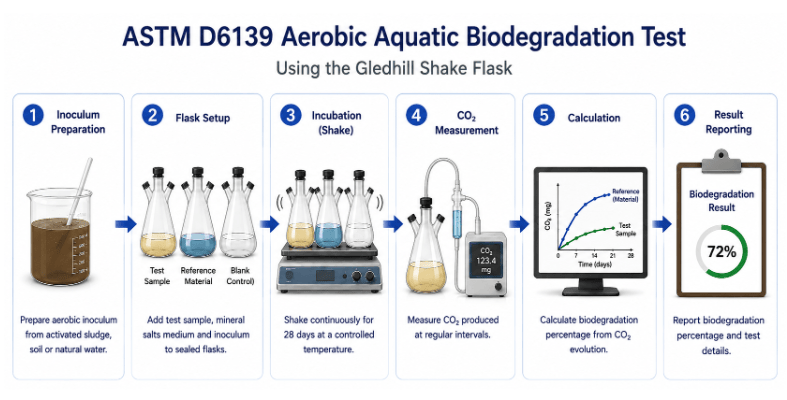
    The ASTM D6139 test method requires incubating the lubricant sample with an aerobic inoculum and analyzing the released carbon dioxide to calculate the biodegradation percentage over 28 days. The ASTM D6139 test method comprises the following procedure-

    Read more

    Inoculum PreparationTechnicians prepare an aerobic inoculum from activated sewage sludge, soil, natural surface water, or a mixture of these materials.
    Flask SetupTechnicians combine the test substance, mineral salts medium, and inoculum in a sealed Gledhill shake flask, and set up a separate reference-material flask and a blank-control flask alongside it
    IncubationTechnicians shake the flasks continuously for 28 days at a controlled temperature to sustain aerobic microbial activity.
    CO₂ MeasurementAnalysts measure the amount of carbon dioxide produced in the mixture at specified intervals.
    Reference VerificationAnalysts confirm the reference material reaches at least 60% of its theoretical CO₂ within 28 days; otherwise, the analyst repeats the test with a fresh inoculum
    CalculationAnalysts calculate the test substance’s biodegradation percentage from its measured CO₂ evolution relative to its theoretical CO₂ yield.
    Result ReportingThe analyst records the biodegradation percentage, inoculum source, reference-material performance, and test duration.

    ASTM D5997 Testing Process and Data Collection 

    An engineer identifies the water stream that requires continuous carbon monitoring and selects a corresponding analyzer. Technicians install the sample line, acidification stage, and membrane conductivity module into the process and system and calibrate the analyzer. The analyzer then automatically oxidizes organic carbon in the water stream, passes the CO₂ through a selective membrane, and measures the resulting change in conductivity. Analysts then evaluate the resulting trend of total carbon, inorganic carbon, and total organic carbon in relation to the process water limit.

    Alt text: The image shows the ASTM D6139 sequence of setting up the aerobic inoculum and setting up the sealed shake flasks with the lubricant sample and reference material, incubating under agitation, and measuring CO₂ evolution to calculate biodegradation.
    ASTM D6139 Gledhill Shake Flask Biodegradation Testing Sequence

    Common Challenges and Troubleshooting

    Stable sample flow, working membrane modules, and standardized reagents are required to obtain accurate results by employing the ASTM D5997 method. Baseline changes in the conductivity detector may occur due to fouling or drift. The acidification and oxidation stages are periodically monitored, and calibration is compared to reference materials to ensure that the analyzer remains within its limits of 0.5 µg/L to 50,000 µg/L.

    ASTM D5997 Analysis Results and Interpretation 

    The report expresses the carbon content of the monitored water stream against the operating limit or historical baseline for that system.

    Read more

    • The analyst enters and reports values of total carbon, inorganic carbon, and total organic carbon in micrograms per liter (μg/L), the unit the standard specifies for all results.
    • The report identifies whether the water source falls into a low-carbon category (such as semiconductor or power-plant feedwater with TOC below 1 μg/L) or a higher-tolerance category (such as pharmaceutical cleaning water between 500 μg/L and 50,000 μg/L).
    • The report accounts for temperature effects on the conductivity measurement through the chemometric model built into the analyzer.
    • The report tracks carbon levels as a continuous trend rather than a single pass/fail value, so engineers can identify a shift before it exceeds a specification limit.

    Link to ASTM D6139

    FAQ

    What is ASTM D6139 used for?
    ASTM D6139 determines the aerobic aquatic biodegradation of fully formulated lubricants or their components using the Gledhill shake flask method.
    The test runs for a 28-day incubation period during which analysts measure CO₂ evolution from the test, reference, and blank flasks.
    ASTM D6139 addresses the water-insolubility and complex composition of lubricants, conditions that many standard ready-biodegradability tests are not designed to handle.
    Malhar Khole
    About Author
    Malhar Khole
    Malhar Khole is a Material Testing Associate at MaTestLab Inc. and holds a postgraduate degree in Material Science and Technology from IIT (BHU), Varanasi.
    Testimonials
    Real results
    Engineers trust us with what matters most
    Start Your Testing
    Project Today
    Define your requirements and get access to
    specialized laboratories ready to deliver results
    Partners with us
    Clients
    Vendors
    Process for testing
    • STEP 01

      You share your testing requirements

    • STEP 02

      You share your sample(s)

    • STEP 03

      We deliver your test reports

    Get your testing done

    Let us known your testing requirements and we will be right back with a solution.

      Let us root for each other. Collaborate to grow, expand, and accelerate our businesses.

      Partner with us

        Contact Us

        Discover more from MaTestLab

        Subscribe now to keep reading and get access to the full archive.

        Continue reading