ASTM D6138 Standard Test Method for Determination of Corrosion-Preventive Properties of Lubricating Greases Under Dynamic Wet Conditions (Emcor Test)

    What is ASTM D6138?

    ASTM D6138  describes a standard test method for evaluating the corrosion-protective characteristics of lubricating grease in dynamic wet conditions. The test method determines the corrosion protection of grease for rolling bearings when water or corrosive solutions expose them. The method uses grease-lubricated ball bearings, which the test liquid partially immerses, and operates them at 83 ± 5 r/min intermittently for one week to evaluate corrosion formation. The EMCOR test is commonly used worldwide for lubricant qualification in the automotive, marine, and heavy equipment industries. ASTM Committee D02 on Petroleum Products, Liquid Fuels and Lubricants maintains the standard. The method expresses values in SI units.

    Read more

     Get Certified ASTM D6138 Testing Services

    ASTM D6138 is a standard test for corrosion protection of lubricating grease that accredited testing laboratories offer. These services provide full analytical reports that contain corrosion ratings, visual inspection information, test condition information, and compliance information. For demanding applications, certified testing guarantees that greases meet corrosion protection requirements. Testing enables manufacturers to develop products, confirm lubricant performance, and ensure equipment reliability. Select a competent testing partner to validate your grease products’ ability to give protection under dynamic wet conditions.  
    What is the Scope of ASTM D6138? 

    ASTM D6138 is the standard test method for determining Corrosion-Preventive Properties of Greases in a Dynamic Wet Ball Bearing Test. The standard specifies the methods for preparing the bearings, applying grease, testing, and assessing the results. The ASTM D6138 standard-

    Read more

    • Determines the corrosion-preventive properties of lubricating grease in dynamic wet conditions.
    • Evaluates the corrosion protection capability of grease in rolling bearings under the conditions of the presence of distilled water, sodium chloride solution, or synthetic seawater.
    • Operates under dynamic wet conditions with grease-lubricated ball bearings.
    • Represents values in SI units correctly.
    • Provides development and specification services.
    • Establishes a test procedure for grease corrosion protection.
    • Supports laboratories to test lubricating grease performance in challenging applications.

    What are the Uses of ASTM D6138  Testing?

    ASTM D6138 testing helps laboratories evaluate lubricating greases to determine their corrosion-protection properties when dynamically applied under wet conditions. Manufacturers and engineers use the results for quality control, product development, and lubricant selection. This standard-

    • Tests the corrosion protection performance of greases in moist conditions.
    • Tests grease performance in water or corrosive solutions for rolling bearings.
    • Helps with quality control of grease production and formulation development.
    • Ensures that automotive wheel bearing and chassis applications use appropriate lubricants.
    • Tests greases on marine/offshore equipment in saltwater.
    • Evaluates lubricants for use in wet-end bearings in pulp and paper applications.
    • Helps select lubricants for heavy-duty equipment and farming machines.

    What Materials Can Be Tested Under ASTM D6138? 

    ASTM D6138 is for lubricating greases, which analysts can prepare for EMCOR testing using standard test bearings. This method is used for various greases in wet rolling bearings. Analysts should determine the grease type, prepare the bearings correctly, and ensure they are the correct size and shape to get accurate results. The test uses double-row 30×72×19 mm self-aligning ball bearings as per ISO 15.

    Why is ASTM D6138  Important? 

    ASTM D6138 is a standard test method for assessing the corrosion-prevention characteristics of lubricating greases under dynamic, wet conditions. Corroding rolling bearings can lead to failure, high friction, and expensive downtime. This test method evaluates the corrosion protection property of grease for rolling bearings when they contact distilled water, sodium chloride solution, or synthetic seawater. The test results enable manufacturers and engineers to verify grease performance, compare different greases, and ensure reliable equipment operation in challenging environments.

    ASTM D6138  Equipment and Sample Preparation Guide

    ASTM D6138 evaluates the corrosion-preventive properties of lubricating greases under dynamic wet conditions using the EMCOR test. The method uses standard bearing components, lubricating grease, and water under controlled operating conditions to assess corrosion protection.

    Read more

    Sample and Specimen DetailsTechnicians test representative samples of lubricating greases in the laboratory to determine corrosion-preventive properties by the EMCOR test.
    Specimen PreparationTechnicians clean bearings with 50-65°C mineral oil and a solvent rinse. They dry bearings at 90 ± 2°C for 15-30 minutes and fill each bearing with 10.5 ± 0.1 mL of test grease.
    Specimen DimensionsAnalysts use double-row self-aligning ball bearings measuring 30×72×19 mm conforming to ISO 15 
    InstrumentationLaboratories use an EMCOR test machine (SKF TMG or equivalent) with an AC motor drive at 80-85 r/min, a digital timer, and a retroreflector for bearing observation.

     Testing Procedures and Requirements for ASTM D6138 

    The lab supplies representative grease-filled bearings and tests the corrosion protection under controlled dynamic wet conditions. The lab uses the test machine with certain run/stop cycles, inspects the bearings, and rates the corrosion. 

    Read more

    Specimen Preparation & Conditioning Technicians clean bearings with mineral oil and solvent, dry them at 90 ± 2°C, and fill each bearing with 10.5 ± 0.1 mL of test grease 
    Test Setup Technicians mount bearings on the EMCOR test machine shafts, run a 30-minute break-in period, and inject 20 ± 1 mL of test solution (distilled water, NaCl solution, or synthetic seawater) 
    Test Cycle Technicians operate the machine at 83 ± 5 r/min through a cycle: 8 hours running followed by 16 hours stopped, repeated twice, then 108 hours final stop 
    earing DisassemblyTechnicians remove bearings, disassemble them, and rinse with solvent to reveal corrosion on outer ring raceways
    Corrosion Rating Technicians rate corrosion based on the percentage of corroded area on the outer ring raceway using a 0 to 5 rating scale 

    ASTM D6138  Testing Process and Data Collection

    Technicians clean the bearing using mineral oil at 50–65°C and a solvent solution. Then, the technician dries the bearings at 90 ± 2°C for 15–30 minutes, then examines them for existing corrosion. The technician fills each bearing with 10.5 ± 0.1 mL of test grease and installs the bearings on the test machine shafts. The technician runs the test solution for 30 minutes, then stops and adds 20 ± 1 mL of test solution. The machine runs at 83 r/min ± 5 r/min, under a set of run/stop cycles. The technician then removes the bearings at the end of the test and cleans them in the solvent. The technician checks the outer ring raceways and rates the corrosion on a scale of 0 to 5. The technician records all the technical data of the corrosion rating, test solution type, and test conditions. 

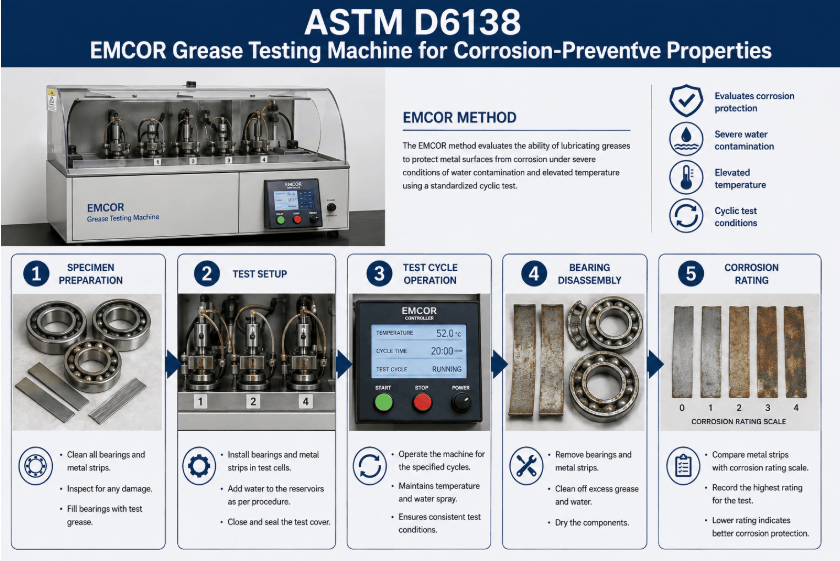
     This infographic shows lubricating grease corrosion testing by the EMCOR method, including specimen preparation, test setup, test cycle operation, bearing disassembly, and corrosion rating.
    ASTM D6138 EMCOR Grease Testing Machine for Corrosion-Preventive Properties

    Common Challenges and Troubleshooting

    ASTM D6138 testing is compromised if technicians use poor cleaning practices with the bearings, use the wrong quantity of grease, or prepare the wrong test solution. Residual rust-preventive oil on bearings results in inaccurate tests. The laboratory must provide a warning about the toxicity of solvents in vapor form and use a fume hood. The technicians always prepare bearings to standard and also make sure to fill the correct amount of grease. If repeated measurements differ substantially, the laboratory should follow up to verify the validity of the bearing preparation, test condition, or testing procedure before reporting the final measurement. The reproducibility of results between different laboratories is within ±2 rating levels for sodium chloride solution and ±1 rating level for the repeatability by the same operator.

    ASTM D6138  Analysis Results and Interpretation

    The grading of lubricating greases is based on the appearance of the test. Corrosion ratings reported by ASTM D6138 indicate the amount of corrosion protection provided by the grease under wet storage, service, or operating conditions. Lower values mean increased corrosion protection.

    Read more

    • Corrosion rating is the percentage of the corroded surface of the outer race of the bearing. The rating scale is from 0 to 5, with 0 representing no corrosion and 5 representing more than 10% surface area of corrosion.
    • Rating 0 indicates that no corrosion is present on the bearing raceway. This is optimal and indicates excellent corrosion protection.
    • Rating 1 indicates a trace of corrosion, with no more than 3 spots and none > 1 mm in diameter. This is an excellent corrosion protection result for most applications.
    • Rating 3 means the corrosion is moderate, involving between 1% and 5% of the bearing surface area. This amount of corrosion is not sufficient for very critical applications with high reliability requirements.
    • A rating of 5 refers to severe corrosion, which covers more than 10% of the bearing surface area. This level of protection is poor and does not comply with most industry standards.
    • After removing the bearings from the housing and rinsing them with solvent, technicians inspect the outer-ring raceways for signs of corrosion. The test uses distilled water, sodium chloride solution, or synthetic seawater depending on the application and desired severity.
    • Engineers compare corrosion ratings with product specifications to accept or reject the product. A failure means the corrosion protection is inadequate, and formulation improvements or additive adjustments may be necessary.
    • The laboratory reports the corrosion rating of each bearing tested. If the differences between the two parallel tests exceed one rating level, technicians run two additional tests to verify the findings.

    What Factors Should You Consider for ASTM D6138  Testing?

    • Expertise: Skilled technicians properly prepare grease samples, operate the EMCOR testing equipment, interpret the results, and evaluate bearing corrosion.
    • Speed: Test time varies depending on the number of specimens, specimen preparation requirements, testing procedures, and bearing evaluation.
    • Cost: Testing costs depend on the number of samples, sample preparation, required equipment, and the complexity of the testing program.
    • Confidentiality: Matestlab keeps all information confidential throughout the testing process and carefully releases the results to the appropriate stakeholders

    FAQs

     What does ASTM D6138 determine? 

    ASTM D6138 specifies the corrosion-preventing properties of lubricating grease by the EMCOR method. It tests the capability of grease to prevent corrosion and rust on bearing surfaces under defined conditions. 

     What equipment is used for ASTM D6138? 

    ASTM D6138 uses a corrosion testing machine designed by ASTM, with test bearings, water, and controlled operating components. It runs the listed test cycle and evaluates corrosion of the bearing surfaces.

    What test solutions are used in ASTM D6138?

    ASTM D6138 test method places the lubricating grease and bearings in controlled water to test them. The procedure (ASTM D6138) specifies the particular conditions of water quality and testing.

    Link to ASTM D6138

    Updated on September 9, 2026

    Malhar Khole
    About Author
    Malhar Khole is a Material Testing Associate at Matestlab Inc. and holds a postgraduate degree in Material Science and Technology from IIT (BHU), Varanasi.
    Know More
    Testimonials
    Real results
    Engineers trust us with what matters most
    Why Choose Matestlab?
    Matestlab is a unified testing services partner based in the USA. Matestlab offers raw material and product testing services through accredited, expert laboratories primarily based in the USA. Matestlab supports physical, thermal, chemical, electrical, mechanical, environmental, and characterization testing needs through its global network of 2200+ accredited testing laboratories. Matestlab's in-house materials science experts curate and design comprehensive testing programs matched to the sample material and specific testing need, with regulatory requirements and confidentiality in mind.

    If you are looking for a managed and trusted testing partner to achieve your research goals, feel free to schedule a meeting with us or send us a request at connect@matestlabs.com to learn more about our services. For a quick quote, call us at (302)244-7710. We are happy to serve you.
    Start Your Testing
    Project Today
    Define your requirements and get access to
    specialized laboratories ready to deliver results
    Partners with us
    Clients
    Vendors
    Process for testing
    • STEP 01

      You share your testing requirements

    • STEP 02

      You share your sample(s)

    • STEP 03

      We deliver your test reports

    Get your testing done

    Let us know your testing requirements and we will be right back with a solution.

      Let us root for each other. Collaborate to grow, expand, and accelerate our businesses.

      Partner with us